The
Warm Side
of
Mount Ephraim
ROBERT
O. HAWES
Hampden,
Maine
Copyright © 2011 by Robert O. Hawes
Illustrations copyright © 2011 by Robert D. Hawes
All rights reserved
Editing and book design by Kyle McCaskill
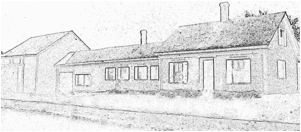
Cover photo: Former home of David L. Hawes, 1140 Bangor Road, Prospect,
Maine—from Hawes family photos.
Printed in the United
States of America
For Ethan, Nicholas, Rachel, Jonathan, Aidan, Benjamin, Anna,
and Addison
Contents
Acknowledgments i
Preface iii
The Boston Show 1
Takin’ the Cow 69
Up March Hill 103
The Proposal 139
The Death of Mr. Peters 156
The Grange Fair 187
Changing Places 222
The Fing in the Attic 253
I wish to thank
the folks who helped me in this effort. First, my wife, Alice, who has read
this story many times over the years, typed various sections, and offered
suggestions and corrections, especially on historical facts. Thanks to Carolyn
Christman of Mebane, North Carolina, former program coordinator for the
American Livestock Breeds Conservancy. She read the entire story long ago and
offered many worthwhile suggestions. Thanks to Rita Yerxa, who typed the
original manuscript and reminds me annually in her Christmas card that she has
not yet seen a finished copy. Hopefully I can change that this year. And to my
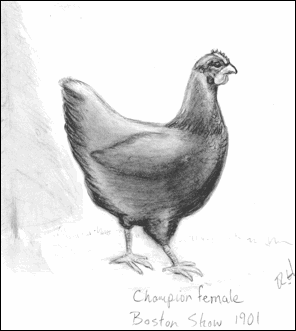
son, Rob, who drew the great sketches of the Rhode Island Red hen, of Mr.
Peters in harness, and of Buttercup, my thanks. My sons, daughters-in-law, and
older grandchildren have read various bits and have been very polite in their
reviews. For all of her help in the final push I would like to thank Kyle
McCaskill. Without her help in editing, preparing material for printing,
and the coordination of printing, this little story would still be in my file
drawer. Kyle's ability to spell the Maine lingo has been terrific!
This story has been many years in the making. It started as a fictional rendition of the development of the Rhode Island Red chicken, using my grandmother as an important figure in this saga. I never knew my grandmother Hamlin but decided on my own what her character might have been. Then the plot kind of got away from me and the story got longer and longer and I decided to make it into a few chapters.
Along the way I thought it would be a nice touch to try and
write in the Maine dialect. I’m hoping the grandchildren will find it
interesting some day to know how their ancestors might have spoken. Most
authors who write about Maine don’t attempt to write in the Maine idiom and I
can see why. Deciding on the correct spelling of some words and how to arrange
the contractions that are so common in Maine speech is difficult. Some authors
will throw in an “ayuh” now and then but generally the speech is so citified
that the story loses the flavor of Maine—a flavor that I was hoping to
convey to the reader. Reading Maine lingo is a little difficult and cumbersome
if you have not heard it spoken, just as a Georgian accent is difficult to
mimic if you haven’t spent time in that state. When you read this story, you
shouldn’t try to sound out every word of the Maine dialect, but rather read
along and say the words as they appear to you, remembering that they represent
an accent derived from the early settlers of the area. One of my favorite
teachers was Mrs. Flora Harriman, in seventh grade. She used to tell us that
Mainers are “lip-lazy,” that we don’t enunciate properly. Well, that’s the way
to read this story: don’t enunciate too carefully. This story is not meant
to be a compilation of the Maine dialect.
John Gould wrote that book in 1975 when he published Maine Lingo.
A few rules to remember: “r” generally sounds like “ah.” “Where” becomes “whe-ah” and “dear” becomes “de-ah.” The word “dear” is not a term of endearment, but simply indicates friendliness and familiarity. When I was a graduate student many years ago, my nickname with the crew on the Penn State poultry farm was “Foahty-foah.” When we were weighing chickens, my accent in calling out the numbers sometimes amused them. I took it as a compliment, as if they had called me “de-ah.”
In Maine, some
one-syllable words can get dragged into two, as sometimes happens with words
such as “well,” which becomes “wey-ell,” and “boy” becoming “boh-ey.” As with
many accents, when a “g” falls at the end of a word it is almost al-ways
dropped: “going” becomes “goin,” for example. The word “to” is never really
spoken but sounds a bit like “tah” or just a soft “t” sound. In this story it
appears as t’, as in “goin t’
Boston.” Oh yes, a final rule and a big rule, always use the broad ‘a.’ “Aunt”
is always “Ahnt,” never “Ant,” and “last” is “lahst.”
I have taken a few liberties in this story regarding times and places. The town of Prospect is generally where it should be in Waldo County. But I have used the old name of “Prospect Ferry.” In the story, the natives may call it “The Ferry” for short, and the narrator may call it just Prospect. It’s all the same town. Mount Ephraim has been moved a few miles to the east to be within the town of Prospect Ferry. I like the name “Mount Ephraim” and wanted it to be in the story. Penobscot Bay has been extended a few miles north so that Prospect sits on its banks. The town of Prospect did not have train service until a few years after Eliza’s trip to Boston, but I wanted her to go by train, so there she went.
Eliza’s house is modeled after the house of my grandfather, which still sits on the Bangor Road, #1140, north of town. A photo of the farm, with Grandfather in a buggy, graces the cover of this story. I have moved the farm to the top of the hill on Hawes Bridge Road, which stays in place but becomes Hamlin Bridge Road. My grandmother was truly a Hamlin, distantly related to Hannibal. Hannibal Hamlin was vice president under Lincoln and remains Maine’s highest elected public official. My great-grandparents, David and Eliza (Stinson) Hawes, lived at the top of Hawes Bridge Road in a farm that had disappeared before my time. The stone walls and some foundations are still evident.
The fictional Shaw farm is modeled after a former dairy farm that is now the Boynton and Son Construction Company at 1129 Bangor Road. This farm sits diagonally across from my grandfather’s former home.
Most of the information relating to the development of the Rhode Island Red chicken is historically accurate. The breed was developed in Little Compton and Tiverton, Rhode Island, and was first shown at the Boston Show in 1901. The sketch of the Rhode Island Red hen by my son, Rob, is an accurate presentation of how the breed appeared in 1901, being based on a drawing done in 1904 by Franklane Sewall, the well-known poultry artist. This drawing can be found on page 77 of the 1905 American Poultry Association's American Standard of Perfection.
This book reminds me of a statement by George Costanza when describing the TV show, Seinfeld: "It's a story about nothing." It's just the usual events that might have happened in the life of an average person once upon a time in Prospect, Maine. Enjoy.
R. H.
Hawes Home Farm, Hampden, Maine
Spring, 2011
Chapter 1

|
I |
t was raining pretty hard on the day that Miles Hamlin got gored by the bull. That day started out unseasonably warm, and about two o’clock in the afternoon some dark clouds moved in over Mount Ephraim and a thunderstorm broke. It was just at this same time that Miles was leading his feisty Devon bull to meet a young heifer who was high into heat.
The bull was nervous. Maybe it was the electricity in the air; maybe it was the sound of the rain. He should have been left in his pen until the storm passed but Miles wanted very much to settle this particular heifer, as she was out of one of his better cows. Just as the bull was being led through the barn there was a tremendous thunderclap that rattled the windows in the old building. The Devon jumped, reared back, and pulled the lead stick from Miles’s hands. Then, with the stick still attached to his nose ring, he turned on Miles and pinned him to a wall, piercing the old man’s chest with a sharp horn.
People had told Miles to “cut them horns off,” but Miles liked the appearance. “He’ll look like a damn cow without his horns. God made them horns and that’s how he’ll stay.” Well, Miles died in his bed on the second day after the thunder-storm, killed by one of those horns made by God and that’s how his daughter Eliza got into the chicken business. But we’re getting ahead of our story.
Eliza Hamlin lived on the warm side of Mount Ephraim, near the town of Prospect Ferry, in a white Cape farmhouse built by her grandfather. Her front windows looked down the length of Penobscot Bay, and on those blue, sparkling days without fog or foul weather you could see the lighthouse on Great Seal Island in the bay’s mouth.
Years earlier Eliza’s grandmother, Hattie, had spent many hours at these windows. Hattie had an interesting way of entertaining herself in those days, before the advent of the radio and the television. She whistled. She knew all of the old songs from her girlhood and she had a great memory for church hymns. She could do bird calls and even imitate a yellow canary that she had owned as a young woman. She rocked in a large, well-padded rocker while she whistled. Small children, on their way home from school, would sometimes stop in and sit in a semi-circle on the floor and be entertained by her sweet melodies. Even adults would stop in and just sit while Hattie rocked and whistled, her eyes closed and her soft hands folded across her ample middle.
But the whistling was also a means of passing the time while watching for the Wyandotte, a three-masted schooner in which Grandfather Hamlin plied the New England coast. The Wyandotte carried hay, building stone, and green-sawed boards to Boston and returned with molasses, salt, sugar, and coal. Grandfather Hamlin was a “straw sailor,” dividing his time among three cows, a dozen hens, a large garden, and seafaring. The family owned a large brass telescope, which sat in one of the parlor windows on a substantial wooden tripod. With it, Hattie could distinguish the Wyandotte by the cut of her sails as she rounded the point on Great Seal. Hattie’s sons—Uncle Herbert and Eliza’s father, Miles—shipped with their father starting in their teens.
Then in the fall of 1846 the schooner ran into a severe northeast gale off Provincetown that caught the crew unawares after a spell of exceptionally good weather. Sugar and salt made for a heavy cargo and the Wyandotte was unable to rise and roll with the swells. She fought the sea for two days, shipping lots of green water, with the deck awash a foot deep at times. At one point on the second day Grandfather Hamlin was washed overboard but on the next wave, as the Wyandotte wallowed in a trough, he rode the crest and was washed back on board! This story was told, embellished, and told again many times in the coastal towns of New England. It even appeared in the Boston Post. One version had it that Hamlin had been taken in by a whale and then spit out just at the right time to be deposited on deck. This rendition was a favorite of children and was firmly believed by many young, active minds.
The Wyandotte was stove up pretty badly, but the crew jury-rigged a mast and the ship made safe port. Alas, Grandfather had taken in a large amount of water. He was thoroughly chilled and succumbed to pneumonia after being home less than two weeks. The Wyandotte was brought home and repaired but Miles, more farmer than sailor, lost all interest in shipping and pledged to Jennie, his new wife, that he would give up sailing. On his return Miles confided to Hattie, “This was the hardest voyage I ever did make and you know I didn’t enjoy those trips even in a calm sea.”
Miles and Jennie moved to the Cape farm to make a home with Miles’ mother. But Hattie aged quickly after the loss of her husband. She no longer had a need to keep her southerly watch at the front window and the spyglass sat unused. The Wyandotte, with Herbert as captain and two of his sons as crew, continued to sail around the tip of Great Seal Island and up the Bay, as grandly as ever. But Hattie seemed oblivious to its coming. She “withered,” as her good friend Annie Harriman put it. Some days Hattie would harness up her black mare, Ebony, and take the buggy down to the shore of the bay. She just sat and watched the waves, and still she whistled. But these were not happy songs; they were hymns of death and dying: “I’m Going Home,” “Shall We Gather at the River,” “Nearer My God to Thee.” She once said to Annie, “I used to see beauty in the sea an’ I know some people write poems about it an’ paint pictures of it. But there’s no beauty there for me, not any more. It’s heartbreakin.” Within two years she followed Grandfather Hamlin to the graveyard called Pilgrim’s Rest.
In 1850, after five childless years, Jennie and Miles produced Eliza, a great strapping baby of nine pounds and ten ounces that nearly took Jennie’s life while attaining its own. But Jennie recovered, seeming to gain strength from this new member of the family, and two more babies followed at regular two-year intervals, Hannah first, then Baby Lottie.
The little farm prospered as well as could be hoped, given Mount Ephraim’s thin, gravelly soils. It was not land for crops but it could grow forage, and Miles slowly built up a herd of Red Devon cattle that scoured the sloping pastures and grew sleek on the sweet grass that competed with blueberries and sheep laurel. The land also supported a flock of some thirty ewes of mixed pedigree, but they were relegated to the top pasture where the granite outcroppings were so thick that Miles often joked that he needed to supply steel nose guards in order for them to graze between the boulders. An annual pig and a motley collection of chickens, aptly called “Dunghill Fowl” by country folks, were also part of the barnyard. After a series of ox teams, with which he had no patience, Miles purchased a team of jet-black Percherons, the first of this breed of horses in Waldo County. With this draft team the farm was now complete.
Thanks to the long days worked by Miles and Jennie, days that stretched into evenings, the girls enjoyed a pleasant and bountiful upbringing. But maintaining the comfort and well-being of the family was a steady drain on Jennie’s bodily reserves. Each winter she was the first to come down with the grippe and each year the recovery time in her bed took a little longer. Eliza filled in on such occasions and as she grew, she was often in charge of her two younger sisters for days at a time. Jennie would keep order and give instructions as best she could from her downstairs bed, and by the age of fourteen Eliza had mastered the chores of baking, milk separation, wool carding and spinning, butter making, pickling, sewing, soap-making, and a dozen other jobs that fell to the farm wife.
The year that Eliza turned eighteen, Jennie took to her bed in early October and remained there until late April, when she quietly passed away. She was laid in Pilgrim’s Rest in the Hamlin lot beside her mother- and father-in-law. Miles had Mr. Butler, the stone carver, put the following verse on her marker:
Her mind was tranquil
and serene,
No terror in her looks
was seen,
Her Savior’s smile
dispell’d the gloom
And smooth’d the passage to the tomb.
Eliza now became the caregiver for her father and sisters.
The following year, at age seventeen, Hannah married young
Thomas Shaw and left the hillside farm. The Shaw family owned a successful
dairy on the edge of Prospect Ferry and Hannah could expect a relatively
comfortable life there. The Shaws employed a Negro couple and much of the heavy
kitchen work was done by a wiry black woman named Hezebel.
Baby Lottie, as she was called until she was eighteen years old, started working as a maid and companion to old Mrs. Sullivan, who owned a fifteen-room “cottage” on the shore of the bay. Lottie was a very pretty young woman; she was high spirited, with a great ability to laugh at adversity. She understandably became a great favorite of the older woman. Mrs. Sullivan’s daughter, with grandson, Edgar, came up each summer from Boston and Edgar, like his grandmother, was also taken by Lottie’s charm. The summer she was eighteen and Edgar twenty, they married in the garden behind the cottage overlooking the bay. It was a surprise to many in Prospect Ferry and in Boston that Edgar Sullivan would be allowed to marry a local girl. Such a union contradicted the New England caste system. It was Lottie’s charm, and her work ethic, that won over the old grandmother and thus paved the way for the Sullivans' acceptance of Lottie as a family member. She moved to Boston with Edgar that fall and never again lived on Mount Ephraim. Thus in a few short years the occupants of the Cape farm went from a cheerful family of five to a somber father and daughter.
Miles and Eliza, now twenty-two, settled into a routine of work that lasted twenty-five years. For Eliza there were a few diversions in the early years. Charley Stubbs, who lived on the next farm and was four years her senior, decided that they should marry and became a frequent caller. It would be more correct to say that Charley hoped they would marry. Charley was short with a thick neck and a rather plain face. He had stiff red hair that was cut by his mother so that it stood out at odd angles from his head. His nickname was Stubby. Although he had a kind heart, Eliza saw no future for herself with him and ignored him as much as possible. Eventually, in spite of his mother’s prodding, he became discouraged. Regard-less of her rejection of his marriage proposal, Charley and Eliza remained close friends and often exchanged confidences on farming and family.
Miles and Eliza enjoyed family holidays at the Shaw home and summer visits with Lottie at Mrs. Sullivan’s on the shore. Eliza even made the rare trip to Boston to stay with Lottie and Edgar for two or three nights. But her services were needed at the Cape farm and as Miles aged, he became quite possessive of her time.
Life changed again for Eliza in the spring of 1897. That was the year Miles was gored by the bull. Eliza had just turned forty-seven. Miles had been well liked and a good crowd turned out for the funeral service. It was held at the undertaker’s parlor in Stockton Springs. It took Eliza only two days after the burial to decide to disperse the Devons and most of the sheep. The cattle did not fetch a great price. Even though Miles had selectively bred them for higher milk yield, the old Devon had lost favor with New England farmers and been overtaken by the newer dairy breeds, the Jerseys and the Ayrshires. As a kindness to Eliza, Charley Stubbs bought three of the better milkers; the Shaws bought two, again out of kindness. The remainder, along with the over-zealous bull, became beefsteaks. Eliza took a Jersey cow and a driving horse from Charley Stubbs as part payment for the Devons.
Stubbs had some of the best Jerseys in eastern Maine; his current herd bull, “Stubbs Farm Imperial Lad,” was a real blue-blood, descending from imported stock. The town folk were less impressed with the bull’s pedigree and more amused by his short legs. When out of earshot of Charley, they referred to the bull as “Stubby the second.” Eliza’s new cow had the becoming name of Buttercup 3rd and was dis-tantly related to Stubby the second.
Of the sheep, Eliza kept three, only for their fleece. The sheep were a nuisance, often straying or being threatened by dogs. The Percherons, the second team since her father’s original purchase, were replaced by a medium driving horse called Mr. Peters. Mr. Peters was the product of a trotter and a large Belgian draft mare so he had some speed and some pulling power. He was twelve years old when he came to the Cape farm. Although past his prime, he had energy enough to do the light work required, and speed enough to drive to town.
Eliza devised a bold plan when considering the future of the Cape farm. She had been reading of the profits to be made from laying hens when kept as the main farm enterprise, although no one in Waldo County would think of hens as income producers. Hens had always been the domain of the farm wife, not worthy of serious consideration by men. Nevertheless, many a farm wife had rescued her household from financial hard times by dipping into her sugar bowl of egg money. In a small book entitled simply EGGS, written by a woman named Anna Barrows, Eliza read, “Few employments are better suited to women with small capital either of money or physical strength, than the raising of eggs for market.” She had also read a recent report from the Maine Board of Agriculture which stated, “From diligent inquiry and observation, we are satisfied a flock of good hens properly cared for, will pay a profit of one dollar per head per annum.” Eliza had a small cash reserve from the sale of the cattle and the sheep. Buoyed by these two optimistic reviews she decided to risk a portion of her funds and convert the west side of her barn into laying pens. The sheepfold would become a summer growing house for the young pullets.
Eliza had been keeping a small flock of laying hens for some years. In summer they ranged over the entire farm and in winter were confined to one end of the sheepfold. They had supplied her and Miles with eggs and stewing fowl and any surplus was used for bartering at McAdam’s Store or at the Shaw farm. However, her flock was a rainbow collection that depended on whatever was avail-able from neighbors or from traders. The English Game had been a favorite: the hens were prolific layers but were unsteady sitters and the young males were so pugnacious that they were marked for the oven as soon as they could be distin-guished from the females. She had owned a few Polish Top-Knots but found them often unable to cope with the more robust breeds due to their restricted sight. The Black Spanish, which supplied lovely large, white-shelled eggs, tended to be delicate as chicks and their enormous combs often frosted in cold weather. She had owned a few Gray Shanghais, a breed imported in the ’50s from the Orient. They produced an appealing brown-shelled egg, something new to the Americas. But they were very slow to mature. She had always main-tained the old American standard, the Dominiques, and more recently their improved descendants, the Plymouth Rocks. Of course, over the years she had owned many of the nondescript Dunghill Fowl. But all of these varieties had some charac-teristic that made her hesitate. She was embarking on a new enterprise; she needed a new breed.
Meanwhile, Uncle Herbert and his sons had carried on the shipping business started by Grandfather Hamlin. The old Wyandotte had been retired in favor of a newer, faster ship. The Hamlins had continued to sail to Boston and, at times, on to Rhode Island where Eliza’s cousins had become acquainted with farmers in the area of Tiverton and Little Compton. Farmers there were breeding a new type of fowl, which was known in the late 1800s as the John Macomber, or the Tripp’s Fowls from the names of early breeders. The name “American Reds” had been more recently attached. These new fowl were red-plumaged, and their color along with their abundant production of brown-shelled eggs became distinguishing traits. Added to these qualities, their well-rounded bodies provided a prime stewing carcass when egg-laying days ceased.
The Reds owed their improvement over the traditional Spanish, Dominickers, and Polish breeds to the importation of the Red Malay Game Fowl from Southeast Asia. The Malay Games were brought to America on the great sailing ships as a source of meat and eggs for the homeward journey. Any surplus birds were sold on the docks of Boston and New York at the completion of the voyage. When these new arrivals were mated with local stocks, a great deal of hybrid vigor was produced. In addition to improved egg production, the buffy red plumage color appealed to farmers, and the selection of breeding stock along these lines led to the birth of a new breed. Eliza’s cousins, knowing her interest in fowl, had brought several crates of these birds to her and she had been propagating them in a small way since about 1892. When she realized that hens might be in her full-time future, the Reds were her choice and she set out to increase her breeding flock.
In the summer of 1900, the periodical Poultry World carried an article telling of the progress of a new organization. The Rhode Island Red Club of America had been formed in 1898 at the Coffee Tavern in Fall River, Massachusetts. The club’s goal was the propagation and promotion of the new Rhode Island Red chicken, and to that end they would be holding “a special competition at the Boston Poultry Show in January of 1901.” A breed standard had been drawn up describing the color and shape of this “all-American” bird. Such a standard would be immediately put into practice at the show by choosing a male and a female bird that most typified the newly composed description. Two special challenge trophies were to be offered for the “reigning King and Queen of this important new creation of poultrydom.” The article invited breeders of Reds to become club members by forwarding one dollar for a year’s dues to the secretary, Mr. Barnes, and to consider an entry at the show.
Eliza studied this information with her breakfast oatmeal on a bright morning in early June. Finishing her meal, she closed her eyes, tipped her head back on the wooden chair and folded her hands over her stomach. With the June sun warming her neat kitchen, she allowed herself, just for a few minutes, to daydream about bringing one of those trophies back to Prospect Ferry. Exhibiting birds was not entirely new to her since several of the local fairs were now offering premiums for “pure-bred land and water fowls,” and Eliza had entered birds under the name of American Reds at the South Branch Grange Fair, at the Monroe Fair, and even, this past year, in Bangor. She was always awarded a small cash prize since there was no competition in her class.
But to go to Boston! Well, that would certainly be vain, and if her birds did not place she would be gossiped about in Prospect Ferry for “reaching above her station.” Furthermore, a dollar was a large amount of money to spend on a club member-ship! Eliza had never belonged to an organization that charged dues. In fact, other than the Ladies Aid Society, the Sandy Point Congregational Church, and the Grange, she had not belonged to any organization at all. She did have the money, she told herself; her egg business was flourishing. Twice each week she shipped cases of eggs to Patterson’s Provisions and Dry Goods in Bangor. At the end of each month a check came back signed by Mr. Patterson himself.
For three days she considered the pros and cons of joining the Rhode Island Red Club. On Saturday morning when she went to the village for her weekly shopping, she stepped up to the mail wicket at McAdam’s General Store and said tentatively to Mrs. McAdam, “A money order for one dollah please, Myra.”
On the same day that she mailed her request for membership to the Rhode Island Red Club, she received a penny postcard from Mr. Patterson of Patterson’s Provisions and Dry Goods, saying that on the following Monday he planned to make her a visit on Mount Ephraim. All the rest of the day she worried. Why would he visit her? Mr. Patterson’s checks had been so regular these past two and a half years that she had come to accept them as part of the whole scheme of things. Was he dissatisfied with the quality of her eggs? Each one was carefully wiped clean and packed large end up, according to Mr. Patterson’s own directions. Could he be closing down his business?
Sunday’s sermon at Sandy Point Church was entitled The Complacent Christian. The subject did not help her outlook. Had she become too complacent in her production and marketing? She read in the agricultural papers that farmers needed to be aggressive in their trade and follow the example set by men in the manufacturing business—those “captains of industry,” as Lottie’s husband, Edgar, would refer to them. Eliza was not aggressive in her work; she looked on her chickens as coworkers. She pampered them with hot mashes during cold weather and with cool mid-day drinks during July and August. Whatever Mr. Patterson paid was what she accepted. It had never occurred to her to question the price. This arrangement for the sale of her eggs had been made with the help of Mr. McAdam at the store. Eliza had never even been to Patterson’s Provisions and Dry Goods. She had merely signed an agreement sent to her through the mail.
On Monday morning there was a fine drizzle falling on the whole state of Maine. Eliza guessed that Mr. Patterson would postpone his visit for better weather. So at ten o’clock, when she was taking off her ragged barn coat for a nice cup of tea, she was startled to see a buggy drive into the yard. She pulled the coat back around her shoulders and stepped out to greet her visitor. Mr. Patterson drove a fancy Stanhope wagon, which boasted a leather three-bow top as well as full-length side and back curtains with isinglass windows. It was painted Brewster green with gold and red striping and was equipped with the latest full-spring cushion seat and full-spring back. It came supplied with a fine English weatherproof lap robe. Mr. Patterson climbed down and graciously tipped his damp hat.
“Miss Hamlin, I presume,” he said somewhat formerly. Eliza detected an English accent. She said, “I am, an’ yoah prob’ly Mistah Pattahson.”
“I am indeed,” he said with a great smile. He was a huge man, well over six feet tall, with massive shoulders and a large rotund middle. Mr. Patterson wore a plaid deerstalker cap, a black cape mackintosh, and Wellington boots, all very British, all imported.
“Put yoah hoss on the barn floor,” Eliza motioned to the large open door. “Theah’s a hitchin rope an’ I threw down a bit a’ hay.”
“Thank you most kindly.” Mr. Patterson led his dripping animal into the barn. The horse had not enjoyed the protection of a leather top and side curtains with isinglass windows during the trip from Bangor.
“Theah’s a blanket too,” said Eliza following him. He tied the horse, wiped off the excess water with a handful of hay, and threw the light blanket over the animal’s back.
“Come in, come in,” invited Eliza as she started for the house. Once inside she said, “I was just stahtin some tea water, will ya have some?”
“Oh, most definitely,” he said. “This was not a good day for my visit but I’ve been terribly busy, and this was a free day. I did need to make a call in Frankfort and I did inform you that I would arrive . . . so here I am.”
She poured scalding water into a large china teapot and added two liberal spoons of black tea leaves. While it steeped she brought a platter of applesauce cakes from the pantry.
“What a beautiful tea pot,” said Mr. Patterson. “I see there’s a chicken on it.”
“Ayuh, that pot’s come all the way from China; one of the Austin boys brought it to me. He worked for me as a young lad, knew I liked chickens, an’ now he’s shippin t’Shanghai outa Po’tland. He wuz an awful nice boy. Still is! T’bring me that pot, round the Horn mind you, well, that was rilly thoughtful.”
“Indeed it was,” agreed her visitor as he inhaled the aroma of the freshly brewed tea.
They chatted about the teapot, the hazards of sailing around Cape Horn, the weather, and Mr. Patterson’s trip from Bangor. Eliza began to relax. In spite of Mr. Patterson’s cultured accent, he seemed a sincere person and Eliza found herself talking easily and actually enjoying his company.
The contrast between Eliza’s education and Mr. Patterson’s was marked. He had attended the Plympton School for Boys as well as the Westchester School, and had received a degree in economics from the fine University at Manchester. Why he had then chosen to set up business in America, especially in a backwater town such as Bangor, had been a great concern to his family. But Mr. Patterson had an adventurous side—as long as the adventure included a soft bed each night, fine china for his table, and an experienced cook. Bangor satisfied his need to escape the “old country.” The city of Bangor could supply his creature comforts and yet it still retained a few raw edges.
Eliza, on the other hand, had begun and completed her education in the one-room Marsh School at Prospect Center. The frequent illnesses of her mother meant that she was needed at home for a part of each school year. Eliza’s education consisted of seven partial years that included the basics of reading, grammar, spelling, history, and arithmetic. The two-mile walk to and from the Marsh was not considered a hardship and the Hamlin girls were still expected to do their full share of farm and kitchen chores before supper was served. High school was not felt to be necessary for young women, especially in rural areas. Eliza had little need or opportunity for adventure.
As he finished his second applesauce cake, Mr. Patterson looked at Eliza and said, “Well, Miss Hamlin, I must tell you why I have come.”
“Ayuh,” said Eliza quietly, to encourage him, but now on her guard again.
“It’s about your eggs, you see.”
Eliza drew a deep breath, expecting the worst. “Somethin wrong with ‘em?”
“Oh, no, indeed not, quite the contrary,” said Mr. Patterson with a chuckle. “They are superior to those from all my other sources.”
“Oh!” said Eliza, exhaling audibly and greatly relieved. “Wey-ell ain’t that nice.”
“Their size, their uniform shape, and that wonderful brown color, I just don’t see other eggs as appealing as yours. I’m planning to start a poultry farm near Bangor to help supply my increasing need for eggs and I wanted to see what variety of birds you were keeping. Perhaps I could get stock from you to initiate my enterprise.”
“Oh De-ah,” said Eliza, now aglow with Mr. Patterson’s compliments. “I can certainly git ya some hatchin eggs or mebbe even some chicks.”
“I won’t be ready until spring,” said Mr. Patterson, “so we have plenty of time.”
“Wey-ell let me tell ya wheah my birds come from,” she said. She explained her Rhode Island Red connection, how this breed had been recently named and how she, Miss Eliza Hamlin, was one of the charter members of a national club catering to this wonderful new creation.
Mr. Patterson listened intently to her story while enjoying his third applesauce cake. When she finished, he said, “I have business acquaint-ances in that area of Rhode Island; perhaps I shall travel there and obtain stock from the original source to combine with the Hamlin blood.”
“Prob’ly a good idea” nodded Eliza. “I have my cousins bring me up a new cock’ril every spring t’keep the blood mixed, like they say, an’ I see a little improvement with shape an’ color every ye-ah.”
They toured the barn and the converted sheep fold and Eliza passed on her many experiences in the husbandry of poultry. Mr. Patterson was still at the farm at dinnertime so Eliza felt obliged to invite him to share her mid-day meal. As they finished, the sun started to show through gaps in the cloud cover. After watering his horse and helping himself to the last applesauce cake, Mr. Patterson departed for Bangor.
But the good food and the pleasant company had made an impression on Mr. Patterson, and following his initial visit he made almost monthly trips to the Cape farm. In addition, he made a trip to Rhode Island that summer and became one of the greatest promoters of Rhode Island fowl to be found in northern New England. Mr. Patterson was the last in his line to possess the family name. He had no male cousins and his only sibling was female. His work had been his family, but now in middle age he felt a yearning to leave behind some tangible legacy. The idea of being a founding father of a new race, albeit it chickens, appealed to his emotional side.
Early in the summer of 1900, Eliza set up two special pens in the unused box stalls. Even to herself she could hardly admit that there was a plan, but she was, without a doubt, preparing for an entry in the Boston Show! A win at this premiere event would propel her into the inner circle of master breeders of the Reds. As her young birds grew and matured through the summer, she carefully watched for that perfect specimen. When she found a candidate it was moved to a box stall: one for males, and one for females. These birds received the choicest mashes. They were offered crushed oyster shell for good bone growth, and bits of dried fish and boiled chopped eggs for production of quality feathers. They had grass clippings and garden refuse and squares of sod to scratch through. Eliza even cut little pop-holes in the side of her barn and constructed outside runs so these pampered birds could enjoy the sunshine when they pleased. The best of the kitchen scraps were saved for them, and they prospered. By September, Eliza had five females and four males that were all potential entrants. On his monthly visits Mr. Patterson often remarked on the fine form and feather of these birds, but Eliza did not reveal her plan.
However, the silence must be broken if she was to carry out this ambitious undertaking. In November, Mr. Patterson arrived just one week before Thanksgiving. He carried a hefty box into Eliza’s kitchen, set it on the floor, and extracted a large dressed turkey.
“For you and your family, my dear Miss Hamlin,” he said with a great smile. “To repay the many repasts that I have enjoyed in your homey kitchen.”
“Oh thank you evah so much, Mistah Pattahson,” she said. She hesitated to tell him that she had been eating chicken every week since late August as a means of utilizing her surplus cockerels. Her plan had been to treat herself and the Shaw family to a large roast of pork for Thanksgiving, but Mr. Patterson’s gift would not go unwelcomed.
“Please sit, Mistah P., while I make tea. I need your advice.”
“Anytime, dear lady, I am honored to be so asked.”
Eliza laid out a plate of newly baked bread with a pot of blueberry jam. She poured the tea, and after a quick sip, said to Mr. Patterson, “Ya know the two pens of Reds I been keepin in the box stalls? Wey-ell, I’d a special reason. I want t’send an entry to the Boston Show an’ I need your advice on which birds t’pick. I’m only sendin one male an’ one female, cahn’t afford moah. Nobody in the family knows about my plan. I been waitin till you had a look at ‘em t’say if one or two was good enough. I know you been lookin at ‘em down south in Massachusetts an’ you’d know how mine compares t’them.” She finished her speech, folded her hands in her lap and waited expectantly.
Mr. Patterson beamed with pleasure at being brought into this little plot. “Oh, Miss H.,” he laughed, “you did take me in! I had no idea of this extraordinary subterfuge of yours. Of course you shall make an entry, you must! You have the best birds north of Boston! I have seen the competition and you have the inside rail. Let me have one more slice of this delicious bread, just to fortify myself, and we shall make some selections.”
Fully fortified, Mr. Patterson and Eliza spent nearly two hours discussing the good and not-so-good qualities of each bird based on the new breed standard, which Eliza had committed to memory. In the end she put identifying leg bands on two pullets and two cockerels, the final choice to await Mr. Patterson’s December visit. When he left, he laid a finger along his nose and said, “I shall tell no one of the events of this day until you say the word. I am very excited! I shall make plans to be at the show myself, as soon as I return to my office.”
Eliza waved him goodbye and went into her kitchen. “Now I’ve done it,” she thought. “I’ve cast my lot; I only hope the family will be as under-standing as Mr. Patterson.”
The family proved not quite as enthusiastic as Mr. Patterson had been. Eliza always spent Thanksgiving Day with Sister Hannah and her family at the Shaw farm. This year was like many others. After the massive meal had been con-sumed, the children’s games had been played, and the discussion of local politics had concluded, the various family groups set out for their homes. Eliza, as always, stayed behind to help Hannah with the clearing and the dish-washing. When they had finished putting away endless dishes and saving the many leftovers, Eliza asked Hannah if they and Thomas could have a little talk.
The three seated
themselves comfortably in a small circle in the parlor and Eliza laid out her
Boston plan in carefully worded sentences. Trying not to appear too eager and
trying to impress upon the pair that
a win at Boston would greatly increase the value of her birds for breeding
stock, she watched their faces for signs of reaction as she spoke. They both sat quietly through the monologue.
“But where would you stay, Liza?” asked the practical Hannah when Eliza had finished. “They say those Boston hotels are awful expensive.”
“I’ll stay with Sistah Lottie of course,” replied Eliza. “She wouldn’t mind just for a few days.”
“But she don’t like chickens and neither does Edgar,” countered Hannah.
“I am not gonna keep the chicks with me,” said Eliza, somewhat indignantly. “They’ll be at the show.”
Hannah seemed unconvinced.
Thomas took his turn. “Are you shuah yoah birds are good ’nough?” he asked bluntly. “I ’magine the Boston Show draws entries from the whole East Coast.”
“My friend Mistah Pattahson from Bangor has seen the Reds in southern New England. He says mine’s as good as any. He says my pullet could be the new club model.” Eliza tried to be firm in her own defense.
More questions and more answers until finally there was a pause.
“Theah’s just one problem I cahn’t solve,” said Eliza seriously. “I’d like t’have someone go with me, someone who could keep me straight an’ make sure I git t’the right train an’ t’help carry the birds.”
“Thomas cahn’t go, he’s gut his work,” said Hannah. “An I cahn’t go as I’ve gut Mother Shaw t’look aftah. The girls are all taken up with their babes an’ their husbands.” Thomas and Hannah had three married daughters.
“I know all that,” said Eliza. “I’ve thought of all that.”
“Mebbe one of yoah friends here in the village,” said Thomas.
“Daow, my friends are my age an’ no smarter, an’ wouldn’t be much help, I b’lieve,” she said.
Jamie Shaw, the youngest of Thomas and Hannah’s children, had been dozing on the settee after his large meal and no one had thought to include him in the conversation. At eighteen, Jamie was still unmarried and lived at home, enjoying the good food and material benefits of his parents’ well-organized farm. He was of just average height and build with brown eyes and brown hair that he parted in the center. But it was his happy disposition and seeming enjoyment of labor that set him somewhat apart from other young men of his age. This positive personality plus a rather handsome face made him a favorite of Prospect Ferry’s young women. While he acknowledged and enjoyed the role, he was not yet moved to seek a wife.
He had been half listening to the conversation of the elders, and he now raised up slowly on one elbow and said in a confident voice, “I’ll go with ya Ahntie.”
Three heads turned simultaneously to stare at the young man. Thomas spoke first. “You haven’t been t’Boston for two ye-ahs. You don’t know how t’find the trains.”
“It cahn’t be too hard. Lots of young people go t’Boston an’ come back alive,” his son said, somewhat deflated.
“Don’t be impertinent,” said Hannah. “An’ why would you want t’go t’Boston.”
“I’d like t’see more’n just Prospect Ferry once in a while.” Jamie said dramatically. He also thought he would like to see his female cousin again. Aunt Lottie’s daughter Lydia had been a very attractive young woman when Jamie had last seen her. They were exactly the same age and often corresponded with one another.
Thomas was weakening as he could see that this trip had some meaning for Eliza. Being a breeder of cattle he knew the importance of advertising one’s animals. His opinion would influence Hannah’s decision to let the boy go.
“Mebbe we could spare you for a few days,” he looked at Jamie. “Things are pretty quiet for the wintah.”
Jamie grinned and looked questioningly at his mother.
“Do you think he’d be a help to ya, Liza?” asked Hannah with a deep frown.
“Oh my, yes!” replied Eliza enthusiastically. Jamie was a great favorite of hers and the thought of being escorted by this bright young man was very appealing. She had thought of this arrangement herself but had doubted that Jamie would want to accompany his old aunt.
“Oh, I don’t know . . . ,” said Hannah slowly.
“Grandfathah Hamlin sailed t’Boston when he was only thirteen. You told me so, Mumma.”
“Jamie, that was a different time. Travelins more complicated now,” Hannah said, but she felt that she was losing the argument.
“I can do it, Mum, please?”
Hannah seldom said no to Jamie. Being the youngest and the only son, he had been given a freer rein than his sisters.
Eliza waited patiently for Hannah’s reply.
“Oh, all right,” she said. “But let me tell ya young man, if you git lost in Boston or git Ahnt Liza on the wrong train it’ll be the lahst time you leave Prospect without yoah Fathah or me for many a day.” Hannah conveniently ignored the fact that she herself had not been to Boston for two years and that Thomas had never left the state of Maine.
Jamie grinned—he knew at his age he could do as he liked, but he had learned that life was much easier and smoother if he had his mother’s blessing. Jamie did appreciate having events run smoothly.
“Then it’s settled,” said Thomas, who was actually a little proud that his son had offered to undertake this adventure. Thomas had been as far north as Bangor and as far south as Portland, and he was quite content to keep within these geographical boundaries. His only reason for travel was to attend meetings of the state Board of Agriculture. Tourism was not for him and Boston was a foreign land.
Eliza was delighted. “I’ll pay the train fare if Jamie could buy his meals.”
“I can do that,” Jamie assured her quickly.
Knowing Jamie’s eating habits Thomas said, “I think you gut the best paht of the bahgain, Liza.”
On Friday after the holiday, Eliza swung into action. She wrote a penny post card to the Boston Show secretary requesting a premium list and an entry form. She wrote a second card to Mr. Patterson informing him that the decision had been made to go to Boston. Then she composed a three-page letter to Sister Lottie explaining her plan and asking for lodging for herself and for Jamie. Thinking of Lottie, with her elegant home and her stylish fashions, she then started to think of her own wardrobe. She had only two or three dresses that she felt were worthy of a Boston trip. She owned one pair of practical black boots, and her best coat was unadorned black wool cloth. Her one good hat was also black, decorated with red silk strawberries, but of straw—quite unseasonal. The coat was several years old. While she did not want to embarrass Sister Lottie with her out-moded fashions, neither did she want to spend money to purchase new ones. New fashions did not attract a wide audience in Prospect Ferry.
The following day being Saturday, Eliza drove to the village for her weekly shopping. Finishing that, she mailed the post cards, returned to the wagon, and turned Mr. Peters toward the Shaw farm. Mr. Peters did not expect this change in his usual routine; he was planning to return to the comfort of his stall. He clopped along dejectedly and no amount of urging from Eliza could speed his pace.
At the Shaws, Hannah paused in her morning chores to make tea for Eliza’s unexpected visit. After they had chatted for a few minutes, Eliza said, “Hannah, my old coat ain’t quite what I’d like t’be seen in at the Boston Show an’ amongst Lottie’s friends. I wuz wonderin, since Mothah Shaw an’ me is about the same size if mebbe I could borrow her good coat?” There was no point in asking to borrow Hannah’s coat, as Eliza was at least two sizes larger than her sister.
“Oh, De-ah,” sighed Hannah. “You know how Mothah Shaw is about such things. She’s real close with her belongins an’ with her bein laid up I don’t want tah trouble her, Liza.” But then she had an inspiration. “We do have that raccoon coat that belonged to Thomas’s Ahnt Midi; you could use that.”
They left their tea and climbed up two flights to the dim light of the cold attic. Hannah opened a long sea chest and there was the coat, at full length. It was fashioned from the skins of raccoons, all of which had been trapped on the Shaw farm and pelted by Thomas’ grandfather. Someone had placed a woman’s black felt hat over the neck opening and Eliza caught her breath when she saw it.
“Good Lawd, Hannah,” she said. “I thought for a second that someone wuz laid out in it.”
Hannah giggled.
They carried the coat down to Hannah’s bedroom and shook out the dust. Hannah held it for Eliza to try on. She took a long look at herself in the mirror. After several years at the mercy of various attic insects, it had the appearance of having been grazed by some miniature herbivore.
“It ain’t for me, Hannah, I nevah did like dead animals draped aroun my neck an’ this makes me look like some kind of overstuffed jungle beast.”
Hannah giggled again and
agreed. “’Tis pretty tatty an’ it
does have a look that ain’t quite Boston.”
“Thanks De-ah,” said Eliza quietly, “I guess I’ll hahfta make do with my old black one.” Then she brightened. “But on the way ovah I gut an inspiration for a hat. They say feathers are liable to be worn in Boston this ye-ah an’ that’s some-thin I see no shortage of on my fahm. I b’lieve I can spruce up my old black straw.”
“Wait, I’ve gut somethin t’dress up yoah coat,” said Hannah. She opened a dresser drawer and produced a filmy pink scarf. “It come from Lottie so it should be right for Boston; she prob’ly won’t remembah it. I nevah wore it.”
Eliza looked dubious and gave a little snort. “Ain’t much warmth in it, De-ah?”
“It ain’t for warmth, Liza, it’s for show.”
“Wey-ell, thanks.” Eliza said reluctantly. “I’ll give it a try.”
Mr. Peter’s energy was greatly restored now that they were headed toward the Cape farm and he trotted on with head up and tail outstretched. Riding behind an old horse on a homeward trip required few navigational skills and having come to terms with her coat, Eliza’s mind took up the redecoration of her black straw hat. Over the summer, as her show prospects in the box stalls had molted their juvenile plumage, she had collected the nicer wing feathers. She had saved them in a pewter mug that sat on the fireplace ledge. Now she imagined how they might look as a way of brightening up her hat. So immediately after her arrival home, having seen to the physical needs of Mr. Peters, she unearthed her sewing basket and seated herself at the kitchen table. Sewing was not one of her favorite pastimes, and the basket had been found only after some searching in the spare bedroom under a pile of semi discarded clothing. Eliza called it her “pile of good intentions,” and would rummage through it from time to time to find a scrap or a patch to make some long-needed repair. Such repairs were often made with little regard for fashion, and her most engaging example of “make-do” was a dress with two different sleeves. Her sister accused her of belonging to a secret lodge that required such a costume but Eliza ignored this attempt at humor; Mr. Peters and Buttercup hardly noticed.
She held the black hat at arm’s length, turning it on her hand. Then with deliberate snips she removed the red silk strawberries. On the table in front of her she arranged the Rhode Island Red feathers in a fan shape, removing and adding until she was satisfied. One by one each feather was sewn to the hatband. Then to complete the makeover, she attached a large gold button at the base of the fan. Finally she again held the hat at arm’s length.
“Good enough for an old country woman,” she said to herself and replaced the hat in its box.
The month of December sped by and she hardly noticed as the holiday season came and went. Her mind was on the show. Mr. Patterson had made a cold and snowy trip just after Christmas to help her choose the final pair for the big day. She kept a careful eye on these select birds, checking them twice and even three times some days. They continued to receive a variety of fine feeds. Their litter was cleaned at frequent intervals. About a week before the show she brought the two entrants—one pullet and one cockerel—to the kitchen and gave them each a warm bath. This degree of preparation was not practiced for the local shows but she had read that bathing was a must for the big-time events. The birds spent the night drying in the kitchen in wicker baskets. The odor of wet chickens mingled with the cooking odors from her evening meal and the result was not appealing. And then she was rudely awakened the next morning at daybreak by the crowing of the cockerel. His clarion call echoed through the little house. She had not thought of this eventuality. It started her day on a jarring note.
The day of the Boston expedition arrived; the train would pass through Prospect Ferry at seven-thirty and stop for ten minutes to take milk, mail, and people, all headed for Bangor. Eliza was up at four-thirty. The temperature was eight above and a light snow was falling. She stirred the ashes in the kitchen stove, threw in a handful of dry chips, put in two sticks of wood, and opened the damper. The teakettle was filled and set on to boil. She then pulled on her barn coat, closed the stove damper, went to the stable and did her routine of chores, including the milking of Buttercup 3rd. Paul would take care of the morning’s milk and do the second milking when he came in the afternoon. Paul was Charley Stubbs’ hired man, and he had agreed to do the chores at the Cape farm in Eliza’s absence. She lit the lantern in each box stall so the prize Reds would quit their roosts and come down to feed. She wanted her two entrants to be nicely filled for the long day’s trip.
Returning to the house, she prepared a pot of tea and poured hot water over oatmeal, setting it on the back of the stove to slowly cook. Going to the cellar, she brought up a pitcher of cream from yesterday’s milking, and when the oatmeal was ready, poured the rich cream generously over it. So as the chickens fortified themselves, Eliza fortified herself. Meanwhile three miles away, Jamie was being urged by Hannah to leave his warm bed.
Eliza had purchased two new wicker hampers for this trip. They had been ordered from Portland, at what she considered the outrageous price of one dollar and fifty cents each. But she was not going to arrive in Boston with the clumsy wooden boxes that she normally used. The hampers had been filled the day before with fresh chopped straw. She now returned to the barn and carefully caught each bird, placing it gently in its own traveling basket. She brought the hampers to the summer kitchen, then went to ready herself.
At six forty-five she sat stiffly at the kitchen table in her black boots, her black cloth coat with the pink scarf, and her black straw hat with the Rhode Island Red feathers. She clutched a small string purse. The lunch basket she had prepared was at her feet with her traveling bag. The kitchen was just starting to warm up nicely; it was getting light outside and she was thinking what a good day this would be to just stay home and knit. But the Boston preparations were too far along to cancel at this point. She heard harness bells, and looking out the kitchen window she could see two side lamps making dots of light through the snow. Jamie had brought the pung in order to accommodate all the baggage. The pung, with its heavy frame and box-like body, was not as maneuverable as the lighter sleigh might have been, but the going was smooth and the team of Morgans moved easily up the hill. She stepped to the door as the pung came to a halt with a creaking of the runners on the snow.
“Mornin Jamie. Yoah in good time.”
“Mornin Ahntie. You ready?”
“All ready, De-ah.”
They stowed the lunch basket, the poultry hampers, and the carrying bag in the pung box and Jamie covered them with an old piece of canvas. Eliza climbed into the seat and pulled the lap robe up around her waist. Just for a second she looked wistfully at her snug house and barn. But then she said with determination, “All right, let’s go t’Boston!”
“Yes, Ma-am!” responded Jamie and slapped the reins so hard on the Morgans’ rumps that they started forward with a jerk, throwing back Eliza, the chickens, the lunch hamper, and the carrying bag.
“Good Lawd, Jamie, you don’t need to upset us before we even leave the doah-yahd!” Eliza said, somewhat breathlessly.
Jamie smiled and gave the horses their heads. The road past Eliza’s hill farm sloped gradually down the side of Mount Ephraim for almost half a mile before it leveled out to cross Hamlin Brook. The new snow was a lubricant on the older packed snow. The horses, with caulked shoes, trotted on confidently and the pung slid along easily behind them.
Eliza pulled the pink scarf over her mouth and nose to insulate them from the crisp morning air. The scarf was not of much value in that regard, as she had predicted, and she thought herself a little silly for wearing such a piece of frippery in January. She could feel the cold seeping through her four layers of woolen clothes. Jamie, on the other hand, excited at the prospect of a holiday, and given the vigor of youth, felt nothing. He had purchased a bright red hunting mackinaw for this trip that he wore over a blue cotton shirt. Both were open at the neck and Eliza marveled a little at his cold tolerance. He wore a pair of brown flannel pants tucked into a pair of hand-knit woolen stockings and leather boots. He had topped his outfit with a snappy black fedora that had cost him the grand sum of one dollar and thirty-five cents from the Sears Roebuck and Co. catalog. He was dressed for Boston!
They arrived at the station at seven fifteen. Hannah and Thomas had driven over in the cutter to see them off—Thomas would drive the pung back. The lunch basket, their traveling bags, and the chicken hampers were set out on the platform. The only other waiting passenger was Miss Phoebe Pringle, the church organist, who was going to Bangor to look over a new anthem book that had recently arrived.
“Mornin’, Phoebe. Little nippy this mornin’,” said Eliza.
“Yey-es, but I guess we gut to expect it. I see yoah all set for Boston.”
Eliza gave a little sigh, “I think we are,” she said. “I hope this ain’t just an ole lady’s pipe dream.”
“You’ll do jest fine,” said Phoebe. “You gut some awful nice chickens the-ah. Everybody says so. An’ if they don’t win, somethins wrong with the judge!”
Eliza thanked her for the good wishes and heard the whistle of the seven-thirty. As the train came to a halt Lester Harriman slid open the door of the baggage car and stepped out onto the platform. Eliza was happy to see Lester. He had worked for her occasionally as a young man and she felt good about leaving her birds in his charge. Eliza started toward him with a hamper and Jamie followed.
“Mornin’, Miss Hamlin. Mornin’, Jamie,” he said. “Looks like this is the big Boston trip.”
“Mornin’, Lestah,” she said with a smile. And then to herself, “My Lawd, is there anyone doesn’t know about this trip?”
“Keep my chickens away
from the drafts, Lestah. I don’t want ’em comin t’Boston with a sniffle.”
Lester promised them good care and the hampers were loaded while Eliza and Jamie gathered up their bags and boarded the passenger car. She settled herself in a seat beside Phoebe, waved out the frosty window to Hannah and Thomas, and thought to herself, “Well this is it. I’m goin t’Boston!” Jamie occupied an entire seat, meant for two and had a small nap on the way to Bangor.
Unlike the quiet little station from which they had embarked, Bangor’s Union Station was alive with people and noise. Traveling salesmen with their large sample cases were bustling about. Gentlemen of commerce were sedately headed for Portland or Boston. Fashionably dressed ladies were going on shopping trips. Milk cans coming to the Bangor Creamery clanged as they were being unloaded. Young boys were hawking the morning edition of the Bangor Courier, and trainmen were calling out arrivals and departures through large bullhorns.
Lester Harriman helped Eliza and Jamie find their train and gave instructions to the baggage attendant to “keep a shahp eye on these prize chickens.” Eliza was grateful, and as he wished them good luck Eliza whispered to Jamie, “The tip!”
Jamie, being the man of the traveling party, had been designated to be in charge of tips. He dug into a pocket of his brown woolen pants and handed Lester a ten-cent piece.
“No, no, Jamie,” Lester said. “Keep yoah money. Between portahs, cabbies an’ such you’ll find plenty of open hands between heah an’ Boston.” Eliza thanked Lester sincerely and moved up the train to her chair car. Jamie felt hungry and said he’d just stop at the lunch counter.
“I got up kinda late, Ahntie,” he said sheep-ishly. “I only had time for a couple of fried eggs and a little toast.”
“Good Lawd, De-ah,” Eliza said, “you had a chicken sandwich on the way t’Bangor.”
“I know,” he said, “but I need somethin sweet. I’ll just be gone a minute.”
“They won’t hold the Boston train for ya,” said Eliza emphatically.
“I’ll be on it.” He said with a grin.
Eliza could not relax until she saw from her window the bright red mackinaw moving back toward the car. Jamie sat down beside her and she said, “Feelin bettah?”
“I’m all set till Po’tland,” he answered. “I had a nice slice of custard pie.”
Eliza sighed.
The schedule called for them to reach Portland at one-ten. When they arrived, Eliza decided to check on the birds and strolled back to the baggage cars. She dragged a step over to the open door, stood on it and peered into the poorly lit interior; she saw no hampers. She looked a second time just to be certain: no hampers. There was no train crew nearby but looking about she caught sight of the red mackinaw just as it disappeared into the lunchroom. Jamie had devoured most of the lunch in Eliza’s basket between Bangor and Portland but was still “a mite empty,” as he put it. Eliza had eaten one of her applesauce cakes and had a cup of tea and was satisfied. Heisting her skirts, she strode quickly after Jamie. She reached him just as he was about to place his order.
“They’re gone!” she said in an excited whisper.
“Who’s gone?”
“The birds, Jamie,
they ain’t in the baggage car!”
Jamie appreciated the seriousness of this situation and they both marched rapidly back to the train. She stopped at the first baggage car. Jamie looked in, and then he looked down the length of the train.
“This ain’t the right car,” he said.
“Yes!” she insisted. “It was two cars down from the chair car.”
“It was three. Remember Lestah was gonna put ’em in the second car back but the baggage fellah said the next one was warmer, had a stove in it.”
Eliza looked at him in hopeful amazement. The two of them walked slowly back to the next car as if to sneak up on the hampers and surprise them in case they were planning an escape. The door was only slightly open but Jamie tentatively opened it wide enough to have a good look inside.
A voice boomed, “Hey there, you folks checkin on yoah chickens?”
Both Jamie and Eliza were really startled and each took a step back, bumping into one another in the process. A baggage man sat tipped back in an ancient wooden armchair, his feet resting on the brass rail surrounding a large black stove.
Eliza found her voice but it was a bit weak. “Ah, we just thought we’d stretch our legs for a minute. I told my nephew heah that I was shuah the birds would be just fine, but maybe we could have a peek at ‘em.” She gave a nervous little laugh.
The baggage man tipped his head toward the two hampers. “They seem happy as clams, they been scratchin an’ cluckin. The ole man’s even done a bit of crowin.”
Eliza, still smiling, said, “Now ain’t that nice. I thought they’d be fine. Wey-ell, I guess we’d bettah git back to our seats.” They both turned quickly and started back up the train.
Eliza laid a hand on Jamie’s arm as they walked, “I’m awful glad you’re heah t’keep yoah old Ahntie straight.”
“I think I gut time for one piece of pie,” he said, glancing up at the large station clock.
Eliza dug into her purse and came up with a five-cent piece, which she handed to her nephew. “This one’s on Ahntie,” she said.
Jamie found a seat all for himself, and adjusting his frame to the space, slept peacefully through New Hampshire and northern Massachusetts. Settling into her own seat, Eliza also dozed for a time. As the train approached Boston, she was alert and marveled at the endless rows of wooden tenements. She thought of her own farm and the privacy she enjoyed there compared to these crowded, untidy buildings. Jamie came slowly awake, well rested and for the moment, not hungry.
They had arrived! Boston’s North Station, though not as large as South Station, was still an impressive sight by Eliza’s standards. Although she had been here a few times on visits to Sister Lottie’s, the size and the variety of people always left her a little intimidated. But with Jamie as her squire she was ready to face the multitudes.
They gathered their bags. The picnic basket was much lighter now, thanks to Jamie. Walking back to the baggage car, they could see the hampers being set down. Taking the initiative, Jamie spoke to a young boy wearing a red cap who was just passing with a handcart.
“He-ah, young man, take these two hampahs to the curb and find us a cab. They’ll be a nice tip in it for ya.”
The young man said, “Yessuh!” and touched his cap. Eliza was favorably impressed.
The porter handed them over to a cabbie and Jamie passed out a ten-cent piece.
The red cap looked at the coin and said, “Thank ya, Suh,” but without much conviction.
“Suppose you’re goin to Mechanics Hall?” said the driver after the baggage and birds were stowed.
“Ayuh, do you know the way?” asked Eliza, exposing her innocence. “My directions say Huntington Avenue near Massachusetts Avenue.”
“Guess I’ve been there once or twice,” said the driver dryly. He clucked to the horse.
The animal clopped along mechanically: Haverill Street, Sudbury, Tremont, past the Common, Boylston, and finally Huntington. It was a different ride from the start of the day when they had been gliding along behind the spirited Morgans over fresh snow. Here the snow was thin and grimy, the streets were spotted with piles of horse droppings, and the hack horse showed little enthusiasm for his work.
Mechanics Hall covered several blocks along Huntington Avenue. It was three stories in height and resembled a collection of six separate buildings with various rooflines and yet quite attached to one another. At one end was the main entrance, accessible from a wide flight of stairs up from the sidewalk and topped by a three-story, octagonally shaped tower. Other more modest entrances were also available from the sidewalk. At the left extreme was a large, two-story covered arch through which deliveries could be made into the building, protected from the weather. A three-foot by fifteen-foot white banner with black painted letters was strung across the face of the building proclaiming “The Annual Boston Poultry Show.” Eliza stared open-mouthed at the size of the structure. It was a different feeling than arriving at the South Branch Grange and displaying her birds under a dirty canvas sail-cloth. Jamie was favorably impressed.
As they approached, the driver said, “You prob’ly want the delivery entrance?”
Eliza accepted this suggestion with a nod of her head. They passed through the brick arch and were met at a loading platform by a wiry little man with a huge handcart. Their goods were silently transferred and Jamie tipped the cab driver.
The little handcart driver watched this transaction, and with the departure of the cabbie said cheerily, “Afternoon missus, afternoon, young sir, follow me if you please.”
“After a tip,” thought Eliza.
They entered the large cavernous building and were met with the overwhelming din of crowing cocks, challenging one another through wire partitions; of ducks quacking constantly; of geese separated from mates, honking sonorously; and at irregular intervals, over it all, the gobbling of turkey cocks. Eliza later learned that a total of 6,202 entries filled the building. Along with the poultry and waterfowl were pigeons, canaries, rabbits, Belgian hares, fancy mice, dressed fowl, and even 67 cats!
“This is wors’en the noise at the granite works,” Jamie spoke in Eliza’s ear. She nodded in a distracted way but was more concerned with staying close behind the little man and her wicker hampers.
An efficient young male clerk with thinning hair, pince-nez glasses, and a black string tie was sitting at a long table covered with piles of assorted papers and entry cards. He appeared to be in charge but was aided, or more precisely, instructed, by an elderly and much wrinkled woman wearing a large purple cape. Her white hair was done up in a wispy bun on the top of her head and appeared to be held in place with several pencils that were sticking out at odd angles. The bun lurched precariously each time she moved her head and Eliza wondered if it was really her own. The woman was directing the young man to various piles of papers and explaining details of the exhibition rules.
As they approached the table the young man looked at Eliza and Jamie and said, a little too sharply for Eliza, “Exhibitor’s card?”
Eliza looked blank.
“Madam, are you the exhibitor?” the pince-nez man asked.
“Yey-es, I am,” she said hesitantly.
“Do you have the exhibitor’s card that was sent to you?”
“Oh, yes, yes!” said Eliza suddenly, realizing that he must be asking for the postcard she had received acknowledging her entry. Such formalities were not part of the small Maine shows with which she was familiar.
“Right in the pocket of my carryin bag,” she said with confidence.
She slid her hand into the small pocket of the bag and felt the color rise to her neck and face. There was no card! She moved her hand about haphazardly in the small space—there was no card!
“It’s gone,” she said in a small voice.
The little man with the
hand cart had a large wad of tobacco stuffed prominently in one cheek and as if
to punctuate her statement he spit noisily into a small pile of wood shavings
on the floor near the table occupied by the pince-nez clerk.
“Please, Mr. Small, I’ve requested that you not spit on the floor,” said the young clerk, looking over his glasses.
“Didn’t spit on the floor Mistuh, spit in them shavins,” said Mr. Small.
“It’s all the same, Mr. Small. Now madam, perhaps the card is inside your carrying case,” said the clerk returning to the more immediate problem. Eliza had ceased her search to follow the little exchange over the tobacco juice.
“No, no,” said Eliza. “I remembah fah shuah puttin it in that little pocket las night so it’d be handy t'day.”
“Obviously it isn’t handy,” said the young clerk, emphasizing the word “handy” in a rather unpleasant tone.
A second cart had arrived at the secretary’s table. It was piled with crates of geese that were sticking serpentine necks through the slats and producing a combination of distracting honks and hisses that added to Eliza’s discomfort.
Jamie was standing helplessly, feeling the need to contribute. “Mebbe a coat pocket, Ahntie?” he said hopefully.
She turned and clapped a hand on his shoulder. “You’ve done it agin, De-ah!” she said jubilantly. She reached inside her large black coat, rummaged about, and withdrew the much-sought card.
“I switched it to my coat this mornin jest in case somebody stole my carryin bag,” she said, thinking they would all consider this a wise move.
Everyone was relieved and the white-haired lady gave Eliza an understanding smile. After verifying the card with her entry, the elderly woman handed the young clerk an exhibitor’s badge and a list of entrants.
“Your number is eighty-six,” he said, with conviction, passing the two items on to Eliza. “Mr. Small will show you where the Rhode Island Reds are cooped.” He seemed glad to pass this responsibility on to Mr. Small.
Mr. Small pushed his cart to an aisle marked “American Breeds.” He left the birds and strolled down the aisle, then returned slowly and with a jerk of his thumb over his shoulder said, “Down he-ah, Missus.”
“Them’s your’n.” he indicated two empty coops diagonally across the aisle from one another. The two coops, awaiting their occupants, stood on long rows of tables from which hung burlap skirts in order to hide the clutter of feed buckets and assorted boxes and baskets stored underneath. Mr. Small placed the hampers and luggage at their feet, then stood quietly, with a hand on his cart, his eyes looking heavenward. Eliza cleared her throat; Jamie received the signal and quickly dug in his pants pocket for the tip.
“Thank you, Mr. Small,” said Eliza, now knowing his name.
“Thank you, missus, and
you, young sir,” he touched his cap. As he moved to the end of the aisle he
spit a glob of tobacco juice into an empty cage.
Eliza looked carefully at her cages to be certain that Mr. Small had left no unwanted contri-butions. Then looking at Jamie she sensed his longings and said, “You mus be a little hungry, it’s been almost three hours since you last ate. I saw a fancy food booth in the corner when we first come in. Why don’t you give it yoah approval?”
“I saw it too!” he said in a most appreciative manner, thinking how kind it was for Eliza to consider his stomach. He wasted no time in making his way to the food counter.
There were no other exhibitors in the aisle, and Eliza was slightly relieved to be alone. The coop accoutrements were simple: an inch of chopped yellow straw for bedding and a tin cup on either side of the cage door to hold feed and water. Eliza rechecked her card to verify the coop number. She smoothed the straw and then carefully lifted each bird from its hamper, examined it for travel problems and placed it proudly in the assigned coop. Each bird gave a shake to rearrange its feathers and then scratched through the straw for any edible tidbits. Eliza stood back and admired them, giving a long sigh. She had mastered the obstacles that just a few weeks earlier had loomed large in her mind and had successfully deposited her birds at the Boston Show! She had done her part. It was now up to God and the judges.
All of the birds were now cooped except for six empty spots belonging to a Dr. Aldrich. One of the founders of the Rhode Island Red Club, Dr. Aldrich from Fall River was a master in the art of breeding exhibition fowl. He had made frequent trips into the area of Little Compton, Rhode Island, where the developing Reds were found in vast numbers. He had carefully inspected birds to find those that measured up to the club standard, which he had, coincidentally, helped to write. It was obvious that he meant to increase his chances of a win, having entered three males and three females.
Eliza’s memory of the breed standard was now put to use. Walking slowly up and down the aisle to appraise the competition, she first evaluated her cockerel. She stood quietly for several minutes in front of his coop reciting to herself his faults. “A little too light of red in the neck hackle, a little shallow in the breast, eye color a tad too dark.” She picked out a male belonging to a Mr. Hadlock, the Club President, as her first choice. There were fifteen males entered. Hers, she guessed, might be somewhere in the center of the pack and that would be quite acceptable in such fast company.
But the pullet—now here was a different story. She walked back and forth in front of the females and her confidence heightened. Her pullet couldn’t be faulted, she was sure of it! Eliza knew that the undercolor and the wing markings, though not seen from the aisle, were just as the standard demanded. She lifted her chin slightly, producing a faint smile, and felt better than she had for days.
Suddenly, a dark form filled the aisle and descended upon her. It was the exuberant Mr. Patterson. He came to Eliza and threw his great arms around her. She felt a little faint, with her face pressed against his buffalo fur coat.
“My dear, Miss Hamlin!” he boomed as he stepped back to admire her. “You look wonderful!”
Eliza realized that he had never seen her in anything but a housedress and her old barn coat.
“The Red feathers in your hat! What a splendid idea! The perfect way to advertise your birds’ excellent color!”
Eliza reddened and said, “Ayuh, we’re safely he-ah, it all went pretty well.” She thought of the incident at the station in Portland but decided it was best not to expose the details of that experience.
“That handsome young nephew of yours, is he here somewhere?” asked Mr. Patterson, with a sly wink.
“Wey-ell, yes, he’s havin a bite to eat befoah suppah,” she said with a chuckle.
“Wonderful! Wonderful!” bubbled Mr. Patterson. “And your birds, where are they?”
Eliza pointed out her coops. Mr. Patterson put on his spectacles, took a few steps closer to the cages and squinted closely at each bird from the aisle. Completing this distance inspection of shape and form, he carefully removed each one in turn from its cage, extended each wing and then looked closely at the undercolor. This procedure seemed to take an inordinate amount of time, considering that he had examined them both only two weeks earlier. Finally he removed his spectacles, folded them into his hand and used them to tap the air in front of Eliza as he made his pronouncement.
“The male is good, but not quite good enough for this crowd. He is in heavy competition,” Mr. Patterson said in a most serious manner. “I would guess a fourth or fifth ribbon at best.”
“Ayuh, that’s what I thought,” said Eliza bobbing her head.
“But the pullet, Miss Hamlin,” and here he spread his arms and touched her shoulders with the tips of his fingers as he smiled broadly, “the pullet is first class. She will surely take the day!”
“We haven’t seen Doctah Aldrich’s birds yet,” she cautioned.
“I have seen most of Dr. A’s stock as recently as November,” Mr. Patterson said, lowering his voice in a confidential manner. “And I tell you Miss. H. that you have nothing to fear; your pullet will be the new club female model, or,” and here he paused for a moment, “I shall cancel my membership!” He finished in a most dramatic manner, wagging a forefinger in the air.
Eliza glanced right and left, hoping that no one had heard Mr. Patterson’s threat. An elderly gentleman two aisles distant looked quizzically at them and then continued on. “I hope yoah right,” she spoke quietly. “It would shu-ah make me look less foolish t’some in Prospect.”
“Never mind those folks, Miss H.,” advised Mr. Patterson. “Your reward will come on Thursday, if I’m any judge of feathers.”
The Rhode Island Reds were to be the last breed scored. This was to give the judges extra time to evaluate them. Since the club was aspiring to breed status for their new creation, several people, including a well-known poultry artist, would evaluate the birds against the new standard and make a recommendation to the American Poultry Association. Results of the individual bird placings would be marked on the coop tags on Thursday afternoon. At four o’clock, following a meeting of the Executive Board of the Rhode Island Red Club, two challenge trophies would be awarded, for best male and best female. These two birds would serve as the club’s models should appli-cation for breed status be approved by the A.P.A.
Jamie arrived back from the lunch counter and received a warm welcome from Mr. Patterson.
“I guess theah’s little moah that I can do heah,” said Eliza. “I think me an’ Jamie will be goin on t’my sistah’s, she’s the one on Mt. Vernon Street.”
“Let me accompany you, please,” said Mr. Patterson. “My hotel is in that direction.”
Mr. Patterson secured a hack and on arrival at his hotel paid the fare for the remainder of the trip to Sister Lottie’s.
“Thank you, Mistah
Pattahson,” said Eliza from the cab window. “Shall we see you tomorrow?”
“Afraid not, dear lady, I must be about some business, but I shall be there on Thursday for the results, have no fear.”
“Good night, then” said Eliza.
“Good night and keep up your confidence!”
The receipt of hugs and kisses from Lottie and a solemn handshake from Uncle Edgar marked their arrival at Mt. Vernon Street. Daughter Lydia hugged her Aunt Eliza most affectionately, and then offered a limp hand to Jamie. Jamie shook it awkwardly, hoping that he was not expected to kiss it.
The next day, Wednesday, was to be Eliza’s day at the show, and Thursday was relative-visiting day. Hattie, Eliza’s grandmother, had come from Boston to Belfast as a young woman, leaving behind a family of younger brothers and sisters. There were two surviving great-aunts whom Eliza dutifully visited on her rare trips to see Lottie. There were also numerous second cousins, but except for one or two favorites, Eliza ignored most of them.
Jamie was to be given the Boston tour by his cousin Lydia, so the next morning, following an ample breakfast, Eliza rode by herself back to Mechanics Hall. Sister Lottie had been invited to accompany her but had declined due to a professed headache. Eliza was not unhappy with the arrangement; Lottie would have been a drag on the day. Eliza went immediately to her birds, topped off their feed, changed their water, and freshened up the bedding. Dr. Aldrich’s birds were now cooped and she spent some time comparing her pullet to the entry of three from this major threat. She wanted to agree with Mr. Patterson that her pullet was superior to all competitors but hardly dared think about it.
Eliza was in her own world for that day as she roamed the great hall. She did not even think of the Cape farm. Every breed and color of poultry was exhibited at Boston. Next to the Madison Square Garden Show it was the premiere competition for purebred poultry in America. She had once said quietly, in a moment of weakness, when she and Mr. Patterson were admiring her flock on a sharp sunny day in September, “I shu‑ah hope they have chickens in heaven.”
Mr. Patterson had
understood completely, he had patted her shoulder affectionately and said, “I
think you and they shall be there together, Miss. H.”
Eliza wandered slowly through the aisles, not having to worry about keeping a schedule. She thoroughly enjoyed meeting other fanciers, and appreciating the labor of the many that had brought birds for display. The array of breeds was far greater than she had anticipated. Along with the newly developed Rhode Island Reds were two other recent American contributions: the Wyandotte and the Plymouth Rock. The American creations were taking over the poultry industry, but the old stand-bys were on display as well: Dorkings, Black Spanish, American Dominiques, Crested Polish, Cochins, Brahmas, and Brown Leghorns, along with a recent British creation, the Cornish Game. These breeds of production fowl, combined with the many fancy breeds and the several breeds of ducks, geese, turkeys and pigeons, provided Eliza with a full day of viewing.
It was three-thirty on Thursday when Eliza and Jamie entered the building for the awards ceremony. Eliza had planned to be back earlier, when the final placements were to be posted, but visits with relations, especially those visits that occur only every four or five years, cannot be rushed. She would have preferred to spend a second day at the show but family ties must be maintained. She was nervous. The decision of the judges would mean a great boost to the reputation of the breeder who was favored with a win.
They walked quickly to the aisle where the Reds were cooped. She stopped: the aisle was crowded with people peering at the written comments on the cage cards and muttering to one another regarding the decisions. She said to Jamie, in a low voice, “I don’t wanta go in theah. You take a ‘look an’ tell me the placin’s.”
Jamie worked his way through the people and looked slowly and deliberately at Eliza’s tags and then at Dr. Aldrich’s. She stood nervously twisting a corner of the pink scarf, awaiting the news. Jamie turned and walked slowly back up the aisle toward her. His eyes were downcast, his mouth in a grim line, his hands shoved in his pockets. He walked up very close to Eliza as if to deliver bad news. Then suddenly he threw open his arms and embraced her.
“You won, Ahntie!” he fairly shouted. “You’ve gut the best Red pullet in America! Yoah gonna be famous.”
She put her hands tentatively on his hips and a great crystal tear slid down the left side of her nose. “Oh, Jamie!” she said trying hard not to yield to her emotions. “Oh, my land sakes!”
Jamie stood back with a
wide grin on his face. “Yoah cockerel was fifth. Doctah Aldrich’s was first.”
She nodded and sniffed, then dug into her net bag, withdrew a handkerchief, and dabbed her eyes. She dug again and withdrew a five-cent piece that she handed to Jamie, saying, “you bettah have a piece of pie, you’ve been a great help t'me.” She wanted to stand alone for a few minutes and adjust to her success. Jamie took the hint and started off.
“But don’t forget, the meetin room in hahf an hour.”
“I’ll be the-ah,” he promised. “An’ thanks, Ahntie.”
A professional-looking man had been standing close by observing this little scene. He now stepped up to Eliza. “I take it you are Miss Hamlin; congratulations,” he said with sincerity. “Allow me to introduce myself. I’m Dr. Aldrich, one of your competitors.”
Dr. Aldrich wore the new-style square-crowned hat, a black overcoat of Irish frieze cloth, striped pants of English worsted, and a colorful silk muffler. Eliza could appreciate the stylishness of his dress.
“Oh,” she said, caught quite off guard, “very pleased t’meet ya, I’m shu-ah.” Marshalling her composure she said, “I understand that yoah male was first.”
Dr. Aldrich nodded once to accept her compliment, and then said, “Perhaps we should arrange a mating for these two great birds. Their progeny could be quite valuable.”
The thought of her perfectly feathered pullet being mounted by Dr. Aldrich’s cockerel did not immediately appeal to her but she said, borrowing a line from a favorite hymn, “We could advertise them as ‘offspring of the chosen ones’!” and her eyes twinkled, just a little. Dr. Aldrich smiled cautiously, a little unsure of her agreement.
Then without really planning to, Dr. Aldrich and Miss Hamlin walked slowly down the aisle of Reds and made quiet comments pro and con regarding the final placings. Dr. Aldrich was much impressed with Eliza’s knowledge of the breed. Heads turned. Here were America’s two premiere breeders presumably exchanging secrets of success. Ears were tuned to pick up some bit of information that could put the listeners into this position another year. People flattened themselves against the cages so that Dr. Aldrich and Miss Hamlin could walk abreast of one another. The Doctor and Miss Hamlin nodded charitably to these lesser competitors.
At four o’clock the members of the Rhode Island Red Club of America gathered in meeting room B on the second floor of the great hall. About thirty-five straight-backed wooden chairs were neatly set up, and as people gathered the room became full of the noise of scraping chairs and low conversations.
Uncle Edgar, Sister Lottie, and cousin Lydia had arrived, as had Mr. Patterson. Each received the news of Eliza’s win with great enthusiasm, especially Mr. Patterson, who gave Eliza another bone-crushing hug. The little party settled themselves on the hard wooden seats. Eliza was stationed on the aisle so she could easily get out. The Sullivans had only decided at the last minute to attend this gathering, just in the off chance that Eliza might receive some award. Sister Lottie, not a fan of poultry, delicately held a lace handkerchief over her mouth so as not to inhale any contaminated dust. Two or three new acquaintances stopped at Eliza’s chair and offered her their congratulations. Dr. Aldrich passed and touched the brim of his stylish hat with two fingers. Eliza nodded to accept his recognition and blushed slightly. Lottie did not miss this exchange.
At five minutes past four the president, Mr. Hadlock, stood and cleared his throat twice. He presented ribbons for some of the lesser awards, and then warming to the occasion, launched forth into an oratory on the main breed points to be considered when judging the new Reds. He praised the productive capacity of this upcoming breed and promised that the entire country would soon be eating eggs produced by the Rhode Island Red fowl.
He continued this recitation by proclaiming that the male bird shown by Dr. Aldrich embodied all of the wonderful characteristics as set forth in the standard. He ended by reminding the group of the unselfish work that Dr. Aldrich had done in forming the new club, and the great debt that was owed to him.
Eliza was growing slightly impatient with this monologue and looked to see how her guests were reacting. Jamie and Lydia were exchanging whispered messages and appeared oblivious to Mr. Hadlock’s remarks. The heat in the room had caused Lottie’s eyelids to droop and she was having a small nap. Her lace handkerchief had slipped down and she was now breathing unfiltered air. But Uncle Edgar and Mr. Patterson were alert, on the edge of their chairs! Uncle Edgar was especially interested, as he had never heard men talk of making money from chickens and he could recognize Dr. Aldrich as the captain of a new industry. When Dr. Aldrich was asked to come forward, it was Uncle Edgar who led the applause!
Now at last it was her turn. The oratory about the pullet was not quite so eloquent. Mr. Hadlock seemed to have spent himself on Dr. Aldrich. But Eliza didn’t notice and when her name was announced she stood triumphantly, adjusted the black cloth coat about her shoulders, and marched forward to receive the challenge trophy.
Although the announcement of her award had been briefer than for Dr. Aldrich, the applause was quite heartwarming. Jamie was to say many times, when recounting their trip to the Boston Show at family gatherings, that he thought the applause for his Auntie was a little louder and a little longer than it had been for Dr. Aldrich.
They dined that evening at one of Boston’s fine eating houses, hosted by Mr. Patterson. Eliza and Sister Lottie had protested mildly when Mr. Patterson invited the group at his expense, but tight-fisted Uncle Edgar willingly accepted and that decided the matter.
The following morning Eliza and Jamie took their leave from Mt. Vernon Street amid promises of future correspondence, invitations to come to Maine, invitations to return to Boston, and shy smiles exchanged between Jamie and Lydia. Uncle Edgar, perhaps wanting to show his financial support to Eliza as Mr. Patterson had done, gave the hack driver the entire fare from Mt. Vernon to Mechanics Hall and from there on to North Station. The fare included a nice tip for waiting at Mechanics Hall and helping to load the bird hampers.
The exhibition hall was even noisier than it had been on the day of their arrival. Chickens let out great squawks as they were removed from their cages and returned to their traveling crates. Each new squawk set off a round of cackling from the remaining coop occupants. A spectator at this exodus could gauge the status of a bird from the manner in which it was crated. Winners were gently removed from the exhibition cage and feathers smoothed before being placed lovingly into their traveling boxes. Losers were unceremoniously grabbed by their legs and stuffed into already-overcrowded rickety hampers. Eliza looked grimly at these latter exhibitors and actually clicked her tongue at one young man as he shoved a protesting Plymouth Rock into its box. The young man returned her censure with a dark scowl. Eliza was a little unsettled; such exchanges didn’t occur at the Bangor Show.
Geese honked, ducks quacked, and the cats meowed sadly and nervously at this great increase in the noise level. People were bumping into one another with carts and boxes in their haste to leave, and the sedate atmosphere of the previous day had disappeared. Mr. Small and his handcart were not to be seen on this day.
Eliza, Jamie, and the hack driver made their way through this crush of people and fowls to the Red aisle. Jamie and the driver were instructed that their jobs would be to hold the hampers while Eliza, and only Eliza, handled the birds. She was the owner of winners! Each Red was deliberately placed in its own hamper and given a few reassuring words.
The train trip was less intimidating than their arrival had been. Both Eliza and Jamie had gained some new familiarity with the world outside of Prospect Ferry. They now transported proven winners; their confidence was up! The birds were stored in a heated baggage car for the trip to Bangor and the human travelers found seats in the chair car. It was just after ten o’clock.
They clicked north through Massachusetts and into New Hampshire. At first they talked with animation about the events of the past few days but gradually they ran down and Jamie tipped his hat over his eyes and napped. His Aunt Lottie had thoughtfully packed him some cold ham, three hard-boiled eggs, some slices of buttered bread, and a nice jug of tea. With these ingredients now digesting inside him, he slept very peacefully. Eliza sat quietly having had only a cup of tea, an egg, and a slice of bread. She watched the white, frozen countryside slide by. The snow that had started with their departure on Tuesday morning had added a good six inches to most of Maine as well as coastal New Hampshire. Now, with bright sunshine, the world was dazzling. She reflected back on that departure day and her apprehension at the idea of exposing her chickens to public scrutiny. She allowed herself just a little smile of confidence. She was returning with the “laurel wreath!”
Mr. Patterson had taken the early train and would arrive in Bangor a few hours ahead of Jamie and Eliza. He was a man who liked pomp and ceremony. On his arrival in Bangor he immediately telegraphed the train agent in Prospect Ferry: “Eliza Hamlin due to arrive Bangor 4:15, expected Prospect 6:10 pm. She carries champion chicken. Have town band on platform for greeting. L. Patterson, Esq.”
Abner Goodsell was the station agent on duty in Prospect. Abner served as station agent thanks to his uncle’s position as a minor executive with the Belfast and Moosehead Railway. Abner was a little slow but he painstakingly wrote out the message of clicks and clacks and then sat for several minutes reading what he had written. He comprehended the part about Eliza and her chicken. But he was quite confused about the segment regarding the band. He was sure there was no town band. The town of Belfast did sponsor the Waldo County Cornet Band, but how they could be mobilized on such short notice, in mid winter, baffled him.
He was also not acquainted with a person named, “L. Patterson Esq.” Was Mr. Patterson a railroad executive? It would never do to annoy an executive. Finally, in a flash of feeble brilliance, he decided that he should notify Eliza’s next of kin. He folded the telegram and stuck it in his shirt pocket. After shrugging himself into his official navy blue railway overcoat, he hurried across the street and down to McAdam’s Store.
“I gut t’git a message t’the Shaws,” he said breathlessly to Sam McAdam. “Some fella called ‘L. Patterson’ wants t’have a band turned out for the six-ten. Eliza Hamlin’s comin home with a champion chicken. We ain’t gut a band.”
Sam McAdam smiled, then
chuckled, wiped his hands on his apron and took the paper waved by Abner. “I
know Mr. P.,” he said, still smiling broadly. “He’s havin a little joke with
ya. I b’lieve the Shaws know of Eliza’s arrival but it’s doubtful they know of
her winnins. Someone’ll be comin along that’s goin toward the Shaws—we’ll
git ’em the message.”
Abner Goodsell was
pleased to be rid of this great responsibility and quickly retreated back to
the station. The message was
passed. The Shaws had known of the
anticipated time of arrival, but Mr. Patterson’s suggestion of a band set
Hannah thinking.
“I know,” she said to Thomas, “I’ll take the pung an’ Jamie can use it t’take Liza up home. You can take the double seatah an’ pick up the Millers along the way, an’ prob’ly Effie Frost would like t’be included. Then Phoebe’s jest around the corner. We’ll git the McAdams t’come ovah an’ mebbe they’ll be someone at the stoah we know, an’ they’ll come ovah, an’ we’ll have a little welcome party for Liza.
Thomas sniffed, “Ayuh, yey-es,” he said slowly and quite reluctantly. He was not a person given to organizing welcome-home parties on the spur of the moment. His plan had been to meet Eliza at the station and return her quietly to the Cape farm. His confidence in her ability to return with a prize-winner had been very low until the arrival of the telegram. He was not a man to turn pessimism into confidence in such a short span of time.
Nevertheless, at 6:10 there were twelve people gathered at the station, if you counted Abner Goodsell. The Boston and Moosehead Railway was generally ten minutes late but no one minded. Abner supplied hot tea in crackle-surfaced ironstone mugs and the little station room steamed with the unusual mass of warm bodies and hot water.
At 6:20, the 6:10 puffed in and came to a hissing stop. Clouds of steam in the cold air enveloped the little crowd of welcomers as they stood in rapt attention for Eliza’s descent. Jamie appeared on the steps first and immediately realized the significance of the crowd. He hopped quickly to the platform and as Eliza appeared on the train steps, he made a sweeping gesture with an outstretched arm and shouted, “Miss Eliza Hamlin, world famous exhibitor of Rhode Island Red fowl!”
Eliza paused in mid step as she too realized that the assemblage was in her honor. In spite of the cold that swept into the doorway, her face reddened.
“Oh, my land sakes!” she gasped.
From the baggage car, Lester Harriman now joined the welcomers and shouted, “Three cheers for Miss Hamlin!”
“Hip, Hip, Hooray. Hip, Hip, Hooray. Hip, Hip, Hooo-ray!”
* * *
“Went to Boston this week. Took two Reds to show—won Best Female. Jamie went too. Lots of snow—more expected tomorrow.”
Chapter 2

|
B |
uttercup 3rd had arrived, in milk, at the Cape farm in late June 1897, at the age of six. She promptly came into heat on July 4, as she had been known to do at the Stubbs farm. She was returned to Stubbs to be serviced and settled, and calved on the following April 10. Now, after four successful calvings at the Stubbs and three at the Cape farm, she was once more in heat. Her cycles had become so familiar to Eliza over the past three years that July 4 was becoming known as “Buttercup Day.” On July 5 Eliza and Buttercup, preceded by Mr. Peters, would be on their way to Charley Stubbs’ bull.
Eliza liked Buttercup’s schedule because it meant a freshening time of mid April, when the chill of March would have receded and the rocky pastures of Mount Ephraim would be greening up. The young calf could enjoy the warmth of a new season and Buttercup would have ample forage for her appointed task: making milk.
July 4 also meant picnics, speeches, and fireworks. On this particular July 4 of 1901, Eliza had gone to the Belfast City Park with Sister Hannah and Hannah’s husband Thomas. The day was a little cloudy but folks made the best of it. Many from out of town came for the day to see clan members and there were a number of very lively reunions. Eliza and her extended family picnicked on the sloping green lawns of the park, serenaded by the Waldo County Cornet Band and surrounded by high spirited children. Hannah and Thomas’s three married daughters had joined them from various directions and each supplied from one to four grandchildren. Along with the cold ham and fried chicken (Eliza’s contribution), the assembled family feasted on green peas and new potatoes carefully brought by Hannah in a fire-blackened kettle. They finished with rhubarb and lemon pies and a frosted spice cake, all supplied by the daughters.
The picnickers listened to Maine Governor Llewellyn Powers, who presented a long but animated address on the fine state of the nation, the fine state of the state, and his own accomplishments over the past four years, especially in promoting the development of hydroelectric power, putting Maine on the threshold of the machine age. His final words were directed toward “those heroes of ’76.”
“This is really their day,” he boomed.
Since there were no remaining heroes of ’76, the Civil War veterans were recognized. Some stood, rather shakily, using a cane or with help from a relative. A few wore their old uniforms. They were warmly applauded, and while they stood, everyone sang “My Country, ‘Tis of Thee” aided by the cornet band. The emotion of the moment caused several women to hunt through their bags for a clean hankie, and a few men used a knuckle to wipe away a tear. The rain held off and the foot races and ballgame were held as planned.
In the early evening, Eliza, Hannah, and Thomas arrived back at Prospect Ferry. Eliza transported herself and the basket to her own wagon and harnessed Mr. Peters. Mr. Peters had been twelve when he was traded for one of Eliza’s Devon cows. Since he was only needed for light farm work, biweekly trips to the village, and the occasional trip to the Sandy Point church, Eliza thought that his age might not be a problem. But now, at 16, there was less spring in his trot. Nevertheless, when Mr. Peters was headed home he often belied his age and trotted on like a colt. He was not a true carriage horse and his gait, at the trot, was rather ambling. In fact, Mr. Peters was what might be termed a Maine “chunk,” due to his ample frame. His father was the famous trotting horse, The Great Peter, winner of many starts at Maine’s trotting parks. But his mother was Queenie, a large and heavy Belgian draft mare from Stubbs Farm with very little ancestry to offer her son in terms of style or speed.
This interesting union had come about because The Great Peter gave lie to the name of his final owner, Lucky LaChance, when he was no longer able to race, owing to a leg injury. Lucky would have had a tough time selling the animal and the prospect of stud fees was appealing. But rather than wait for clients to come to him, Lucky decided that The Great Peter would become mobile. So this rather famous stud, who had known the cheers of many race fans, was now carted roughly over the countryside and expected to breed any willing mare presented to him. It came to pass that as The Great Peter was serving the Prospect area of Waldo County, Queenie came into heat. Charley’s hired man, Paul, always enjoyed giving his firsthand account of The Great Peter’s visit to Stubbs Farm.
A large, awkward farm wagon pulled by two rather lumpish bay geldings rumbled slowly up the dusty lane to the Stubbs’ farm. The head of a third horse could be seen surveying the world from the wagon box. A little round man with a permanently smiling face held the reins. His head, his eyes, and his body all formed almost perfect circles. His short, heavy arms and legs completed the impression. His part in any conversation was to add “you betcha!” to anything uttered by Lucky LaChance.
Lucky, the other person on the wagon seat, was the real spokesman for this expedition. He was a French Canadian by birth and breeding, a bundle of energy who was a grand promoter of the virtues of The Great Peter. As the wagon ap-proached, Charley emerged from the barn. Lucky jumped to the ground even before the wagon halted, grabbed Charley’s hand, and pumped it vigorously.
“My fren, I hear you need da service of Da Great Peter. My fren ‘e is a willin fella an’ ‘e make you one fine colt!”
Charley looked a little blank. He had heard that LaChance and his traveling stud were in the countryside but he had certainly not expected to see them arrive in his barnyard. LaChance sensed Charley’s hesitation and asked more seriously.
“You gut da mare in ‘eat? I ‘ear at da store dat you gut da mare in ‘eat.”
“Yey-es,” answered Charley cautiously, and then it came to him that LaChance wanted to sell the services of Peter for his buxom blonde mare. Lucky continued.
“You heard it, ‘bout my hoss? By gee, I tell you ‘e is one great boy, dat hoss. ‘E can give you some speed for da babees. You can ‘ave a great new hoss, for da farm. An’ da price, she is good news, only fifteen dollar.”
This idea took form in Charley’s imagination. Slow and patient draft horses were not his favorite animals. A horse that combined the pulling power of Queenie and the speed of The Great Peter could be a great advantage to him. Charley’s mother, who would normally have had the last word in all decisions regarding the farm stock, was not at home. Charley would make this decision and would later wish that he had deferred to mother.
“Come and see the may-ah,” he said in a confiding voice to Lucky.
They walked through the barn to the box stall where Queenie was being kept, since in her heightened state she was making a nuisance of herself among the other animals. Charley opened the top half of the stall door and Lucky peered in. The fact the Lucky’s chin was only a few inches above the top of the lower door gave him a distinct disadvantage in height.
“Sac-er-ree-damn! She is one big hoss, ‘ain’t she?”
“Think yoah stud can covah her?” asked Charley, dubiously.
“Ah, mais oui, monsieur,” said Lucky, heartily, his confidence only momentarily shaken.
The deal was made. Charley’s enthusiasm increased as he thought about the strong, swift foal that the union of these two horses would produce. They took Queenie to a gentle slope in the pasture where The Great Peter could stand uphill and gain a slight advantage in height. He accomplished the task of procreativity with ease. Fortunately his injury was to a foreleg so that when performing the act he had two good legs to rely on.
The pregnancy was normal. The birth was a breeze. The foal, having had the light horse sire, was not as large as a normal draft foal and slid out of Queenie with ease.
“Jes like one big faht!” was how Charley’s Uncle Adam described the birth.
Charley was wrong, it turned out, in his appraisal of the potential for this foal. “Mr. Peters,” as the newcomer was called in honor of his sire, never really had the stamina for a full day’s work. Charley was always looking for a replacement by noontime. Neither did the horse have the speed that had been expected. Charley would have been happy to be rid of Mr. Peters, but the horse’s reputation was known around Prospect Ferry and none of the local farmers were interested in acquiring him.
But Mr. Peters was the answer to Eliza’s needs, and both she and Charley were pleased with the trade. Now as Mr. Peters crossed Hamlin Bridge and started up the last half-mile to the Cape farm there was little sign of infirmity, and style was not a virtue that concerned Eliza.
She guided the horse as he backed the wagon into the barn, unharnessed him, and led him to the pasture bars. There was Buttercup 3rd to greet them. Restlessly she tossed her head and made long, low mooings. When Eliza took down the bars for the horse, Buttercup came to her and nudged Eliza with her head. Eliza scratched the dreamy cow under the throat and Buttercup extended her head, closed her eyes, and slowly switched her tail. Eliza knew the signs. Buttercup was in heat.
“Are you sure you wanta go through this agin, De-ah?” said Eliza aloud. “I could git buttah an’ milk from Sistah Hannah an’ you could take a year off.”
The fact that Sister Hannah had married Thomas Shaw, whose family owned one of the largest dairy farms in the county, meant that Eliza could easily and cheaply obtain dairy products. But she enjoyed the freshness of having her own cow and the skim milk was a great feed additive for her chicks in the spring.
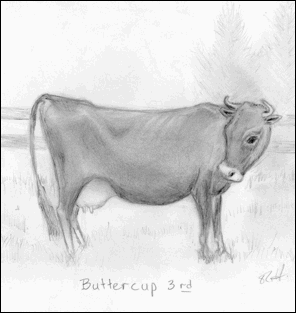
But Buttercup was no blushing heifer and her seventh calf, a young bull, was now bawling impatiently for his share of Buttercup’s evening production. Eliza had penned the calf separately and weaned it to a pail so that Buttercup no longer had to be subjected to the head-butting that always accompanied her son’s nursing. Not that a cow of ten was ready to beef, but Eliza was hesitant to commit her to another round with Charley Stubbs’ neurotic bull and another birth.
On the other hand, Buttercup 3rd claimed a blue-blooded pedigree, which always meant a ready sale for her offspring. Her father was Duke’s Butter Boy, a very expensive bull that Charley and his mother had imported from the Isle of Jersey. Charley had kept three daughters from this great sire which, because of lack of imagination on his part, he had called Buttercup 1st, Buttercup 2nd, and Buttercup 3rd. Eliza now owned Buttercup 3rd.
Eliza changed to her barn clothes, returned to the pasture bars, and led Buttercup to the tie-up where she was given her ration of meal. Positioning herself on a sturdy, three-legged stool at Buttercup’s right flank, Eliza carefully wiped each teat with a damp cloth. Then setting the white enamel pail under Buttercup’s udder, she took a teat in each hand and squeezed and pulled, firmly and regularly. The milk sprayed out in long streams, ringing against the side of the pail. The calico cat appeared from somewhere. She seemed to have an internal clock that rang whenever it was time for Buttercup’s milking. Eliza paused now and then to aim a stream of milk at the cat, who opened her mouth and deftly caught the liquid in midair, swallowing quickly. Any excess milk on her fur would be carefully licked off when this main event was completed.
Eliza also shared the milk production with Buttercup’s calf, who dove his head into the weaning pail and sucked noisily. She poured an additional amount into a sauce dish for the cat. The remainder she took to the cellar and poured into settling pans, from which she would later skim off the thick cream to churn into the sweet butter that added to her income.
She spent nearly two hours feeding her laying flock and collecting eggs, which were also taken to the coolness of the cellar for cleaning and packing. Her Reds were her main source of income. At a time when poultry was still considered a sideline by some, she had invested real money in remodeling the barn to accommodate 200 laying hens. After four years she was well known as a legitimate poultry farmer. With the growing interest in commercial poultry enterprises, she was even approached by local growers for advice.
Later, as she was finishing supper, she heard a carriage enter the dooryard. Mrs. Sabina Stubbs, mother of Charley and matriarch of Stubbs Farm, was arriving. Sabina was not a local girl. She was a Lowell—a Boston Brahmin “gone astray,” in her own words. When she was a young woman, she and her family had often summered at a cottage on Sandy Point, and Reggie Stubbs was their milkman. The Stubbs farm on Mount Ephraim had been established in 1820, the year Maine achieved statehood, and the Stubbs men had been some of the best farmers in Waldo County. Reggie was the third generation and, while a true country boy, was not an altogether poor catch. In spite of his plain face, shyness, and somewhat awkward frame he was good-hearted, with a well-developed sense of morality. He was also an accomplished farmer and the house at Stubbs Farm, which was a fine old white colonial, would have made a pleasant home for most any woman.
Sabina loved life in Maine and she loved cows, and while her family could well understand her feelings toward the state they simply could not comprehend her feelings toward bovines. Nevertheless, at the age of twenty-one—when she was expected to accept her place in Boston society—Sabina shocked both Boston and Prospect Ferry by marrying Reggie Stubbs. Her detractors claimed that Reggie had little to say about the marital arrangements and that Sabina was in charge of both Reggie and the farm from the start. But no one could deny that under her influence Stubbs Farm flourished even more than it had under Stubbs men. For it was because of Sabina’s persistence that the farm converted to the newly famous Jersey cattle. Through the years Stubbs animals were major contributors to the breed.
While Sabina was a forceful farm manager and well-organized housekeeper, she was not a good “breeder,” as Reggie’s family often said. Some would have liked to blame her childless years on her “inbred ancestry,” but given her iron constitution and her management ability, it was impossible to classify her as weak or wispy. When her first and only child, Charles, finally arrived, Reggie’s brother Adam was heard to say, “It warn’t hahdly worth the effort.”
Young Charley Stubbs was not a beautiful child, and he did not develop into a particularly attractive man. He seemed to draw the worst of both parents, and matured into a short-legged fellow with a homely face and uncontrollable bright red hair that always stood out at odd angles from his head. Strange hair growths were sometimes called “elf knots” by elderly New Englanders and were thought to indicate that the person had been planning something mischievous or perhaps evil. Charley’s grandmother Stubbs had once shaved the poor boy’s head hoping that the new growth might be more manageable. It was, in fact, worse, and his cowlicks grew back like two small horns. This was proof to his old Gram that the poor boy’s head was full of evil thoughts, prompted by the Devil himself.
Since Charley was the only issue from the Reggie/Sabina union, he received all the attention his parents could offer. But when Charley was only ten years old, Reggie was killed by a fall from the haymow. Sabina then threw herself even more forcefully into both the farm and her son’s upbringing. The farm prospered but Charley did not, and by the time he was twenty he was no more than a hired man, with little promise of the firm hand of leadership shown by his mother.
Now Eliza stepped to the back door to greet Sabina, who had driven as closely as possible to avoid any extra steps. Her age, over eighty years, combined with her weight to cause her great shortness of breath. When Sabina had first arrived at Sandy Point as a young woman of seventeen, she was truly slim and attractive, but her love for cows extended to their products. Through the years her intake of rich Jersey cream, butter, cheese, and homemade ice cream had not been kind to her figure. Hot rolls, biscuits, muffins, pancakes, baked potatoes, any vegetable, and even scrambled eggs were all excuses to use her own home-churned butter, and she could easily take in a quarter pound each day. The legendary Jersey cream was spooned into tea, coffee, hot chocolate, even over puddings, and served as the basis for all her gravies and sauces. The results could easily be seen on her person.
She climbed down painfully from her carriage, her weight aggravating the arthritis in her hips and knees. She drove an unusually low-slung wagon to reduce the step for mounting and dismounting. Charley and Paul, the hired man, had rebuilt a conventional carriage, using as a model the gallymanders that were used for hauling granite blocks from Mount Waldo. The humor of the similarity was not lost on Prospect Ferry locals.
Sabina’s usual outfit was a pair of men’s bib overalls and a ragged woolen sweater, covered by a huge denim barn coat that Uncle Adam said “would make a likely tent for two small boys.” But today she wore a voluminous purple dress and a large white sun hat.
Eliza met her cheerfully. “Evenin Sabina, you look awful nice. You goin to a pahty?”
“Cahn’t stop but a minute, Liza,” Sabina puffed. “Have to meet the train. Theodore and Esther are coming up from Boston for a few days.” Theodore was Sabina’s baby brother, who at sixty-five had taken his first wife.
“Don’t know why he’s bringin her. Theo never did like country living an’ she’s never been north of the Maine line but it seems a pilgrimage they felt compelled to make. I’m here to ask you to supper tomorrow night. Theo always enjoys talkin to you, an’ the new bride will want to meet the natives.” Sabina chuckled.
“That would be just lovely. You gut time for a quick cuppa tea, Sabina? I’m just finishin suppah. Step in an’ I’ll tie the hoss.”
Sabina moved ponderously into the kitchen, settled herself like a huge broody hen, almost enveloping the kitchen chair, and hitched herself from side to side until her bulk was evenly distributed.
As Eliza entered the kitchen, Sabina chuckled and said, “It’s Buttercup’s time isn’t it, Liza? I could hear her bellowin from the other side of Ephraim.”
“Ayuh,” sighed Eliza, pouring Sabina a cup of tea, to which the elder woman added a large spoonful of Buttercup’s cream. “Tryin to eat a little less butterfat,” she said somewhat apologetically to Eliza. “I usually take two but Doc Wheeler told me to lay off the fat foods, as if it’s goin to make any difference at my age.” And she laughed again.
“I’m thinkin I might let her go a ye-ah,” Eliza said, returning to Butttercup’s condition.
Sabina carefully laid down her spoon and stared at Eliza. “What do you mean, ‘let her go a year?’ You cahn’t let her go a year. No one keeps cows as pets. They need to be producin or they have no need for bein’.” Sabina was quite serious and Eliza could see that the idea of a year’s vacation for Buttercup from calf bearing and milk production would have no support from her.
“It’s just that I could use the time for the chickens an’ buy my dairy goods from you or from Hannah, an’ besides my hands get a little stiff from milkin these past few months. Buttahcup won’t just dry up on a given day, she might milk on for a few months.”
“Liza you don’t want to be known as buyin butter an’ cream,” admonished Sabina. “The neighbors will think you’ve given up workin. You know what they say: no cow, no kitchen.”
A cow was considered an indispensable part of any successful farm kitchen because of her contributions of whole milk, from which came butter and cheese for the table, cream for sauces and gravies, buttermilk for drinking and cooking, and skim milk for the hogs and the chickens. Everyone needed a cow, or at least easy access to a neighbor who owned one.
Sabina looked Eliza straight in the eye and said authoritatively, “As for her milking on for a few months, that might be but those last few milkins won’t give you enough milk to warrant the time it takes to pull the tits.”
“Yoah prob’ly right, Sabina,” said Eliza slowly. “Tell Chahley I’ll be along in the mornin’. He ain’t usin Laddie tomorrow that you know of, is he?”
“Nope,” said Sabina, firmly. “Two days ago I told Charles,” (Sabina always used his formal name), “Liza and Buttercup will be along soon so save Laddie for them. You cahn’t depend on him to think of that, Liza. He cahn’t remember Buttercup’s time from one year to the next.”
Stubbs Farm Imperial Lad was the current herd sire at Stubbs Farm and Buttercup had been accepting his advances for the past three years. Stubbs Farm Imperial Lad was known to his clients as Laddie. While Jersey cattle have always been one of the smaller breeds, the Stubbs Farm bull was exceptionally short-legged. These abbreviated legs gave him a rather comical appearance. Had it not been for his pedigree and the impressive potential for milk yield that he passed on to his daughters, he would not have received the attention that he currently enjoyed. Since his master already carried the unenviable title of Stubby, the bull became Stubby the second, at least outside earshot of Charley.
The unions of Laddie and Buttercup had been exceptionally blessed and the calves found a ready market in the area. In fact, Charley himself had purchased Buttercup’s first calf from the Cape farm, a heifer, whose registered name was Laddie’s Butter Girl and was dubbed with the unbecoming working name of “Girlie.”
The tea and the conversation were finished. Eliza helped Sabina back to the carriage and brought an egg box for her to use as a step. With much puffing from Sabina and some pushing from Eliza, the matron of Stubbs Farm mounted to her seat.
“See you in the mornin’, Liza,” she panted as she slapped the reins on the back of her little mare.
By morning, Buttercup’s passions had inten-sified somewhat and Eliza knew that she had to be on the road. She prepared the feed for the laying hens and the growing pullets, milked Buttercup, fed the calf, cleaned its pen, collected eggs, and finally returned to her bedroom to change to some better clothes in order to appear at the Stubbs farm before Sabina’s relatives.
She thought how pleasant it would be to go dressed up, take a book, and enjoy some quiet reading for the day, or to hear all about the great city of Boston from Theodore and his new wife. But she was a woman of business; she must return home by mid afternoon to repeat all of her morning chores, plus the cleaning and packing of the day’s eggs. At times she was envious of the married farm women who could spend their days inside a warm and tidy house and had men to do the barn chores. Then again, she was quite satisfied not to have a man around to call her “my ole lady” or “the little woman.”
She went to the pasture bars to get Mr. Peters. Using a pan of oats as a lure, she took him firmly by the halter and led him to the barn. Mr. Peters required a little brushing since he was to be seen by the Boston aristocrats. Somehow he had found one of last year’s burdock bushes and his tail was well matted with burrs. Eliza grumbled to herself as she combed out the tail and made it as presentable as possible. Once Mr. Peters was installed between the wagon shafts, she returned to the pasture and slipped a rope over the head of Buttercup. The restless animal followed with much head tossing and tail switching, and was tied to the rear of the wagon.
Now the little procession started over to the cool side of Mount Ephraim at a slow walk. This was a dull ride for Eliza since the pace was regulated by Buttercup’s walking speed. Mr. Peters didn’t seem to mind and since he received no urging from Eliza, he plodded along to match Buttercup’s pace. What a come-down for a son of The Great Peter, towing a cow to a bull.
Eliza had packed a basket with offerings for the visiting couple: a comb of honey from her own hive, a jar of last year’s blueberry jam, and a healthy wedge of cheese from the Shaw Farm dairy. Eliza was always somewhat intimidated by Sabina’s relatives, even though she herself had Boston roots through her mother’s side, and she was wishing that she did not have to make her first appearance with Buttercup in her present state of longing.
The two miles to the Stubbs farm seemed endless as Mr. Peters slowly moved one foot ahead of the other, while Buttercup strained at the rope and rolled her eyes, occasionally giving voice to her condition. The road was dry and dusty. The weather had been hot and rainless for several days. Some moisture for the hay and the gardens was needed. Little circular puffs of dust rose up from Mr. Peter’s hoofs as he clopped along.
They met only one other wagon. Adam Stubbs, brother-in-law to Sabina, was headed toward Prospect Ferry. Eliza was not excited over this encounter. Adam was the family renegade and lived in a small rundown cabin on the edge of the Stubbs farm. In his younger years, he and brother Reggie had worked the farm together but with the arrival of Sabina, Adam quietly moved from the main house and now survived on a war pension, a small garden, handouts from Charley, and enormous quantities of Black Horse ale. He drove an old buckboard with broken floorboards and several missing wheel spokes. His horse fitted the tone set by the wagon and was thin and ancient with a long, sad head. In spite of the heat, Adam wore a black overcoat, quite threadbare, and a brown felt hat. He was a pathetic figure to some in town, in his ragged coat and broken-down wagon. But to others, he was an independent soul who enjoyed life in his own peculiar way. Adam was a great tease by nature and since he was usually in some phase of intoxication, his jokes became rather ribald. He was also quite hard of hearing as a result of his war experiences and so he shouted most of the time. Although he never attended church he loved to sing the old hymns that he had learned as a youth. Eliza could hear him before he came into sight, presenting a very loud rendition of “Rock of Ages, Cleft for Me.”
“Lizzie,” he yelled, as he caught sight of her. Their wagons drew alongside one another. “By Gawd how are ya, De-ah?”
Eliza hated the name Lizzie.
“Ole Buttahcup gut an itch fah Stubby the second, has she?” He gave a lecherous laugh. He laughed in an odd manner. He said, “Haw, haw, haw,” pronouncing each word separately. Three haws were the maximum and meant he found the situation hilarious. Lesser levels of humor would rate only one or two haws.
“Ayuh, it’s her time,” said Eliza loudly.
“By Gawd I might jes turn ‘round an’ come watch this. Chahley always gits red in the face when a woman’s around t’watch th’humpin. That snotty little bull of his is rilly a pistol, they otta chahge admission jes t’see him pahform.”
“Oh, it ain’t that excitin, Adam,” Eliza said loudly wanting to be rid of him. “You bettah keep yoah date in the village.”
Adam didn’t seem to hear her reply. “I see th’Boston bahsted
is visitin again,” he shouted. “Nevah liked that damn Theodore.” Adam gave great
emphasis to the name. “He always looks like he smelt somethin bad even when
they ain’t nothin t’smell.”
“Good t’see you,
Adam,” shouted Eliza. “I bettah keep movin.”
“Oh wait, Lizzie,” he shouted. “I gut a story for ya. Whut made the man call his rooster ‘Robinson’?”
“I’m shu-ah I don’t know,” said Eliza, letting her impatience show.
“Because he Crusoe! Ain’t that a good one? Thought you’d like that, you bein a biddy lovah?”
“That is entertainin,” said Eliza dryly. “Now we bettah git movin.”
“Shu-ah, shu-ah,” he yelled. “Stubby’s prob’ly picked up the scent by now, don’t wanta keep him waitin. He’s prob’ly gut a busy day ahead,” and he laughed, “Haw, haw.”
Eliza spoke a little too sharply to Mr. Peters and the horse started forward with renewed enthusiasm after the rest. In her haste to leave Adam’s company, Eliza had forgotten she was attached to Buttercup. The rapid startup caught the cow off guard. She had been attempting to reach the grass growing along the roadside. Eliza heard a grunting gasp. She looked back to see Buttercup, feet planted, at the end of a very taut rope. Her neck was stretched to the limit, her large brown eyes bulged and her tongue hung out the side of her mouth.
“I think she’s havin second thoughts, Lizzie, haw, haw,” and Adam slapped the reins on the rump of his bony horse.
Eliza backed Mr. Peters a few feet, got down from the wagon, loosened the rope and spoke soothingly to Buttercup, and the trek continued.
The lane to Stubbs Farm was bordered on either side by rail fences surrounding fields of placid Jersey cattle. The dooryard was planted with flowers and the lawn was kept neat with frequent scythings.
The flowers and the lawn were the work of Paul, the hired man. Paul enjoyed a scythe; he could trim along the stone wall that bordered the lawn without ever dulling the edge of the blade and he could cut precisely around trees without so much as a sliver of bark being lost. Paul, however, was more than an employee. He and Charley had been close friends as young boys. Truthfully, Paul had been Charley’s only friend when they were growing up. Paul had aspired to be a schoolmaster and attended the Maine Normal School at Castine for two years after high school. After graduating, he’d secured a teaching position in the better section of Portland. Unfortunately, during his second year there was an incident involving two of his young students, the details of which were never publicized in Prospect Ferry. Then, much to everyone’s surprise, Paul returned home before the school year was completed, and was never offered another teaching position. His reputation had been tarnished. Stubbs Farm needed a man at the time and since Charley and Paul were good friends, Paul moved into the farmhouse. Now, twenty-six years later, he was doing the same chores at almost the same salary.
When Eliza had met Paul on his return to Prospect Ferry after “the incident” she had said, “Wey-ell Paul, they worked you pretty hahd I guess?”
Paul had shrugged and said, “It wasn’t too bad,” but had invited no more questions. That was the last time they spoke of the matter.
Other than the routine of farm work, Paul’s only interests were the flower beds, the lawn, and the kitchen garden. This must have been a rather humdrum life compared to what he might have hoped for himself. He came forward now from the barn as Eliza drew up. “Good mornin’, Eliza,” he said quietly.
Eliza had to adjust her hearing. Having just carried on a full-volume conversation with Adam, the quiet, calm voice of Paul was a complete change.
“Mornin’, Paul. I brought Buttahcup. I sent word yesterday with Sabina; hope you boys ain’t too busy.”
“No, no we’ve been expectin’ you. I’ll tie up Mr. Peters and get Buttahup to the stall. You’ll prob’ly want to stop at the house a minute.” Paul held Mr. Peters’ bridle and Eliza stepped down and then reached for her basket.
“I won’t be long,” she said, with a soft laugh.
“We’ll wait,” he said with a wink.
Sabina, Esther, Theodore, and Louisa, Sabina’s hired girl, were seated at the kitchen table. Greetings and introductions were made and Sabina said, “Esther and Theo are havin a late breakfast an’ Weeza an’ I thought we’d just join in to be sociable.” Sabina seemed to need to explain the reason for such a meal at ten o’clock in the morning.
The table was spread with the remains of a small feast: a large platter of scrambled eggs, a plate of bacon, a pile of toast, hot biscuits, various jams, an apple pie, a large mound of yellow butter, a cooling pot of coffee, and the usual pitcher of Jersey cream. Louisa hopped up and began to clear away the dishes as if she had been caught in an unseemly situation with her employer.
Eliza presented her basket to the newlyweds. The offering seemed a little skimpy given the spread that the guests were currently enjoying. But they thanked her graciously and assured her that the items would be much appreciated back in Boston.
A few more casual remarks were exchanged about the weather and the train ride and the changes to the town, and finally Eliza said, “I should be gittin t’the barn.”
“Why, Dear?” asked Esther innocently. “We’re just getting started on a nice visit. Have some breakfast with us. Louisa could heat up the eggs and there are more hot biscuits, I’m sure.”
“Eliza’s cow needs servicin,” said Sabina flatly, helping herself to a piece of pie.
“Do you mean breeding?” asked Esther in a low, whispery voice.
“Yes, Esther, we mean breedin’,” Sabina, said as if speaking to a child. She poured a goodly portion of cream over her pie. The move did not escape Eliza and she smiled.
“But do you watch?” asked Esther, looking at Eliza with wide eyes.
Theodore stepped into the conversation in his usual officious manner to help his new wife understand the rural ways.
“These bodily functions of farm animals are quite familiar to country people, my Dear,” he said. “They don’t see them quite in the same light as you or I. It’s part of their way of life. Breeding is necessary if milk production is to be expected.”
Sabina looked over the tops of her glasses at her brother and then winked at Eliza. “Yes we’re right up to our elbows in it most of the time,” she said with mock seriousness.
Then in her own defense Eliza spoke to Esther, “It ain’t exactly watchin. I’m theah more t’keep Buttahcup calm an’ make shu-ah theah’s no problems.”
“I see,” said Esther, hesitantly. The conversation had apparently affected her appetite, for she slowly pushed away the remains of her breakfast. Sabina finished her pie and gave a soft, lady-like belch.
Four years past when Laddy, alias Stubby the second, had reached breeding age, it became apparent that the length of his legs would be a hindrance to successful mating. But Stubby was homebred and Charley was determined to make him an important sire of the breed. Laddie was used to service not only the Stubbs Farm Jerseys but also other local milkers. Several families kept a family cow, and some had small herds of three or four as income producers. Many were now keeping Ayrshire cows because of their greater yield of milk; others still hung on to the old Durhams. Now while the Jerseys were a challenge for Stubby, the longer-legged Ayshires and Durhams were, as Uncle Adam put it, “jes wishful thinkin.” However, the Jersey x Durham was a useful cross, combining a high flow of milk with good fat content, and thus Stubby had gained quite a following of Lady Durhams.
So Charley, in order to take full advantage of Stubby the second, had constructed a special servicing stall on the barn floor. It consisted of a head stanchion, on either side of which were two sturdy planks at an angle of about forty-five degrees. Behind the stall was a platform raised about six inches above the barn floor. The cow to be serviced stood between the two inclined planks and was held by the stanchion. Laddy, alias Stubby, mounted the platform and, using the inclined planks to augment his abbreviated front legs, performed the act prompted by his masculine constitution. The stall was known locally as “Stubby’s secret.”
As Eliza entered the barn, Charley greeted her in his meek voice. “Mornin’, Liza. Buttahcup’s in place, the boys are bringin Laddie.” “The boys” consisted of Paul and young Junior Collins.
“Mornin’, Chahley, jes had a quick visit with yoah Uncle an’ yoah new Ahnt. They might like t’see this proceedin. Yoah new Ahntie seemed kind of interested in the details of servicin.” She gave an innocent smile.
“Oh I don’t think so, Liza,” he gulped quickly. “She’s not use t’bein around animals an’ Uncle Theo pretty much stays in the house when he visits.”
A loud bovine bellow cut short their conversation and announced the coming of Stubby. The similarity between the little bull and his master always tickled Eliza. They shared the same short legs, rather thick neck, somewhat bulging eyes and even similar coloring, although Charley’s hair was carrot red while Stubby the second’s was more of a golden tone.
Stubby was a performer: he rolled his eyes, he whipped his tail, and he danced in a stiff-legged way. As he came within smelling distance of Buttercup he turned back his upper lip in a sort of bovine grin, all the while making a variety of snorts, grunts, and bellows.
Charley watched the arrival of Stubby as one might watch a favorite son. His eyes were fixed on the dancing bull as if this was the first time he had watched these antics. Paul guided Stubby with a wooden pole about four feet in length that had a swivel snap attached to one end, and the snap held the ring in Stubby’s nose. The pole was to keep the bull at a distance while still having control over him. Paul walked slowly and easily while the little bull danced at the end of the pole. Junior Collins walked on the other side, holding a rope attached to Stubby’s halter. Charley owned only one snap pole and Junior’s role in holding a limp rope was more ceremonial than utilitarian.
“You ready, Liza?” said Charley, a little nervously.
“Ayuh,” she said and spoke soothingly to Buttercup while scratching her neck.
Charley led Stubby close to Buttercup’s rump for a good sniff. The routine was always the same: a sniff, then a walk on the barn floor, another sniff, another walk, and on the third sniff, the mount. Charley thought the walks helped “to charge him up, make him think we changed our minds,” as if Stubby needed any such incentive.
Places were now changed. Charley stepped forward and grasped the pole. Paul walked behind the bull and took the halter rope. Junior was instructed to hold Buttercup’s tail to one side. Junior was new at the farm, only a summer helper, and thus was given the job requiring the least experience. This was his first “servicin.”
Stubby the second was roaring continuously now with each breath. Junior Collins looked rather apprehensive. Jersey bulls had the reputation of being a little meaner than most breeds. Junior suddenly realized how close he would be to the action. Stubby circled in for the third sniff.
“Now!” shouted Charley and he lifted the pole, which helped Stubby raise his head. The little bull lunged but was too close to the front edge of the platform; his rear feet slipped forward and now he was standing on the barn floor at Buttercup’s level. His chest rested on her rump and his front legs paddled in the air trying to reach the inclined planks. Junior Collins quickly quit his place at the tail.
“Back him up! Back him up!” said Charley, showing his agitation.
Paul and Charley pushed on his shoulders but Stubby would not raise his rear feet up onto the platform.
“Lift his foot, Junyah!” puffed Charley.
Junior Collins was not of a mind to insert his hand in the area of four shuffling bovine feet. But as Stubby tried to lift one foot, Junior moved in and very deftly, with the toe of his boot, guided and lifted the foot up to the platform. Shifting his weight, Stubby raised the second foot and was safely back on the platform. They backed him off and took another walk. Stubby was panting a little now and had less energy for dancing.
“All right, this time he’ll make it,” said Charley confidently.
“He’s doin his best,” Paul said, smiling.
Buttercup was craning her head in an attempt to see the action behind her. Eliza was wishing she had stuck with her idea of giving her bovine friend a year’s vacation. Junior Collins was starting to see the humor in this exercise and was mentally constructing a story to amuse his friends over a glass of beer that evening.
“Ready?” asked Charley. No one answered but as if on cue, Stubby again attempted to mount. His feet stayed on the platform but he missed his target and again was backed off.
“Fah Chrise-sakes!” muttered Charley, and then in a louder voice, “Switch places!” He wanted this to be over, especially with Eliza present.
Paul took the pole; Junior held the halter rope and Charley grabbed Buttercup’s tail. As Stubby lunged for the third time, Charley provided a guiding hand and Buttercup was served!
Stubby was returned to his pen. His exit was much quieter and more composed than his entrance had been. He was puffing hard and showed no inclination for roaring or dancing.
The patient Buttercup was taken out of the stall and put in an empty calf pen to “settle down,” as Charley described. The servicing committee withdrew to the house for refreshments.
“Did everything go as expected?” asked Esther solicitously, not quite sure how to word the question.
“Everything’s fine,” said Eliza. “Buttahcup’s restin fer a minute an’ then we’ll staht for home.”
“And when will she need servicing again?” asked Esther, now confident with her new word.
“Not for a ye-ah,” said Eliza with some relief.
“Oh?” said Esther. “That long?”
“Don’t forget yoah comin back for suppah tonight,” called Sabina as Eliza started for the door.
“I won’t De-ah an’ thanks for thinkin of me.”
The return trip was without incident. They met no one and both Mr. Peters and Buttercup seemed anxious to be back on home turf, moving along at a brisk walk. As Eliza rode she reflected on Esther’s reaction to Stubby’s coupling with Buttercup.
“City folks!” she said aloud as if those two words summed up all the naiveté and lack of good horse sense that she pictured in most Bostonians.
But Esther’s inquiries into the breeding process caused Eliza to recall another situation regarding Stubby’s role in the community. Charley loved to recount a story involving his neighbors, the Lufkins. Young Jason Lufkin was sent with the family cow to the Stubbs farm early one morning. The cow was serviced and returned home, and then Jason hurried off to school. On arriving at his classroom the teacher demanded an explanation for his tardiness.
“Had to take our cow to Stubbs’ t’git bred.”
“Couldn’t your father have done it?” asked his teacher.
“Wey-ell, mebbe,” said Jason hesitantly. “But we always use Mistah Stubbs’ bull.”
Charley could tell that story daily and still cause himself to chuckle. Of course in his telling of the story the bull was always known as “Laddie.” Eliza now smiled broadly to herself, thinking of Jason’s reply as well as Charley’s enjoyment of Stubby’s reputation.
When they reached home, Eliza lowered the pasture bars and led Buttercup in.
“Theah, De-ah, I hope you’ll rest easy for a while, but when next April comes, don’t say I didn’t warn ya!”
* * *
Took B’cup to bull today—sunny. Went back for supper—had peas and new potatoes. Met Theo’s new wife, city girl.
Chapter 3

|
T |
he winter of 1901–02 following the great Boston Show was one that the natives of Prospect Ferry talked about for many years. Snow arrived on Mount Ephraim in early October. Being the highest point of the countryside, Ephraim often got the worst of the weather and this year was a good example. The first snow didn’t stay but it was a forecaster of what nature had in mind. Ponds started freezing in early November and there was plenty of opportunity for the young people to organize skating parties on Thanksgiving Day. Even on the warm side of Ephraim, Eliza was snow-covered by early December and the temperature dropped to record lows for two or three days at a time in mid month.
With snow filling the barnyard, Eliza was grateful for Grandfather Hamlin’s plan when constructing the Cape farm. The snug house faced the Hamlin Bridge Road the long way. Extending from the south end, also parallel to the road, was an ell containing the summer kitchen, the toilet, and the wood shed. The wood shed was then attached to the front corner of the barn, which had large double doors facing the road. The weathered barn, which had once held her father’s small herd of Milking Devons, was now home to Mr. Peters, Buttercup 3rd, and Eliza’s flock of two hundred Rhode Island Reds.
The Reds enjoyed the entire south side of the barn, which had formerly been used for a hay storage bay when the Devons were in residence. Two roomy box stalls stood opposite on the north wall, which had accommodated the Percherons of Eliza’s father, and two standing stalls and a calf pen completed the north wall. Mr. Peters enjoyed one of the box stalls during the colder winter months. However, from spring until late fall, these stalls housed Eliza’s special Red matings, first as pens of breeder birds and then as pens for the growing offspring from these matings. During these months, Mr. Peters either used a standing stall or slept under the stars. Buttercup occupied a standing stall year-round.
The central barn floor area served as storage for feed, egg crates, and other assorted poultry paraphernalia. There also lived in the barn, in winter, a trio of gray geese. Eliza always enjoyed the company of these fowl and they supplied her with feathers for the occasional pillow, offspring for Christmas roasting, grease for chest colds, and surplus eggs for fluffy angel cakes.
From the front of the barn you could walk to the opposite back corner to an attached shed used as the pullet-rearing house in summer, and in winter housing the three ewes, kept for their fleece. Having the buildings tied to one another in the Maine way meant that she could care for herself and the stock without ever stepping outside.
|
|
January and February dragged on with no let-up in the cold. Penobscot Bay was frozen from Castine to Belfast, and on frigid mornings great plumes of sea smoke hung in the air over any open water. The January thaw, always anticipated to provide a respite, lasted a mere twenty-four hours, when temperatures reached forty degrees at McAdams’ store at midday on the tenth. McAdams’ store thermometer was considered to be the unofficial weather station in town and record highs and lows were passed around by word of mouth. On Candlemas Day, the sun shone with a cold brilliance and any woodchuck would surely have seen its shadow. To make good on this prediction, a severe northeaster came in on February 5, blew across the mountain for nearly two days, and banked snow up to the window sills on the west side of the house. This abundance of snow would give added moisture to the fields and gardens in the spring, and since it was free it was often called “the poor man’s fertilizer.” Eliza had laid in a supply of chicken feed in late November when the roads were still easily passable, so her birds would have no worries. Poultry feed, formulated and bagged, was just starting to be used in central Maine. And she was one of the first to take advantage of this great convenience. The bags were neatly stacked on the barn floor, and although the resident mice were enjoying Eliza’s foresight, their numbers were kept in check by the calico cat. No, the poultry gave her little concern, but the appetites of her other five guests—Mr. Peters, Buttercup, and the three sheep—were quickly using up her hay supply. The bull-calf of the previous summer had been purchased as a future herd sire by Orrin Macomber in Brooks. Eliza had been pleasantly surprised when Macomber easily agreed to her asking price.
She often remembered how her father had recited the old rhyme, “half your wood, and half your hay, you should have on Candlemas Day.” She had plenty of wood but her hay mow was well below half on February 2. The previous summer had been dry and the grass grew thin and tough. It didn’t help that most farmers waited until grasses were past maturity before cutting, which meant that last year’s forage was not only in short supply but poor in quality as well. The newly created College of Agriculture and Mechanic Arts at Orono advised that hay cut early in the season had greater feeding value than that cut late. However, hundred-year habits die hard and the old custom of beginning to hay on the first Monday after the fourth of July still prevailed on most farms.
But today was March 1, and the sun had genuine warmth to it. For the first time in months, one had hopes of a real thaw. By ten o’clock water was dripping from the eaves of the house on the east side and the drifts appeared to be settling. March had arrived as a lamb! Eliza stepped out and stood on the doorstep for a few minutes, just letting the sun warm her face. Returning to the house, she made her way through the shed to the barn and rolled open the double doors to release the aromatic buildup of winter smells. The geese took advantage of the day to bathe in the snow puddles in the barnyard, dipping into the shallow water with a sideways tilt to their heads and then rummaging wet bills through their feathers.
Eliza moved into the chicken pen, opening all the windows. With the thaw, the level of ammonia was becoming somewhat overpowering and she felt a little bad for the birds, since they could not escape from this eye-watering odor. As she worked, her ears caught the sound of a sleigh coming along the road and she recognized the tone of the bells as belonging to the Stubbs Farm team. The horses stepped with difficulty through the wet, heavy snow and came to a grateful halt by the barn door. The gray gander spread his wings and hissed at them for invading his territory.
“Mornin Chahley,” she said, coming to the open door. “Nice t’see it meltin.”
“Ayuh,” he said quietly. “Hope it keeps right on t’May Day.”
“Gut time for a cuppa tea, Chahley?” This was a ritual request. Charley always had time for a cup of tea. His visits with Eliza were a pleasant stop for him on his way to and from the village and he counted on her asking. There was also a more practical reason for Charley to stop, as he often took Eliza’s eggs to the station to be shipped to Patterson’s Provisions and Dry Goods in Bangor. Since egg sales were her main source of income, freshness was important and she tried to make two shipments each week. She would have shipped yesterday but with the snow breaking down on the roads, she had hesitated to drive Mr. Peters and had hoped that Charley would appear.
They sat in the kitchen and Charley produced a small brown parcel. “Mothah sent a piece of cheese,” he said shyly. From the rough way that it was wrapped, Eliza suspected as usual that Charley, not Sabina, had initiated the gift but she would say nothing of that.
“Be shu-ah to thank her for me,” she said kindly. “I’ve gut a fresh dried-apple pie, I think we bettah cut it an’ have a slice of that nice cheese.”
Eliza’s baking was enjoyed by everyone and her dried-apple pies, liberally laced with sugar and cinnamon, were Charley’s favorite. Her orchard of six trees boasted Baldwins, Northern Spies, and Wolfe Rivers, and the medley of these three produced an outstanding pie. She poured the tea, served up two large wedges of pie and sliced triangles of cheese to lay atop each piece. They ate quietly for a few minutes, enjoying the bright kitchen with the sun adding its warmth to the wood stove.
“How’s yoah hay holdin out?” she asked.
“Not good,” he answered. “We emptied the loft ovah the tie-up ‘most two weeks ago and that usually lahsts well into March. I shoulda cut yoah meadow by the brook but I figured we’d eke out, an’ it’s so far to haul home from theah.”
She always gave her standing hay to Stubbs Farm in return for a cut portion to store for her own use.
“Mothah told me at the time to cut it, an’ she’s told me every week since.” He sighed. “It’s awful easy to fahm from a soft chair.”
She smiled to herself. How often over the years had Charley repeated that line?
“Wey-ell,” she said solemnly, “if we can make it up March hill things’ll look bettah in April.” How often over the years had she repeated that?
“Finish yoah pie, De-ah,” she said. “I’ll git the eggs.” The eggs were safely packed in her own wooden cases, which had a capacity of fifteen dozen each. Eliza’s name and town were carefully printed in black paint on the underside of each lid. Three full cases were sent, by train, to Bangor on Tuesday and Friday to Patterson’s Provisions and Dry Goods. Empty cases were returned to Prospect Ferry on the following day.
Charley stowed the cases in the back of the sleigh and packed an old horse blanket around them for cushioning. He clicked his tongue at the team. They turned slowly in the wet snow and pulled with effort until they reached the harder-packed road where they could step along with fewer impediments.
Eliza went back to her spring cleaning. She tied Mr. Peters on the barn floor and thoroughly cleaned his stall, replacing the old bedding with clean straw. She scraped the boards behind Buttercup, gave her new bedding, and even threw some clean straw to the sheep. Then with her garden fork, she turned over the litter in the chicken pen, hoping to speed up the drying. She really only succeeded in increasing the ammonia level and frightening the hens with her vigorous rearranging of the straw. But it felt good to be able to work without the heavy grip of the cold.
In late afternoon she had another caller, Charley’s Uncle Adam. Mostly deaf, partially in-toxicated and wearing his usual black overcoat, he slogged into the yard and hammered on the door.
“Hello Adam,” she shouted.
“Lizzie, De-ah,” he hollered. “Ain’t it nice t’git a little sunshine?”
“Ayuh,” she called back. “Whut do ya need?” Uncle Adam lived mainly on handouts and rarely stopped unless he wanted something.
“Wey-ell,” he yelled, “Chahley give me a nice side of bacon yestiday an’ I wuz thinkin how nice ‘twould be t’have a few eggs t’go with it. I’m awful tired of eatin salt pork an’ beans an’ I thought mebbe you’d have a few cracks.” Cracked eggs were usually free.
“Come in, Adam,” she shouted.
The combined smells of beer, wood smoke, and unwashed flannel underwear emanated from Adam once he entered the warmth of the kitchen. Eliza hurried to the cellar in order to move him along as quickly as possible. She returned with a small pasteboard box and handed it to the old gentleman.
“I ain’t gut any money jes now, Lizzie,” he said trying to lower his voice to pass on this confidence but finding it difficult to do so. “But syrupin should start pretty soon an’ I’ll bring ya one of my first batches,” he yelled, happily returning to his usual volume.
His promise of maple syrup did not excite Eliza. Charley (and Sabina) let Adam have the use of the maple grove on Stubbs Farm as a way of making a little cash. But Adam’s attempts at quality control left much to be desired. To start with, his syrup was bottled in old beer bottles, of which he had an ample supply. Beer in glass bottles was just coming into general use and Adam was doing his part to make the introduction of bottled beer a success. But maple syrup offered in a bottle that still had a whiff of alcohol about it had a very dampening effect on consumer accep-tance. And upon opening the finished product, the recipient often found bits of bark and sawdust. This debris Eliza could accept, but she had once poured out a large gray spider, and after that the gifts of maple syrup were carefully stored in a dark corner of the cellar.
“Don’t worry about payin me, Adam, just enjoy yoah suppah.”
He shuffled to the door and she kept close behind him to keep him on the move.
“Shu-ah be glad when spring comes,” he hollered. “My bones don’t like this cold. I’m on my own today, don’t ya see. My ole hoss come up lame this week, gut a ride t’town an’ then back as far as the bridge but warn’t nobody comin the rest of the way.” He carried an old gray cloth bag holding a few groceries.
“Oh, the exercise’ll do ya good!” she shouted, opening the door as she guided him out. “You take care now goin home, this bright day’ll mean a cold night without some clouds to keep in the heat an’ you wanta be home by dark.”
“I do Lizzie, I do,” he agreed heartily. “I wanta git started on my suppah. I can jes taste them eggs an’ bacon now. God bless ya, De-ah, you gut a kind heart.”
Her prediction of a cold night was borne out when the temperature dropped nearly fifty degrees. At bedtime she carried her plants from the windowsills to the kitchen table so they wouldn’t frost. She opened the oven and removed two warmed beach rocks, wrapped them in an old piece of flannel and carried them up to her bed to warm the cold sheets.
The following day started as had the previous one, with bright sunshine, but the air was cold. By ten o’clock, gray clouds were obscuring the blue sky and a light freezing drizzle had started that turned to sleet. As the temperature fell throughout the day, the sleet turned to snow.
Cloudy skies with intermittent periods of freezing rain and snow continued for two days, and the low-hanging clouds persisted for another three days, obscuring both the sun and the top of Mount Ephraim.
On the following Saturday Eliza decided that she must go to the village. Charley had not been by. There were eggs to ship and groceries to purchase, and Mr. Patterson’s bank draft from her egg sales would be waiting at the post office.
The clouds moved out and the bright sunshine of the previous week was again shining on Ephraim. Though her dooryard had softened, Mr. Peters pulled the pung to the road without too much difficulty. But the road down the mountain was barely passable, being lined with sleigh ruts, spotted with hoof prints, and showing occasional patches of bare ice. They went slowly. Mr. Peters picked his way along, and the two-mile trip that normally took twenty minutes or so stretched on to an hour.
On the return trip, the sun had dropped and the surface of the packed snow, which had melted earlier in the day, was now refrozen and treach-erous for walking. In his haste to get his stall, Mr. Peters turned too quickly into the dooryard. He slipped, in spite of his caulked shoes, and came down heavily on his right knee, letting out a great breath of air. Eliza decided against getting down from her seat, thinking she would be of little use to the horse on the slippery surface. The animal got clumsily to his feet and stood trembling for a minute. Then with no urging he slowly dragged the pung to the barn. She unharnessed him; he limped into the stall and stood dejectedly, resting his leg on the tip of his hoof. Eliza made him a warm mash with a measure of Buttercup’s bran meal, a cup of molasses, and some warm water. He ate it slowly.
She did the evening chores and returned to Mr. Peters with a small bucket of warm water and a roll of torn-up bed sheet. Soaking the sheet, she then wound it carefully around the swollen knee. She left the poultice intact while she made her own supper and then returned to the barn. With light from the lantern she found an old bottle of liniment on a cobweb-covered beam and carefully dusted it off. Removing the bandage, she poured the liquid into a pad of sheeting and generously swabbed the knee. Mr. Peters showed his displeasure by blowing through his nose and lifting his left hind foot up against his belly and gently kicking out with it. Eliza persisted and soon had the stall reeking with the odor of alcohol and turpentine.
“The-ah, old friend, that’s the best I can do for ya.” She threw in extra straw, should the horse want to lie down, and filled the manger with fresh hay. Then she retired to her warm kitchen.
Her plan had been to attend church the following day; she had not been to Sandy Point for a few weeks due to the state of the roads. So keeping on that schedule, it was time for her weekly bath. A sturdy tin bath tub was dragged in from the ell and set in front of the kitchen stove. Shades were pulled down, curtains drawn, doors locked. It took quite a bit of water to fill the tub to the desired depth. She emptied the warming tank on the stove and also used two tea kettles from the stove top. The warm bath was a luxury for her and she emerged from the tub refreshed and cleansed from her week’s toil.
But on Sunday morning Mr. Peters was in no condition to go out. She studied the knee carefully. It was even more swollen than the night before and hot to the touch. He was not putting any weight on it. Her animals were so seldom sick that she did not have a great deal of experience in home doctoring. She repeated the hot packs followed by the liniment, accompanied by much sympathy. After chores she made herself half ready in case someone from further up the road should stop to offer her a ride to church. Paul, the hired man at Stubbs Farm, was pretty regular in his attendance and often stopped to see if Eliza wanted to ride along with him. He was, in fact, a deacon of long standing. He was a great favorite of the minister, the Reverend Arthur Stebbins, who made certain that Paul’s position on the Board was always successfully renewed.
Sabina Stubbs had neither interest in nor time for church and she had raised Charley to observe the Sabbath as another day of work.
As the hour of church passed and no ride appeared Eliza realized she now had two full hours to the good and felt she should mark the day with some sort of recognition. She sat with her hands clasped together on the kitchen table and she sang. She sang “Jesus, Savior, Pilot Me,” one of her all-time favorites. In spite of her rough outdoor life she had a sweet, clear singing voice.
“Jesus, Savior, pilot me,
o-ver life’s tempestuous sea;
unknown waves a-round me roll,
hiding rocks and treach’rous shoals.”
She knew all three verses by heart. The reference to the sea pleased her. Maybe the writer had grown up in Maine, maybe his father was a fisherman. Anyway she liked to think that.
And she sang “Bringing in the Sheaves.” The words told about sowing and harvest and the end of all labor when “He will bid us welcome” and “We shall come re-joic-ing, bring-ing in the sheaves.” She particularly liked the chorus on this hymn and let her voice out to its extreme; then she was embarrassed as the sound filled the kitchen.
Then as a sort of finale she sang the “Gloria Patri”: “World without end, Amen, Amen.” She sat for a while after this little service and tried to think pious thoughts. But her mind kept coming back to Mr. Peters so she changed to her barn clothes and again tended the swollen knee.
Her continued nursing on Sunday had no effect and by Monday she had come to the feeling that something of a professional nature must be done. She waited for Charley to come by on his way to the station with the milk shipment, and finally heard the familiar clanging of the sleigh bells. No worry about missing him; the team was turning in, although at a slow and careful walk. Eliza came to the door.
“Chahley, I’m shu-ah glad you stopped, come an’ look at Mr. Peters, he fell on Sat’day an’ his knee is swollen somethin awful.”
They went to the stall where Charley tenderly probed the swollen knee, and each time he touched it, Mr. Peters flinched.
“I put hot packs and liniment on it for two days but I think it’s gut worse.” Eliza said, sadly.
“Ayuh,” Charley said thoughtfully. “I think cold’s whut’s called for he-ah, need somethin to bring down the swellin.”
“I thought of that,” she said emphatically. “But it just didn’t seem the thing to do when he was so cold to staht with.”
“Ayuh, but I think it’s cold what’s needed. I wish Mothah was he-ah, she’s a great one for doctorin’. Doc Adams might even lance it. It’s pretty hard.”
Dr. Adams was the local horse doctor and suggesting that he might lance the knee was a safe prediction. Lancing was his favorite form of treatment.
“If just by luck he wuz in town I’d send him out,” said Charley. “An if he ain’t in town I could send word to him by someone comin by the stoah.”
“I’ll bet you could, De-ah. Send word that I need him today.” She sounded a little desperate to Charley.
Charley was successful. In mid afternoon Dr. Adams arrived. He drove a very stylish cutter pulled by a single horse of great stamina and spirit but of little known parentage or pedigree. Dr. Adams had been dosing and patching animals between Searsport and Prospect Ferry for nearly forty years. He knew every farm and farmer in that part of Waldo County, and although Eliza was not a frequent client, she was well known to him.
The doctor was “from away,” which in this case meant as far as Hartford, Connecticut. He was not a Mainer and made no pretense of being one. He had not allowed himself to fall into the local dialect, as some did to cover their foreign roots. His manner remained very fussy and fastidious in spite of the unsanitary conditions under which he was generally forced to work. The doctor’s practice was not especially lucrative, given the economic level of most of his clients. Yet he enjoyed an above-average standard of living. It was said that he came to Maine to escape “an unpleasant family situation.” No one really knew the details but the gossip lent a certain air of mystery to Dr. Adams even after so many years. Now he arrived, wearing, as always, a black derby hat and a tweed jacket, indicating that he was a professional man.
“Good afternoon, Eliza,” he said, somewhat formally. “I understand that Mr. Peters may need lancing.”
“Wey-ell, I just ain’t shu-ah, Doc,” she said slowly. “Chahley Stubbs came by this morning and that wuz what he thought.” She did not want to presume to tell the healer about his business.
“I see, I see,” he said pursing his lips as if this was a new and radical procedure to him. “I expect that the treatment will soon become apparent.” He produced a long brown duster from his black bag and carefully buttoned it down to his knees.
As they walked to the barn she explained the cause of the injury. The Doctor clicked his tongue. “Many a good horse has been ruined on ice,” he said gravely.
Mr. Peters was brought out onto the barn floor and held by Eliza while Dr. Adams knelt in front of the animal. His examination was very similar to the one Charley had conducted earlier in the day and consisted of prodding and fingering the knee. Perhaps not surprisingly, the diagnosis was also similar.
“This is an inflammation, not an infection,” he said with great finality. “My advice to you is covering it several times a day with a cold compress. Use the liniment sparingly until the swelling subsides and do not give any heating mashes, just good clean oats and hay and plenty of water. That’s what’s called for here, Eliza. Walk him a bit each day just inside here so the knee won’t stiffen up. It will take a few days before he’s ready for a trip to town.”
Eliza returned Mr. Peters to his stall and followed the doctor from the barn, offering “a nice cuppa tea.”
“Delighted,” he said. “It’s been a long day and I still have two calls to make on my way home.” He removed his duster and returned it to the black bag. On entering the kitchen he washed his hands very carefully at the kitchen pump and dried them on the roller towel. They drank tea and talked about the harsh winter and about animal injuries.
After the departure of Doctor Adams, Eliza swung into action, and for the next two days, along with her regular chores, she applied cold compresses to the horse’s knee several times each day. The swelling did subside and the outlook for Mr. Peters improved. But Eliza was not responding to this positive change as well as she might have.
On Wednesday, the fourth day after the accident, Charley drove in. Eliza made no move to get up but called, “Come in, Chahley. It’s open,” in response to his timid knock. She was sitting dejectedly at the kitchen table.
“Whut are you doin at the table at this hour, Liza, you feelin right up t’snuff?” he asked.
“No, I ain’t, De-ah,” she said, somewhat dejectedly. “I ain’t done a lick of work this mornin. I just ain’t gut any spark. All my bones ache an’ I think I gut a fevah.”
Charley, usually the timid one, walked quickly across the kitchen and laid his hand on her forehead. “Ayuh, I b’lieve you do. I say drinks and bed rest is called for he-ah.” He spoke with more authority than he had really intended.
She looked at him with some appreciation. “I guess you’ve diagnosed it, Chahley, but I’ve gut birds an’ beasts t’tend an’ lots of eggs that need packin’.”
“Paul can help, you can tell him whut’s to be done,” said Charley, settling the question with quiet finality. “I’ll send him ovah jest as soon as I get home an’ I’ll have Mothah send Louisa t’help tidy up the house an’ get you some nice soup. They ain’t no shortage of chickens he-ah for such a meal as that.” He chuckled over this attempt at humor.
“Oh Lawd, I cahn’t say no t’that. It seems a great chore jes to git back upstairs.”
“I’ll help ya.” With no hesitation he took her arm and guided her toward the stairs.
“Up March hill, Chahley,” she said, trying to make a joke of it as they climbed the stairs.
“Ayuh.”
Louisa and Paul arrived together later in the day. Louisa tidied up the kitchen, filled the wood box, and made a large pot of soup. This she served to Eliza along with soda crackers and strong tea with Sabina’s “fever remedy” added. Along with her managerial farm duties, Sabina found time to mix her own herbal remedies. They were often vile tasting and of questionable medicinal value, but many of the local people set great store by them.
“Take a big spoonful, mornin and night,” Louisa instructed. “Sabina says it’ll take care of the fever an’ put you right in a few days.” Eliza thanked her but planned to ignore the instructions.
Paul collected the eggs, fed the birds, fed Mr. Peters and the sheep, and fed and milked Buttercup. Before they left he came to Eliza’s bedroom and reported. “We’ll be back in the aftahnoon to milk Buttahcup, an’ Weeza will get you some supper. Chahley said I could spend most of the day tomorrow so I can send off the eggs and then come back an’ do the evening chores. Between Weeza and me we’ll keep you up-to-date. You take your rest.”
“That’s awful nice of ya, Paul,” she said. “I don’t believe I’m goin t’be up for a day or two. I really feel bad. I’ve slept most of the day. I sent word t’Hannah. She’ll come in the mornin an’ then Louisa won’t have t’come back.”
The illness that everyone thought might last a few days stretched out to a week. Hannah wrote to Sister Lottie and advised her of the situation on the Cape farm. Eliza’s fever stayed high. She was incoherent at times and Dr. Wheeler could find no cure. “Just a real bad case of the grippe is all I can figure,” he said more than once while shaking his head.
Eliza ate little, much to the consternation of Hannah, who had taken over the kitchen. Hannah produced soups, custards, eggnog, and endless plates of toast and cups of tea, all with little success.
During the second week, when the fever continued, Sabina arrived with three different remedies, each one a little more unpleasant than the last if smell was any indication. She was quite incensed when Hannah suggested that Dr. Wheeler was doing his best and they should stick with his treatment. He had been in contact with a specialist at the Bangor hospital and was following his advice. Sabina pointed out to her that the good doctor’s remedies were having no effect and that it was time to let nature take a turn. This difference of opinion led to a rather heated argument in the kitchen. The main point of disagreement was who might have Eliza’s best interests at heart. The finality to this scene came when Sabina stomped heavily out the door vowing not to return as long as Hannah was on the premises and admonishing Hannah that Eliza’s good health was now on her shoulders.
Later, when Hannah went upstairs, Eliza asked sleepily what had taken place down below. “Oh, it was jest Uncle Adam, stopped by t’wish you well,” said Hannah. “He’s so hard a’ hearin.”
“Well bless his heart,” said Eliza and drifted off again.
Finally in the third week of her confinement, Eliza’s temperature returned to normal and she no longer drifted off in mid sentence. On Thursday of that week, Charley quietly pushed open the front door of the Cape house and called tentatively, “Halloo.” Receiving no answer he walked lightly to the foot of the stairs and tried again. “Hello, Liza.”
“Hello, Chahley,” she called down from the bedroom. “Come on up, I’m decent.”
Charley climbed the stairs and stepped into the crowded bedroom. Extra chairs for her visitors, the sewing table for meals, a pile of farm papers and assorted bits of clothing piled about all combined to give the room a very close feeling. Eliza was up and seated in a large wooden rocker with a soft leather bottom, surrounded by her own goose down pillows to cushion her recuperating muscles. She was wearing a blue flannel night-gown and wrapped in a great plaid blanket which looked not unlike one that Mr. Peters might wear. The bedroom was cool; it was warmed only by what heat filtered up from downstairs.
As Charley came into the room, Eliza suddenly realized that her chamber pot was in obvious view at her feet. While Charley busied himself removing his coat, she discreetly, with the toe of her slipper, slid it under her bed hoping that he had not seen the movement. He had seen it and was em-barrassed enough to fumble with his coat until he was certain that the porcelain bowl was well concealed.
He chose a hard, straight-backed chair and smiled innocently. “It’s shu-ah good t’see ya up. I jes passed Hannah an’ she said you wuz havin a good day an’ t’come right up.”
“Ayuh, Hannah’s gone in for the day t’do some errands an’ check on her family. I can git myself up an’ down stairs now but it’s nice up he-ah in the mornin with the sun, when it chooses t’show itself. I usually stay put till noon. Just settin, that’s about all I’m good at. I don’t want t’sound spleeny but I’ve been some sick these past days.”
“I brought yoah mail,” Charley said, with-drawing a paper and a small white envelope from his jacket pocket.
“Oh, thank you, De-ah, jes put the paper on the pile. Excuse this place for lookin like a ram pahsture but I’ll get it straightened up one day. Who’s the lettah from?”
“Wey-ell, I don’t know,” he said. “Ain’t got my specs on.”
Charley was not accustomed to reading mail. He had no one to write to and Sabina ably handled what correspondence was done at Stubbs Farm. But to oblige, he slowly unbuttoned the flap pocket on his flannel shirt and withdrew a black, well-worn glasses case. Carefully he opened the case, removed an old pair of gold-rimmed spectacles, and very deliberately fitted them to his head.
Eliza watched him quizzically. “I ain’t evah seen you in specs,” she said. “Are them new?”
“No,” he chuckled softly. “They ain’t. They wuz fathah’s. I been havin a little trouble readin small writin for the last few months so I took t’wearin these. Mothah said it seemed foolish to buy new ones if I had the same problem as fathah. They do help. It’s just that the ear pieces ain’t quite right an’ I don’t wear ’em less I have to.”
He studied the return address on the letter for a full half-minute and then said, “It’s from yoah sistah Lottie.”
“Read it out,” she said. “My old eyes still water a lot ‘specially when I try t’read.”
“I could loan ya fathah’s glasses,” he said with a smile.
“No, you read good,” she said. “I remember in school that you wuz always one of the best readers.”
Charley reddened, accepting rare praise. Reading had been one of his few attributes as a young boy. He dug in his pants pocket and withdrew a small penknife. He opened a blade and neatly and painstakingly slit open the envelope. Laying the envelope on the sewing table, he closed the blade and returned the knife to his pocket. Then he withdrew the letter from the envelope and quietly cleared his throat.
Eliza watched all of this impatiently and then relaxed to hear the news.
“Dear Sister, I take pen in hand to send you my best wishes. I hope
that you are now recovered and able to be up and about. I have been receiving
cards from Hannah and would have come to help out but she said that it was not necessary.
I will come up in May when it’s warmer and we can walk up to the top of Ephraim
like we used to. We’ve had our trouble here, too. Both Edgar and Lydia have had
the grippe and I’ve been running up and down stairs to take care of them. Then
two days ago I got a message from Uncle Al. He’s been kind of helpless now with
Aunt Flo gone and he had fallen and wrenched something so I been over there
about every day fixing meals for him. I feel like Florence Nightingale herself.
I will be glad when this month is over. But the crocuses are up in the corner
by the kitchen and spring can’t be too far behind. I pray for your recovery
every night and I know that you are in the hands of Almighty God. His power
over the evil forces of this world will see you through this time of adversity.
Your loving Sister, Lottie.
P.S. I enclose a newspaper clipping about a big new chicken farm that someone’s building in Jamaica Plains. Thot
you might like to see how we do it in Massachusetts etc.”
“The-ah’” Charley said with some finality. “Sounds like she’s gut a few troubles too.”
“Wey-ell, bless her,” said Eliza. “She always was the caretaker of that family although I can tell you that she warn’t no great help when we were all girls in this house. But she’s doin her share now. That husband of her’s is tighter than a clam at ebb tide an’ he won’t let her have no hired help except a cook, an’ a maid for spring cleanin, an’ maybe the odd special pahty. But won’t that be nice to have her come in May. I ain’t been t’the top of Ephrum in two years. Not shu-ah I could make it agin.”
“Oh you can make it soon’s you git yoah sea legs back,” he said. “Two more days till April first, then things’ll warm up a bit.” And then he touched his fingers to his forehead and said, “Oh I have t’tell ya, we gut a letter at our place this week. ‘Twas from my cousin Clara from Baltimore, that’s in Maryland. She and her family are planning a boat excursion north this summah an’ asked to stay with us for a day or two.”
“Wey-ell that’ll be a nice visit, I b’lieve I’ve heard yoah mothah speak of Clara as one of her well-to-do relatives.”
“Yoah right, Liza, an’ there ain’t many in that category. They’re plannin t’go to a resort in Nova Scotia an’ do some tentin by the ocean.”
“Tentin?” Liza repeated the word as if she doubted she had heard correctly. “I nevah was much for tentin. Fathah took us girls once out t’Round Island for a few nights. Tentin’s all right when yoah young but give me a warm an’ tight house at my age.”
“Ayuh, I feel that way myself,” agreed Charley. “Tents don’t offer much protection if anyone should want to make mischief. An’ them night noises ain’t for me. Those little noises that ya might not notice in the daylight seem strange at night. Why, the other night I woke up an’ I could hear this sighin noise. Sounded like some giant breathin hard somewheah in the house.”
“Wey-ell, that’s odd,” said Eliza, “did you pin down the cause?”
“No, I nevah,” he replied in a sort of breathy voice.
“Did you wake Paul an’ get his feelins on it?” she asked.
“No,” he replied, “I nevah. I’ve done so befoah when I’ve heard noises but we usually cahn’t find the reason. Or if we do it’s pretty easy to explain it, like one night a window shade was flappin. The breeze through the house was just so that night an’ made that shade do soft little flaps. I thought it was somethin flyin through the house. Paul ain’t too happy ‘bout bein woke up for no reason. I have t’be rilly shu-ah that somethin’s amiss.”
“Yey-es, noises can play tricks on ya in the night,” mused Eliza.
“How ‘bout you Liza,” Charley asked, “don’t ya evah mind bein alone he-ah night afta night?”
“Guess I don’t know enough to be scared,” she said and added, smiling a little, “But I did have a strange fright night befoah last. This fever has made me a little strange an’ I thought I heard someone comin up the stairs. It was just as the downstairs clock was strikin twelve. The witchin hour,” she said, in a husky voice. “The clock had just finished an’ I heard a little squeak on the stairs. I know that squeak. I’ve tried to fix it many times but it seems t’resist my carpentry skills. Wey-ell, aftah the squeak I heard somethin in the hall, rilly soft and quiet-like.
Charley hitched forward in his chair.
“An’ then,” she continued softly, “my bedroom door was pushed open but I couldn’t see anyone or anybody.”
Charley was breathing a little harder.
“Befo-ah I knew whut wuz happenin somethin landed on me in my bed! It was the calico cat!”
Charley gave a little laugh of relief.
“I’ll tell ya Mistah that gave me a start. I don’t usually let her in the house at night; she’s assigned t’mouse patrol either in the cellah or the shed. I guess Hannah let her stay in that night.”
“That would ha’ been a real surprise,” agreed Charley. “I think I would ha’ shouted right out. Did you shout out, Liza?”
“I think I gave a little yelpy noise but I knew quick enough what had happened. But to kind of add to the mystery that night I heard the gulls callin’. Ya don’t usually hear them at night and especially bein a ways from the bay, the way I am. But they were callin an’ circlin. Sounded as if they came right ovah the house. It gave me kind of a strange an’ lonely feelin.”
“Mebbe that cat felt a little unsettled too, hearin them noises in the night,” offered Charley. “Mebbe she was lookin for a little comfort from you?”
“Mebbe,” said Eliza, thoughtfully.
For a few minutes they both thought of gulls calling in the night and how it might affect a cat and neither of them spoke.
But then Eliza snapped back to the present and to more practical matters.
“How’s yoah hay holdin out?” She asked.
“Oh, Gawd, don’t ask me that,” he sighed. “That’s comin to be a real sore spot at our place. I’m feedin the hosses the salt marsh cuttin from last year, had a little left. They ain’t too happy about it, but the-ah eatin it. Ain’t gut much choice. Sold two heifers t’Abner Rowell in Stockton an’ one t’Freddie Rowe an’ then we beefed one that warn’t makin good progress. I think we’ll make it now but it’ll be damn close. Spring grass cahn’t come none too soon. I told Mothah we couldn’t handle thirty head on whut we cut but she’s bound an’ determined to keep buildin up the herd. How ‘bout Buttahcup an’ Mistah P.? Paul says yoah pretty close to the end too.”
“I am,” Eliza said slowly. “But Thomas said they could spare a bit from the Shaw farm an’ that should see me through.”
“Wey-ell, yoah fo’tunate.” replied Charley. “I know of some that’s killin off prime cows just fah lack of feed. Might help the price of stock in the spring though, it’s an ill wind that blows no good. Well I bettah be gettin back, Mothah’ll think I been kidnapped.” For some reason this was Charley’s favorite joke and it never failed to cause him to chuckle.
He stood and hitched up his pants. Even though he wore suspenders as well as a belt, gravity seemed to be constantly working against him. He had an odd manner of raising his pants. He would place the palm of his left hand on his abdomen and the back of his right hand on his rear and give an upward pull. One almost expected him to break into a hornpipe dance.
“Wey-ell thanks a lot for stoppin,” Eliza said. “I’m gonna go downstairs with ya jes t’have an arm t’rest on.”
The first day of April brought all the signs of spring that Eliza had hoped for. March had gone out with a day of gray, low-hanging clouds and a warm drizzle. The winds were from the south and on April 1, when the sun broke through, the temperature rose quickly by twenty degrees to a balmy sixty.
Eliza was alone. She had convinced Hannah that she was at last able to fend for herself and was now fixing a dropped egg for her breakfast. Paul would do the chores for a few more days until her strength had completely returned. She went to the cellar after eating and packed the eggs from the previous day’s collection. She felt good for being able to get back to her routine. She even made a slow trip to the barn, her first in three weeks, to visit Buttercup and Mr. Peters. She was pleased to see that Mr. Peter’s knee was now mended.
Returning to the bright kitchen at about ten, she set the teakettle on to boil, and then looking outside she smiled as an idea came to her. She would have tea on the lawn! What better way to celebrate the coming of spring? She first pinned a heavy woolen shawl over her shoulders and then carefully dragged out a chair and set it on the walk at the front door. Returning, she brought out a small plant stand to serve as a table. Then for the last trip, she carried a tray with the teapot, a cup, and a pot of honey.
A soft breeze blew across Mount Ephraim that was definitely from the south, and it brought a pleasant rise in the temperature. It was warm on the skin, unlike the chilly blasts that had been blowing down from Canada for the last three months. This wind had probably started in the Carolinas, or even as far south as Georgia, and it brought the spring warmth enjoyed by those southern states.
The sunshine was all hers! It shone on the Cape house and reflected off the white clapboards, warming the whole front yard. The sky was now cloudless and you could see down Penobscot Bay to the end of the world. What a treasure to enjoy after the weeks she had just passed! She heard a cart coming along the road. As Sabina drew nearer to the house, she spotted Eliza and gave a sharp tug on the left rein, turning her horse into the doorway.
“Eliza,” she practically shouted. “My Lawd, it’s good to see you up, but are you sure you should be out? I was gonna find some little treat for you at the stoah an’ stop on the way back—maybe I’ll still do that.”
“Step down now an’ have some tea with me,” Eliza said, happy to have a guest. “I’m celebratin April. We’ll prob’ly pay for it later.”
“Damned right, but let’s enjoy it today,” said the older woman.
Eliza came forward and tied the horse to her hitching post and then helped Sabina down from her seat. With much puffing and blowing Sabina said, “Doc Wheeler says I ought to take off a few pounds but I’m happy an’ I’m such a good cook.” She laughed heartily at her own pride. She took Eliza’s chair, and the hostess brought another along with a clean teacup.
“This is a rewardin day for all the rain an’ fog we’ve put up with lately.” Eliza said. “I been cooped up in that house for almost a month now an’ I’m ready for an outin.”
“It is lovely sittin he-ah,” agreed Sabina. “I just hope it dries up a bit by mid month so we can git some peas an’ lettuce in the ground. I do love my peas on the fourth of July and if we can plant ’em by the middle of April they’ll make it.”
“I haven’t even thought of the garden,” said Eliza, sounding regretful. “I’ve gut to git my incubator goin this week. I’m already well behind in my hatchin schedule.” Incubators were not a common item on most farms and Eliza was thought of as forward-thinking for owning one.
“Ah, they’ll come on in the fall and catch up probably,” said Sabina. “You have a way with your birds. They always turn out healthy.”
They talked more about the weather and the neighbors and church and Jersey cows, and when the conversation and the tea were finished, Sabina stood to leave. She drew in her breath and said slowly, “I’m kind of sorry I told Hannah I wouldn’t be back. You know that I wasn’t to be taken serious but I’m darned sure I could have shortened your bed-stay if you’d have tried one of my true remedies. Doc Wheeler may be all right but it did take him more than a month to cure ya didn’t it? Your deah sister could have at least let you try my cures.”
Eliza was puzzled. “I’m not shu-ah what yoah talkin about,” she said. “I don’t know anything about yoah talk with Hannah but I was kinda out of my head for a few days.”
“Oh, let it pass,” said Sabina with some relief. “Just that Hannah and I had words about your recovery an’ I said a few things that I needn’t have an’ wouldn’t have, if she hadn’t been quite so high-hatted about her authority. No, it’s water under the bridge an’ now you’re up an’ that’s the important part. But I sure think I could’ve had you out of bed ten days ago.” “But,” she said philosophically, “we’ll let it pass, maybe another time they’ll be need of my remedies.”
“I’m shu-ah there will be, De-ah, I often use yoah stomach powder,” said Eliza, wanting to smooth the waters and leave everything on a peaceful note. She helped Sabina into her cart.
“Wey-ell you made it up March hill, Eliza,” puffed Sabina from her seat.
“I did, De-ah, an’ I’m grateful for it,” said Eliza and commenced to return the tea party things to the kitchen.
* * *
Clear, 40 above at seven-thirty—shot up to 60 at eleven. Sabina and me had tea on the front walk. Uncovered the jonquils in the afternoon—just in time—some had started up. Clear sky at supper time—probably be cold tonight.
Chapter 4

|
M |
r. Patterson, of Patterson’s Provisions and Dry Goods, appeared to be courting. “There’s no two ways about it, Liza, he’s courtin,” Hannah declared.
“Oh, he ain’t courtin’, De-ah, he’s sixty years old. Why would he want to git married at that age?”
“Mebbe he just figured out what he’s been missin all this time.” Hannah smiled broadly. “He sent you that box of fancy chocolates, he’s been t’see ya every week for the past two months an’ he brought you that expensive Rhode Island Red cockerel when he come back from Boston.”
“The chocolates was a gift ‘cause I feed him so often, he’s done that befoah, an’ he does have an appetite. He visits me ‘cause he wants t’see how I make up my breedin pens, he’s nevah been able t’best me at the Bangor Show an’ it kinda sticks in his gizzard. An’ he brought me that cock’ril so I could put it with my best hens an’ supply himself with settin eggs!” Eliza tried to be patient but her voice rose at the end of this explanation.
However, two weeks later she had to admit that her relationship with Mr. Patterson was taking a definitive turn. On Monday she received a note from the portly gentleman inviting her to have supper at his Broadway home on the following Saturday evening, stay the night, and attend church with him on Sunday morning. He even enclosed the train tickets for her convenience.
In an attempt to suggest that they might be chaperoned, he mentioned in his note that Mrs. Hennesey, his cook/housekeeper, and her hus-band would be at the house. He urged her to arrive by noon so they could have the afternoon to tour “the better parts of Bangor.” He ended by saying that he especially wanted to show her the new crop of young Reds and that they could have a pleasant drive to outer Broadway for a visit to his farm.
Eliza absorbed all this information while sitting in her buggy outside the general store and post office. It was the end of June in 1905, a perfect summer’s day: blue sky, warm sun, puffy clouds. She read the note twice so there could be no misunderstanding. She had planned to go to the Shaw farm before returning home and she debated in her mind how to tell her story to Hannah. Her sister would place great importance on this invitation and would remind her that she had predicted just such an event only a few days before.
It wasn’t as if she had never before visited Mr. Patterson in Bangor. She had made the trip a little over four years ago when he was building his new poultry plant. She had gone in order to offer suggestions as to the placement of windows and nests and yards. But that had been strictly business and it had not been an overnight excursion, just a simple day trip. She had seen his home, they had gone there for the noon meal, but he had included a Mr. Murray and his wife. Mr. Murray was also contemplating a new poultry operation. There was no hint of intimacy on that trip. The invitation in hand was heavy with the prospect of togetherness.
After swapping eggs for cheese at the Shaw farm, she mentioned to Hannah in an offhand way the invitation that she carried in her sweater pocket.
“I knew it,” Hannah chortled. “Didn’t I say he wuz courtin? You watch out big sistah or you’ll be the gossip at McAdam’s stoah.”
Eliza reddened and tried to sound convincing. “Oh, it ain’t like that, he jes wants me t’see his birds. Aftah all these yeahs of raisin birds he still ain’t gut the eye for pickin a good one like I do, if I have t’say it myself.”
“But why does he want ya overnight? You bettah make sure you git a room with a lock, that ole Mr. P.’s gut a gleam in his eye, I’m tellin ya.”
On the trip home, Eliza let Mr. Peters choose his own pace and she rode in deep thought. An overnight trip was not to be considered lightly. She rarely left home for that long a time. The occasional trip to Sister Lottie’s in Boston; once in 1895 when she had traveled to Portland for a few days to visit an old school friend; and once in their younger days, when her cousins had been sailing the Wyandotte, she and Hannah had gone to Providence with them and stayed for two nights in a middle-class inn.
No, a day in Bangor with the prospect of a ride around the city and a delicious supper did have its appeal, and she did sincerely look forward to evaluating Mr. Patterson’s Reds. She did like to keep abreast of the competition since having the best Reds in the area meant sales for her. She certainly wanted to offer no encouragement if this was a courting move on the part of Mr. Patterson but she still doubted that such a motive could be involved.
Later that evening she sat at the large, round living-room table that doubled as her office and accepted the invitation. She wrote on her best ivory-colored stationery with the curly “H” embossed on the front that had been sent to her from Boston by her sister. Of the dozen pieces that she had originally received six years ago, she had found only three occasions to use such an important gift. Once as a card of condolence when the Reverend Arthur Stebbins’ mother passed away. Once when she had declined the wedding invitation from one of her upper-crust second cousins living in Boston. And once when she had written a congratulatory note to one of her former chicken helpers who had gone on and graduated from the Normal School at Castine. In spite of her doubts and professed indifference, there was a slight glow of excitement as she sealed the envelope and placed it on the kitchen mantle.
At three-fifteen on the following Sunday afternoon, she returned to Prospect Ferry from the weekend outing in Bangor. Hannah met her at the station with the Morgan team to return her to the Cape farm.
“Yey-es, I had a rilly good time,” Eliza said carefully in reply to Hannah’s expected first question. She did not want to sound too excited and give Hannah any hint that she might have enjoyed herself. “We toured all ovah north Bangoah in the aftahnoon an’ we saw the gahdens an’ the fountain at Davenpo’t Pahk; you’d’ve liked that. There were some awful nice beds of white geraniums with them fancy red calla lilies in the middle. It made a real pretty sight.
“An’ then we went to see his poultry plant way out on Broadway. My, but that’s a goin concern. He’s gut two hired men that do nothin but feed an’ clean. An’ then the-ah’s a woman that spends all day weighin and packin eggs. She weighs every egg an’ puts it in a special case by weight. Lawd, it looked like a tirin job but she was real quick an’ used two scales an’ both hands wuz just a flyin. One hand lookin aftah each scale. An’ then he’s gut a special house just for breedin stock with another man just t’fuss with ‘em. Oh, they was so clean. I nevah saw a cleanah chicken house. Not a cobweb or a fly spot an’ everything all white-washed. An’ his young stock looked very promisin. One or two o’them pullets I’d a liked t’hid under my coat an’ brought home. I’m gonna ask him at a later time if he don’t wanta exchange a few birds. He’s always tryin t’git more of my blood.”
“Liza,” Hannah broke in. “I rilly ain’t too interested in his chicken fahm, tell me about his house.”
“Oh, yes,” Eliza said, forcing herself reluctantly to change subjects. “Wey-ell it was very fancy, you’ve seen it from the outside, all gingerbread trimmin an’ that nice wide piazza an’ them turrents that rilly set it off.”
“Turrets,” corrected Hannah.
“What, De-ah?” Eliza asked.
“The word is turrets not turrents.” Hannah said with confidence. Many years ago she had been picked up by her mother-in-law for the same mistake. “I’ve seen the house from the outside. It’s the inside I’m interested in.”
“Yes, De-ah just let me get t’that. Wey-ell it was some changed from when I was theah foah yeahs ago, I can tell ya that. It looked almost newly done t’me. I b’lieve that Mr. P. has had some prosperous times.
“He prospered an’ he refeathered the nest an’ now he’s lookin for a little turtle dove t’share it with. Am I on the right track, Sistah?” Hannah grinned broadly.
“No, De-ah, I think you’re off on a sidin again. Theah wuz no mention of sharin his nest. Although I’m sure that there’s many a one that could enjoy it. It was just a little too overdone for my plain tastes.”
“Wey-ell do tell me about it so I can have an opinion.”
“Wey-ell the rooms wuz airy an’ bright, not a lot of ole hoss-hair pieces in ‘em as I saw on my first visit but new plush-velvet chairs in his parlor an’ a big settee in a sorta rose-pink color. An’ theah wuz glass ornaments everywheah! I b’lieve I spoke of those aftah my first visit, but theah’s more than evah now. Mr. P. is very partial to glass ornaments; there wuz hosses, cupids, buttahflies, swans an even a Rhode Island Red chicken. Mr. P. commissioned some I-talian glass blower to make that chicken. Sent the bird right ovah to him in It’ly so he’d have a real model. That Mr. P. does things up right. I b’lieve that must have cost him a lahge sum. But there wuz too many ornaments, Hannah. Shu-ahly Mrs. Hennesey has her fill of dustin that collection. One or two would be nice, but who’s gut time for all that dustin?”
“An’ then, he has a table in his pahlor with a glass top and under it theah’s all his poultry ribbons displayed. I should like t’see if Jamie could make me somethin like that. I have boxes of ribbons stacked in the spay-ah bedchambah an’ I’m always afraid that the mice will nest in ‘em. I think I’ll explain the construction of that table t’Jamie, he’s very clevah about wood workin, as you well know, it wouldn’t have t’be too big. My pahlor ain’t large like Mr. P.’s of course.”
“Liza, back to the house!” Hannah was worried
that they would reach the Cape farm before all the information was divulged.
“Oh sorry, yes it
wuz airy an’ sunny, walls all papered with rilly nice colahs an’ in the dinin
room big purple roses on the walls. Mr. P. likes roses; he has a very pleasant
rose garden all along one side of the property. It was so warm on Sunday mornin
that we sat out theah before church and had our coffee.”
“But the yard wuz
so close, Hannah, you could look right ovah the
fence an’ see the neighbor's house. I didn’t like that. Made me feel like I was
bein spied on. Oh no, I like to be able to look off a good distance an’ see a
few trees or a hill or somethin like that.”
“Yes, I’m shu-ah
you do. What did ya have for suppah?” Hannah queried.
“Wey-ell, I’m glad
you asked me that. It was quite a spread, I can tell you that! We started with
raw oysters. Now that ain’t too special for you an’ me but Mr. P. was quite
excited about ‘em. You know me an’ oysters; I always say they look like
somethin that fell from the nose of an ox.”
Hannah interrupted,
“I know you do an’ I wish ya’d fahget that unpleasantry. I hope you didn’t say
that in front of Mr. Pattahson.”
“No, no, I was most
polite, got ‘em down without too much slurpin.” Eliza smiled to herself. “Next
we had an onion soup. Wasn’t much to it, just broth an’ a few bits of onion an’
flavorin. Mr. P. said that it was French, so I guess that made it special.”
“Wey-ell then the
real treat wuz of course the main dish. We had a roast loin of beef with
Yorkshi-ah puddin’. That roast was done to a T an’ the puddin recipe wuz right
from Mr. P.’s own mother. It wuz worth the trip! I was some stuffed, an’ of
course we had all the vegetable fixins.”
“It’s funny ain’t
it about old recipes they always seem to have a richah flavah somehow than the
modern ones. Course with a pound of buttah an’ a pint of cream you can make a
good cook from a bad one every time. I remembah when Mumma wuz cookin for us
girls, oh that Devon cream, if that didn’t add the taste to sauces an’ gravies.
I don’t think yoah Holstein cream has the same ability to do that; it’s kinda
watery by comparison.”
“Cream is cream,
Liza, I don’t think it matters what cow it comes from, but finish the meal. Shu‑ahly
you had dessert.”
“Indeed we did an’
there wuz another fine dish. We had a pecan nut pie with little mounds of
whipped cream on the top. First time I’d ever had a nut pie, seems it’s a new
dish from the south. I shall try t’make one for an upcomin Ladies Aid meetin,
it wuz that good. Course then we had a bit of chocolate cake just t’finish
things off. The cake was just a little bit on the dry side. I didn’t say nothin
cause the rest of the meal was so good an’ I know that poor Mrs. Hennesey must
have spent two days in the kitchen preparin it. But I don’t think you or I
would have served dry cake just to have a finishin touch. By the way, De-ah, I
think yoah mistaken on the mattah of the cream but let’s ask Thomas sometime.
“Aftah the meal we
decided to take a little walk down t’the waterfront t’see all the boat traffic.
Wey-ell, I’m tellin you the noise that was comin out of them beer parlors on
Exchange Street—such hootin an’ hollerin I nevah heard before. Made me a
little anxious even though I was with Mr. P.”
It was quiet for a
few minutes and the pleasant clop of the Morgans was all they heard. They were
just reaching the Hamlin Bridge and Eliza realized she had been talking all the
way from the station. Even though she had been away just twenty-four hours, the
thought of being back in her own kitchen was appealing and she took a new
interest in the familiar roadsides.
Hannah broke into
her reverie. “You know in all the time we’ve known Mr. Pattahson I don’t think
I’ve ever heard his first name spoken.”
“It’s Lancelot,”
said Eliza, quietly, hoping the information could be passed quickly.
“It’s whut?”
puzzled Hannah, wrinkling her brow.
“It’s Lancelot!” Eliza said loudly.
“Lancelot? Who
would give a child such a name?” Hannah laughed in spite of Eliza’s obvious
discomfort.
“His fathah had a
great interest in the knights,” Eliza explained. “He’s got a sistah named
Guineveah back in England.”
“Oh, my Lawd,” said
Hannah. “I shan’t evah be able t’meet him again without smilin ovah that name.”
“He
wants me t’call him Lance,” Eliza volunteered.
“Wey-ell that ain’t
so bad,” admitted Hannah. “Lance an’ Liza, now that rolls right off the tongue,
don’t it?”
“There ain’t gonna be no Lance an’ Liza,” stated Eliza emphatically. “There ain’t gonna be no marriage. I don’t fit inta his circle. We went t’the First Congregational Church on Sunday mornin, aftah a full English breakfast. I’ll have t’tell ya about that breakfast some othah time. But that church was just too grand for me, they ain’t my kinda folks. I’m more at home with the Ladies Aid crowd. Lawd, some of them men had fur collahs on. How many times do ya see a fur collah on a man in Prospect Ferry?”
Hannah smiled.
“Wey-ell, did he give you any little hints as to his intentions?”
“You do move right
along with yoah questions don’t ya, De-ah?” And then she spoke very pa-tiently,
as if explaining something to a child. “Listen, it wuz just two friends visitin
about chickens, that’s all! I think we should put the idea of marriage
t’rest.”
Hannah was not to
be discouraged. “All I’m gonna say on the subject is, think it ovah, they ain’t
gonna be many moah chances like this.”
“Is that supposed
to make me feel bad?” asked Eliza. “I don’t need any moah chances like this. I been
lookin aftah myself since Papa died an’ not done too bad a job at it, an’ I can
go on doin it for a few more ye-ahs. If things get too hard for me I’ll go an’
live with Charlie an’ Paul. We git along just fine. I gut a standin invitation
t’come along to the Stubbs farm whenevah the need be.”
“Eliza, I didn’t
mean that. There’s always a home for you at the Shaw farm,” said Hannah,
softening. “Thomas an’ I have said it to you befoah. You can come whenevah yoah
ready.”
“I know, De-ah, I
ain’t ungrateful, but I just love my little place an’ I’m not leavin till they
have to carry me out.”
The conversation
had come to an end in the dooryard of the Cape farm. Eliza dismounted the
carriage and retrieved her carrying bag. She thanked Hannah for the ride. But,
as she turned the horses to leave, Hannah had the last word. With a crafty
smile she said, “Wey-ell, Liza, you may hahfta make a big decision ‘cause I
smell a proposal comin!”
On Tuesday the
proposal did come. It was in the form of a brief note written on very expensive
paper, and dated Sunday evening. Mr. Patterson, of Patterson’s Provisions and
Dry Goods, had wasted no time in his decision after Eliza’s departure.
Eliza sat in
Hannah’s kitchen that morning with the newly arrived letter carefully hidden in
her dress pocket. They had just started on their tea and Hannah felt that all
was not right with her older sister.
Eliza took a long
sip from her cup, swallowed carefully and said in a serious and unnatural tone,
“Mistah Pattahson has proposed marriage.” As if to offer proof, she removed the
letter from her pocket and placed it carefully beside her tea saucer, smoothing
it with a worn hand.
“Wey-ell now and
who might have said this was comin and who might have said ‘just two chicken
friends visitin?” chortled Hannah. “But why did he do it by mail? Why didn’t he
git in the mood on Sat’day night when he had the privacy of his own house?”
“Mistah Pattahson
is rilly kinda shy, all things taken together, I think this was a good way t’do
it,” Eliza said quietly.
“Mistah Pattahson, shy!” exclaimed Hannah, “that is a surprisin piece of news! Anyway, I’m
very happy for ya, Thomas says he’s quite prosperous. I hope that you’ll give
this more thought, it’s wonderful news.”
“It ain’t rilly
wonderful news, Hannah. It might be wonderful news if I was twenty or
twenty-five yeahs old an’ I wanted t’live in a big house on Broadway in Bangoah
an’ have the neighbors peeking ovah the fence at me. But I ain’t twenty. I’m
fifty-five an’ I don’t wanta leave the Cape farm. If he wuz t’come an’ live
with me I’d think about it more so but he’s a city boy an’ says we’re too far
from the bright lights down he-ah.”
“Such a chance
don’t come along too often,” Hannah would not give up the argument. “Mebbe
you’d like Bangoah an’ a big house once you got used to it. You wouldn’t have
t’do all the fahm chores. Mebbe you’d even have a maid to go along with Mrs.
Hennesey.”
“Pfft!” said Eliza.
“Whut would I do with a maid? If I can’t run my own house an’ do my own cleanin
I’d be a sorry sight.”
“Have you talked
this ovah with Phoebe?” asked Hannah. Phoebe Pringle was Eliza’s closest friend
outside the family and Eliza usually made a long visit with Phoebe on her
weekly trips into Prospect Ferry.
“I just gut the
news from the post office,” said Eliza somewhat impatiently. “I wasn’t about to
bring up such a delicate matter before this when you were the only one thinkin
in the matrimonial vein. I may tell her about it aftah all is said an’ done but
I ain’t plannin to get too much advice just now, it just muddles the water.”
They finished their
tea in an awkward silence.
In a voice that was
a little too sweet, Hannah said, “Did you bring me some of them lovely brown
eggs?”
“Oh, for shu-ah. I
left ‘em in the buggy I was so taken up with this lettah.” Eliza swiftly left
the kitchen, glad to be able to get on with another subject.
When she returned,
Hannah had set out an especially generous piece of cheese in exchange for the
eggs. Eliza took it and stood uncomfortably in the center of the kitchen. “I’ll
think this matter ovah but don’t hold out too much hope of gettin me out of
town. I gut one leg chained to Ephrum.”
Hannah smiled and
said in a more natural tone, “Just sleep on it, that’s all I’m gonna say, just
sleep on it.”
Eliza felt a little
ugly with her sister for taking Mr. Patterson’s part in such a decided way and
not seeing her side of the matter. On the ride home she took out her
frustrations on Mr. Peters by snapping the reins repeatedly on his rump to keep
him at a smart trot right to the foot of Hamlin Hill. Mr. Peters did not
appreciate this enforced rate of speed; he trotted on but with ears laid back
and with much puffing.
They reached the
Cape farm in record time at Mr. Peter’s expense and Eliza felt a little sheepish
for having forced him along with such persistency. After unharnessing him and
putting him to pas-ture she returned to the barn and dipped out a measure of
oats. She went back to the pasture bars and dumped the grain on the ground
inside the fence.
“Sorry ole boy,”
she said apologetically.
Later in the
afternoon she returned to the pasture gate to take Buttercup in for the evening
milking. Eliza folded her arms on the top bar and looked up her pasture to the
rocky top of Mount Ephraim. The late-day sun had just hit the peak, causing it
to appear golden-yellow in contrast to shades of purple and green further down
the slope. Buttercup stood at the gate and stared with large, innocent eyes.
“We been he-ah a
long time together, ain’t we,” she said to the cow. “Wey-ell I been he-ah a
long time, you an’ Mistah Petahs are kinda
youngsters by comparison.” The horse raised his head at the sound of her voice
and ambled toward them, thinking more oats might be in the offing. The geese
were marching up from the brook, led by the gander, Amos, and further up the
pasture slope she could see the three ewes cropping the grass. Even the calico cat appeared from the coolness of
the barn where she had been sleeping away the day.
Eliza gave a long
sigh. “It ain’t t’be,” she said to the assembly of beasts. “There’s no place on
Broadway that comes close t’this.”
* * *
Had a note from Mr. Patterson today proposing matrimony—will have to pen him my regrets tomorrow. Strawberries coming on nicely.
Chapter 5

|
E |
liza lived on what Mainers would call a “one-hoss fahm.” Now this term was rather derogatory, intending to cast such enterprises as somehow less than fully efficient. One-horse farms were often run by part-timers. Maybe the owner of the farm also did some roadwork for the town or ran the mail route, or did a little lobstering. But the one-horse farmers’ roots were in the soil. Or as deep in the soil as Maine’s gravelly topography would allow. The horse was kept because he was needed for transportation, and because a horse had been on the farm for as long as the living residents could remember. There was a horse stall, harness, hayracks, and hay fields, all centered on the keeping of a horse.
Life for the horse was varied and not overburdensome. He was called on to haul a little manure, mostly his own, to the garden spot in the spring. He plowed and harrowed. He cut and hauled hay through the summer, for his own winter feed. He hauled logs and sled-loads of stove wood when the ground froze in the winter. It wasn’t a bad life. There was succulent new grass to enjoy in the spring sunshine, and warm summer days for dozing under an elm tree. There was a warm stall in winter when the master was fishing or road grading or some other task that brought in real cash.
Often the one-horse farm had a family cow, or maybe two, so that the farm wife could also bring in a little cash from the sale of surplus butter and cream. In that case the horse hauled cow manure to the garden along with his own and made a few extra trips with the hayrack to bring in winter fodder. But a cow wasn’t all work. She was also company on pasture and another body to help warm the tie-up in winter.
The horse was expected to make regular trips to the village for food staples and mail. The children learned to ride on this horse. Maybe they had a battered old army saddle and rode around the pasture or down the road to Grampa’s farm. The horse became a family member, for being the only equine he received all the attention. People talked to horses; they included them in family decisions. Later tractors would take over, but you couldn’t talk to a tractor. They were cold and mechanical. Tractors couldn’t make eye contact.
Eliza owned a one-horse farm, but in her case the farm was her only enterprise. Her egg income, the cash from a few pounds of Jersey butter, blueberries in August, and surplus fowl in September, kept her in a comfortable position. There was no mortgage on this farm; her grandfather had taken care of that long ago. There was no electric bill, since there was no electricity, and no water bill. House repairs could often be exchanged for produce. The Cape farm had survived nicely for seventeen years with Mr. Peters as the horse.
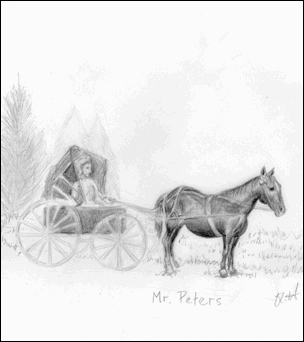
The loss of the horse on a small farm was a significant event, because there was no backup. The wagon, the plow, the harrow, the sled, the hayrack: nothing moved without horsepower. As tractors and trucks became available, the one-horse farmer had a major decision to make in the event of the loss of the horse. Maybe this was the time to go mechanical. The farmer didn’t really want to, but the teenaged daughters voted for a car and the teenaged sons voted for a small truck. Riding behind a horse was not their idea of a romantic event. Speed was becoming a necessity. City cousins who came for summer visits now rode in cars.
So the off-farm jobs were expanded and the harness was sold, when you could find someone who still kept a horse. The horse stall became a repository for cultch. The hayrack sat in the field and became a trellis for bindweed, and the plow and the harrow slowly rusted away. Without the horse to haul manure and hay in their seasons, the sale of the cow followed. Slowly, and for some sadly, the farm horse disappeared and the one-horse farm disappeared with it, and a mechanical vehicle took over the barn floor.
Mr. Peters died in late June of 1914 at the age of twenty-nine. That was a ripe old age for a horse, being approximately equal to eighty-seven human years. Eliza had been contemplating a replacement for some time but just couldn’t bring herself to a decision. Folks remarked on Mr. Peters’ continued stamina and it was true. On a home-ward voyage his slow trot was remarkable for an animal of his age. Charley remarked, more than once, that the horse probably owed this longevity to his unique parentage. Charley, of course, reminded the listener that it had been his idea for the mating that produced Mr. Peters.
For most of his life at the Cape farm, Mr. Peters had hauled eggs, twice weekly, to the train station. He had made fairly regular trips to the Sandy Point church, although Eliza sometimes rode there with Paul, or stayed at home if she felt her Christianity gauge still registered full from the previous week. Mr. Peters also made irregular trips to the Stubbs farm or the Shaw farm. His knowledge of a very small part of the world was quite complete and he could find his way home, unguided, from any of five or six points within a three-mile radius. It was true that he had slowed down considerably in his later years, but Eliza’s business had also slowed a bit and she wasn’t as anxious to get places as she had been in their earlier years of traveling together.
Mid July of the year Mr. Peters was twenty-seven was a turning point. There was a major heat wave simmering in the state of Maine. Mainers, like polar bears and penguins, don’t function well in hot weather, and the temperature forcibly struck down Mr. Peters. Eliza and Mr. Peters were returning from Prospect Ferry—or “the Ferry,” as local folks referred to the town. The temperature was ninety-five degrees; Eliza had checked it when they arrived at the Cape farm. She later made an entry in her diary with the added comment “this is a record level in my memory.” Mr. Peters was moving very slowly up the grade of the Hamlin Bridge Road, breathing in a labored manner and shiny with sweat. He made it to the barn, but as Eliza took off the last bit of harness, he sank to the floor with a most dramatic sigh. Eliza was alarmed—you can see how she might have been—and decided correctly that cold water was needed. She found two pails and carried water from the trough at the back of the barn, pouring water slowly over the horse’s head and back. This treatment helped, much to her relief. The heavy breathing subsided, and he lay easily with closed eyes. After her third trip she paused, turned one of the pails upside down and sat on it, observing the downed animal. She kept this position for several minutes and at last the old horse opened his eyes. With much blinking, he raised his head and shook it gently to rid himself of Eliza’s water treatment. Then slowly, very slowly, he positioned his front legs and pushed himself to a sitting position, a stance quite unbecoming to a horse. Then with great care and slowness he raised his rear end and stood on outstretched legs like a new colt.
Taking him by the halter, Eliza gently urged the old veteran to the pasture gate. He followed with awkward, halting steps and when he reached the soft earth of the pasture he collapsed again, although this time in a more controlled manner. He lay with his head up but with drooping eyelids. Eliza had filled the pail one more time, and she left it within reach of Mr. P’s muzzle, in case he felt the need of a cool drink.
That was the end of Mr. Peters’ career as a carriage horse. In the two years since his collapse, his only travel had been from barn to pasture. Eliza had harnessed him about two weeks after his “spell” but he had no strength and could hardly move the wagon across the barnyard. She had turned him at the road and re-entered the barn. He was unharnassed for the last time.
“Put him down,” Charley had advised. “You cahn’t afford t’feed him, he may live for another five ye-ahs.”
“Oh, I don’t think so, De-ah,” she had said after a long pause. “I’ll see what Doc Adams says.”
Dr. Adams had been summoned and gave pretty much the same advice. “Heat stroke, probably affected his brain, he’ll walk and eat, but he’ll be no good to you. I’ll take care of him if you like. I’ve got everything with me.”
“No I’m not quite ready for such a final verdict.”
Paul had come by. “I’ll do it for you, if you want it done by someone he knows. Just tell me if you decide t’do it.”
Eliza didn’t want “it” done. She realized that she would need some means of transport and that would mean two horses, but Mr. Peters had been a long-time friend. She had covered many miles and had many conversations with him. Buttercup had been a friend too, but cows are rather blank when it comes to weighty conversations, whereas horses look you in the eye and point their ears toward you to pick up the words. Besides, she hadn’t really traveled with Buttercup, unless you counted the annual trips to Charley Stubbs’ bull. On those occasions Buttercup was towed rather than being a genuine traveling companion. No, Mr. Peters had been a friend and a confidant, and he would have a home till the end.
However, with her one horse now an invalid, Eliza needed a means of transportation. Charley knew a man who had a horse. “Ozzie Jacobs ovah in Blanket Lane’s gut a little mare that’s hahf Morgan an’ hahf somethin else. She’s only five, jes gittin started. I think he’ll sell ’er. She ain’t quite heavy enough for him but she’d be a nice cart hoss. He needs somethin for yahdin logs.”
“I would appreciate yoah lookin into it f’me,” said Eliza. “Make shu-ah she’s clevah, I’m too old t’have a hoss that don’t mind well. Bein a man you can prob’ly strike a bettah deal than this old woman can.”
Horse-trading was a man’s game. It was not supposed to be honest. If you owned the horse it was defended to the end and no guilt was felt. If you were the buyer you looked carefully for the faults and magnified them. Eventually the price came to a point where both the buyer and the seller thought they had gained the advantage. Each would boast slyly to their friends for months afterward about how they had “come out on the top in that bargain.”
Charley said, “I’ll feel him out. She prob’ly won’t cost ya too much. Prices for hosses ain’t too good just now.” He looked at his shoes while delivering this information, as if he were somehow personally responsible for the depressed horse market.
“Oh, maybe prices ain’t jes what they have been but they’ll come back, I b’lieve. Fahms cahn’t do without hosses. It’s my luck that I’m the buyer jes now.”
“Tis yoah luck,” Charley agreed, “but I b’lieve that hosses is on the way out. Some folks right heah in Waldo County have made purchases of gasoline cahs an’ they say out west they’re usin them traction engines, call ’em ‘tractors’ for short. They use ’em t’plow an’ harrow an’ even t’plant.”
“Wey-ell, mebbe out wheah they got them big flat fields it’s workin but machines such as those will nevah become an item in our neck o’ the woods. No, De-ah, hosses are heah for a long time t’come, an’ I need me a new one.”
“Ayuh,” Charley said, giving up the argument.
Two days later Charley had “felt out” Ozzie Jacobs and reported to Eliza that the mare was available for twenty dollars and could be moved at any time.
“I think he was pretty tickled t’git rid of her.” Charley admitted. “Hosses ain’t movin like they use ta.” He slipped in that opinion to bait Eliza, but she either didn’t hear or didn’t feel inclined to continue their previous discussion. “Paul’s goin ovah tah Addie Liscombs’ tomorrow t’git fence posts. If you gut the cash, he could bring ’er home.”
“Wey-ell, hadn’t I ought t’see her first?” asked Eliza, puzzled.
“Oh, wey-ell, yey-es if yoah so inclined,” Charley sighed. “But I’m fairly certain she’ll please ya. She’s a mod’rate animal, she’s gut a real nice head, prob’ly from the Morgan side. I seen her move in the cart an’ I was quite taken. A few yeahs back an’ she’d been worth twice the price. I ain’t the greatest lovah of hosses myself but I gut an eye fer ‘em if I do hahfta say it.”
“Handsome is as handsome does,” said Eliza dubiously.
The deal was made, and Sadie—that was her name—arrived late on the next afternoon. She was tied to the back of the farm cart as Paul reined the team into the dooryard. She was in good shape, in fact just a little on the fat side. Her coat was seal-brown with black mane and tail. She had bright, prominent eyes and smallish ears that pointed toward Eliza as she approached the wagon.
“That’s my new transport, is it? Seems a little small. Charley said she was small but I kinda expected more than this.” She pursed her lips as she surveyed the animal.
“She would look small aftah Mistah Petahs, but she’s got a good reputation for work. Addies’s seen her in Ozzie’s rig an’ says she’s an easy mover an’ a willin animal.”
Eliza ran her hand down the mare’s back, checked her teeth and lifted each hoof to look for signs of possible problems. Sadie stood amiably for this examination.
“She comes with a money-back guarantee,” said Paul. “Ozzie said since you couldn’t get over to see her that if she wasn’t t’your likin you could send her back.”
Eliza didn’t answer for a minute. She took two steps back, placed her hands on her hips and ran her tongue around her mouth. Then she took a long look from head to rump and back from rump to head. “That was mighty nice of him,” she said at last. “Guess I ain’t hurt too bad for twenty dollahs.” And so Mr. Peters was replaced.
Paul smiled, dismounted from the wagon, untied Sadie’s halter rope, and handed Eliza her new purchase.
Sadie and Mr. Peters had taken to one another immediately. Poor Mr. Peters was really in no condition to resist a new pasture resident, and Sadie seemed to sense his infirmity. There had been no nipping or kicking. There was some exploratory sniffing and a little head tossing, but by the next day they were grazing shoulder to shoulder like a pair of old established teammates.
Now, two years later, Sadie was firmly fixed at the Cape farm, and Eliza’s twenty dollars was well repaid.
Although Eliza had expected Mr. Peters to expire in time, she became complacent as the days of his recovery extended to weeks, then months. Still, the end was a jolt, as it can be, even when anticipated.
Mr. Peters’ last day at the Cape farm was a beautiful one, weather-wise. It was late June. The pasture grass was sweet and lush. Buttercups and oxeye daisies bloomed along the fencerows and the iris bed at the back of the house provided shades of orange and purple. Barn swallows made long swooping passes back and forth across the fields to capture insects for their growing broods up in the barn rafters.
Eliza left early for the Ferry. It was a Tuesday, egg shipment day. Sadie trotted along smartly. What with the stop at the railway station, some errands in the village, an invitation to have dinner with Phoebe Pringle, and finally a stop at the Shaw farm, Eliza did not return to the Cape farm until nearly four o’clock. She unharnessed Sadie and led her to the pasture bars where they were usually greeted solemnly by Mr. Peters, but not today. Eliza’s mind was on the chores to be done, and she thought little of Mr. Peters’ absence. Only later, after the chores and her supper, it came to her that in passing back and forth between the house and the barn she had not seen the old horse.
She walked casually to the pasture bars. Neither horse was in sight, and she thought that a little queer. The horses often stood at the back of the barn, out of sight from the gate bars and the house. The barn provided afternoon shade during the warm part of the day but now, in the cool of the evening, there was no need for shade and the two animals should have been grazing together in sight. Eliza took down the bars and walked through the pasture to the rear of the barn. As she did so an air of misgiving seemed to come over her. Then as she rounded the barn corner the cause of her feeling became apparent. Mr. Peters lay silent and stiff, lying flat out, as a colt would, and Sadie stood nearby with lowered head, her nose pointed toward him.
Eliza approached the two and stood beside Sadie, who nuzzled her pocket for the carrot that was usually there. “Nothin tonight, De-ah,” she said softly. She took a handkerchief from her apron pocket, wiped her eyes, and then blew her nose quietly.
“You an’ I hahfta make another trip,” she said to the mare in a weak voice. She had Sadie in harness and was just about to leave for the Stubbs farm when she thought of poor Mr. Peters lying exposed in the pasture. She tied Sadie to the hitching post and went to look for a suitable shroud. She remembered an old piece of canvas sail in the shed. This she dragged to the spot where Mr. Peters lay and attempted to cover him. The canvas, however, was not quite large enough and a choice had to be made between either the top of his head or his hoofs showing. She chose the exposed hoofs as less personal, and then stood with her arms crossed on her chest surveying the sad scene before returning to Sadie.
She covered the distance to the Stubbs’ in about fifteen minutes, keeping Sadie at a smart trot. Charley and Paul were seated at the kitchen table finishing a late meal of cold beef and boiled potatoes. It looked pretty unappetizing. “The boys” had been on their own for five years now. Sabina had left this life in 1909, and soon after, Louisa had gone to care for an invalid sister in Brooks.
Paul was the cook and Charley, the housekeeper. Neither enjoyed their roles and as a result, the meals were generally dull and monotonous and the house was usually cluttered and dusty.
“Eliza, what brings you here this time in the evenin?” Paul asked, showing concern.
“It’s Mr. Peters,” she said sadly. “I just found him gone behind the barn. I was away all day or I might have been able to be of some help to him. But he’s gone now . . .” Her voice trailed off.
“I’m sorry. He was a useful animal.” Paul offered.
“Ayuh, good hoss,” added Charley, hoping that everyone might remember that it was he who’d arranged for the mating that brought Mr. Peters into the world. He rose from the table and added his dish to the large pile that was accumulating on the sink bench.
“You boys said once that pra’ps you could help me with the buryin,” she said hopefully. “I don’t want t’send him off t’the renderin works. I think he’d like t’go through eternity in his own shady spot behind the barn.”
“Tomorrow ain’t good,” Charley said apolo-getically. He leaned on the sink and used the nail of his little finger to dislodge a particle of meat from between two teeth. “We gut hay down at the Birch field that we cut this mornin an’ we can’t afford t’let it git wet. First cut ya know.”
Silence for a minute.
Paul spoke to Charley, “What about that new family at the Fogg place? They have a couple of good-sized boys who might be interested in some pocket money.”
Charley seemed dubious.
“I dunno. Need a pretty big hole for that hoss. Ya think they’d stick to it?
Family don’t seem too thrifty t’me, jes drivin by.”
The new family named Rogers had taken possession of the Fogg farm, the place next to the Stubbs farm along the Hamlin Bridge Road. The Foggs had been gone for fifteen years and three tenants had inhabited the place since then, however, the ownership had not changed. Some distant relative “from away” still owned the property and so it remained the “Fogg place.” Few repairs had been made to the buildings since the last Fogg passed away and it was a sore sight. The present tenants didn’t appear to be much more promising than the previous three.
“They wuz burned out of a place in East Dixmont,” Charley volunteered. “Heard that one time at the Ferry. They ain’t gut much t’start ovah with; one hoss, an’ two or three skinny cows. Prob’ly could use some money.”
“We could go by on our way t’haying in the morning.” Paul suggested. “We’ll stop in and send the boys along t’do the digging, then Chahley an’ I can come over aftah suppah an’ finish the job.”
“That sounds good t’me,” agreed Eliza. “Oh, that would be a great relief t’have him underground by tomorrow evenin.” It was nearly dark as she started for home. She had no side lamps, but the moon was out and Sadie knew the way. She heard a whip-poor-will call and it gave her a sad and lonesome feeling.
At nine the next morning, Eliza heard a soft knock at her door, and on opening it met the Rogers brothers.
“Hello,” she said brightly to put them at ease. “You must be my new workers?”
They looked at one another and the older one said seriously, “We’re heah t’dig a hole for a dead hoss.”
“Yey-es, De-ah, an’ I’m glad t’see ya, my name’s Miss Hamlin, what’s yors?”
The older boy was probably fourteen; he had a line of small black hairs just starting on his upper lip. “I’m Richard,” he said. The smaller one, who was about two years younger, said with a tentative smile, “I’m Robert.”
“Wey-ell I’m happy t’meet ya,” she said. “My old back can’t stand much bendin so I’m mighty glad t’have you boys t’help me.”
They were dressed in patched bib overalls and their shirts were obviously hand-me-downs. The material hung on their bony shoulders and the sleeves covered their hands. Having an extended sleeve proved to be an advantage for Robert since he seemed to have a chronic nose drip and the cuffs on his sleeves provided handy wipers. He accomplished this with a one-two motion: left sleeve, left nostril; right sleeve, right nostril.
Eliza ushered them in and directed them to sit at the kitchen table. “You boys had quite a walk from the other side of Ephrum. I’ve gut some milk an’ some new bakin for a little nourishment before you staht yoah job.”
They ate and drank without further urging and Eliza guessed that this was their first meal of the day. Six molasses cookies and a pitcher of milk disappeared quickly.
“Save room for lunch,”
she laughed. “I gut a nice fish chowdah an’ you’ll have tah help me eat it.”
“Yes, Ma-am,” they said in unison.
“Wey-ell let me show ya wheah we’re diggin’.” She led the way to the shed and collected an array of tools: a long-handled and a short-handled spade, a pickaxe, a crowbar, and an axe. As they walked to the pasture, each dragging one or more implements, she gave out instructions. “Now I know you boys are expert hole diggers but just let me remind ya tah use the bar an’ the pick t’loosen up the soil. It’ll make the shovelin a good deal easier. Be careful swingin the pick, make shu-ah the other one of ya is outta range. Only use the axe if ya come to a root. Don’t chop dirt an’ rocks. That’s my best axe. An’ watch out for yoah feet when yoah choppin.” She paused.
“Yes, Ma-am,” said Richard. Robert echoed, “Yes, Ma-am.”
With Buttercup 3rd and the sheep gone; only Sadie inhabited the pasture. Eliza had been thinking of Buttercup only yesterday when she found Mr. Peters. Buttercup had gone just about this time of the year. Coincidentally Buttercup and Sabina Stubbs had gone in the same week of June in 1909. Buttercup left first, on Tuesday it was. She had seemed fine on Monday and Eliza had not expected such a rapid departure. But there she was on Tuesday morning stretched out quite dead under a large apple tree that had been her favorite spot for resting and ruminating. Doc Adams had been summoned but couldn’t offer any good reason for her demise.
“Probably her heart,” he said in an offhand manner, “since she went rather suddenly and without any signs of pain.”
Eliza was glad that Buttercup had apparently not suffered and felt that she had done her best to offer the aging cow some relief in her declining years. Buttercup had not borne a calf for the past two years, having freshened her last at age fifteen. The American Jersey Cattle Society had awarded her a framed certificate for her lifetime production of twelve offspring. Not all her progeny were around at the time of the award, however. The daughters were, of course, being spread around Waldo County at various farms or as family cows, but only two of her sons were in evidence, as herd sires.
Sabina Stubbs, matriarch of Stubbs Farm, was also struck on Tuesday, as Buttercup had been, but Sabina lingered a little and left this life on Friday, almost reaching her ninety-first year.
“I’m very surprised she made it this far,” Dr. Wheeler had said. “She was pretty heavy and that made a great strain on her heart. I warned her many times over the years to cut back on her intake of butter and cream but it fell on deaf ears. Still, one can’t complain on reaching the age of ninety.”
The formal ceremony for Sabina was not until Wednesday of the next week in order to allow the news to be passed on to the Boston relatives, who then had to make travel plans. Charley had been a little worried that Sabina would not “keep” for five days, given the warm weather at that time. But Mr. Sparrow, the undertaker, was all confidence and there were no noticeable signs of deterioration at the calling hours.
Sabina had a home burial. She had not been a strong adherent of the faith. The Stubbs house overflowed with family, townspeople, and members of the Jersey Cattle Fraternity from throughout the state. Charley was forced into the role of host and spent a very uncomfortable three days until all of the visitors had departed. Sabina was buried in the Stubbs lot at Pilgrim’s Rest. She had picked her own spot in the family compound and had left careful instructions that she should not be too close to Uncle Adam. Her grave was marked with a large granite shaft carved with weeping willow trees and hovering angels.
Buttercup 3rd was picked up on Wednesday morning, the day after her departure, by Shorty Stockwell and taken to the rendering plant in Stockton. She had neither a formal ceremony nor a lasting memorial. There were no members from the Jersey Cattle Club, Eliza being the only mourner.
Mr. Peters had very kindly decided to die where the digging was easy. Eliza’s pasture was strewn with boulders, and in places the gravelly soil made digging difficult. But Mr. Peters had selected a clear spot near the barn where the soil was loamy and mercifully free of rocks. It was a place where he would often stand when resting.
Eliza watched the two young diggers as they stared at the canvas-covered mound that was the old horse. The hooves gave a very good clue as to what was under the cover. The flies had found Mr. Peters and there was a great deal of winged traffic, crawling in and out from under the canvas. Eliza collected four small rocks and placed them in a square about five feet apart near where Mr. Peters lay.
“That’s the size,” she said, “and about as deep as up to Robert’s chin.”
The two boys looked at the area and Richard looked Robert up and down mentally calculating the amount of dirt to be moved.
“Think you can do it?” she asked.
“Yes Ma-am,” they said in unison, but without much conviction.
Neither made any move to commence. Eliza thought perhaps Charley and Paul had overestimated the boys’ ability.
“If you boys cahn’t get it finished, that’s alright, I can get someone else t’help.”
“We can do it,” said Richard, a little more emphatically this time.
“Yup, we done one at our other place fer a dead cow,” said Robert as if to present their qualifications.
“Dig away then,” she said. “Come to the kitchen whenevah ya git dry.”
They made good on that invitation. Their trips to the house for water became so frequent that Eliza finally said to Richard. “Why don’t you take the pail and this dippah an’ that’ll save ya some steps?”
“Thanks, Miz Hamlin,” he said and plodded back to his work with the water slopping from the pail onto his leg and down into his battered shoe.
Two pails of water and many rests later the hole was finished. Eliza had peeked around the corner of the barn at one point to see how the work was progressing and found both boys stretched out full length on the cool, soft grass. She had smiled to herself and guessed that Charley and Paul would end up finishing this job.
So at noon sharp when they both appeared in the kitchen, she was pleasantly surprised. “How’s it comin?”
“All done,” Richard said with a hint of pride.
“All done?” she echoed, in a startled voice. “That’s just grand. You boys have done me a great service. Let’s go look.”
The three marched to the canvas mound. The hole was exactly the size that Eliza had laid out and Robert jumped in to prove the depth.
“Right up to my chin,” he said, doing the one-two wipe of his dripping nose.
“Let’s eat!” she announced. “You’ve done yoah duty for one day.”
Back in the kitchen she provided them with soap, warm water, and a towel and gave instructions on washing their hands and arms. When they were cleaned to her satisfaction she indicated where they should sit and then dished up three bowls of fish chowder. It was thick with cod, potatoes, and onions and had large yellow islands of melted butter floating on the surface. She passed each boy the bowl of soda crackers and they crumbled them into the chowder until the butter islands were obscured. They easily consumed two helpings each while Eliza ate one.
“Save room for the pie,” she cautioned.
Finally, filled with chowder, crackers, dill pickles, and custard pie, they pushed back their chairs.
“We’ll go harness my hoss and I’ll give you a ride home. Yoah feet are prob’ly kinda tired.”
They followed her to the barn and did their best to help with straps and buckles as Sadie was attached to the wagon. Eliza returned to the house, packed up two dozen eggs and a piece of cheese from the Shaw farm and the remainder of the molasses cookies. But as they were about to leave she exclaimed, “I almost forgot yoah wages!”
Another trip to the kitchen; all three went, marching in single file. Eliza opened a drawer in her buffet and removed a well-worn leather purse. This was her treasury. She handed each boy two quarters and their eyes became as large as the coins.
“Thank you!” they said in unison and Robert wiped his nose.
“Hold on a minute, I got a little gift for you,” she said looking at Robert. She stomped upstairs and returned with a large white handkerchief and presented it to him.
“Have a good blow, De-ah,” she suggested.
He did and the noise startled calico cat number three, who had been sleeping by the wood box. They laughed and Eliza said, “That should hold ya for awhile. Let’s be on our way; Sadie’s anxious.”
The trip around the mountain was a pleasant one. The day was a repeat of the two before and the sun was almost too warm as it shone on their heads and shoulders. The boys, stuffed with codfish chowder and now more acquainted with Eliza, were quite relaxed and they talked of many things. Well, actually Eliza talked—mostly ques-tions—and the boys supplied short answers. By the time the Fogg farm came into view, she knew more about the Rogers family than anyone in Prospect Ferry.
As she turned Sadie into the dooryard, she felt a disheartening cloud settle over her. The house and barn had gone unkept for fifteen or more years. Rooflines sagged, shingles were missing, and everything badly needed paint. Large amounts of time and money would be needed to bring these buildings back to their original condition. Eliza assumed correctly that the Rogers family had no money and very little time to spend on repairs. The boys jumped down from the wagon and headed for the house. Eliza followed after tying Sadie to a handy lilac bush.
Mrs. Rogers met her at the door. “You must be Miz Hamlin,” she said, her arms folded across her breast. “Come in. We ain’t too tidy just now, you’ll have t’take us as ya find us.” She was a thin, sharp-faced woman. Her hair was pulled back in a wispy bun and she wore an apron that needed a good washing. The sleeves on her faded housedress were rolled up to her elbows, showing her pale, bony arms.
“Glad t’meet a new neighbor,” Eliza smiled, all the while surveying the dirt and clutter of the kitchen.
“These are my kids,” said Mrs. Rogers with a little pride. “You already seen Richard an’ Robert an’ the next one’s Ronald.” She pointed to a boy of about ten years, another step down from Robert. “An’ these are the girls, Ruth, Rowena, an’ Rose.” The girls were another set of steps. They stood in a semicircle hoping for recognition from their first visitor.
“Lots of ‘R’ names,” said Eliza, surveying the brood and receiving a smile from each as she recalled their names in the order given. She was trying to imagine supplying three meals each day with the meager resources that appeared to be on hand in this house.
“Yey-es we named Richard an’ Robert aftah their gran’pas,” said Mrs. Rogers. “An’ then it seemed kinda natural t’keep goin ‘cause my husband’s Ralph an’ I’m Rosetta.”
“Wey-ell, that is a mouthful,” ventured Eliza. “Almost like two families you gut he-ah, three boys an’ three girls.”
“Yey-es an’ quite a gap between ‘em,” admitted Mrs. Rogers. “I was sick abed for about two ye-ahs aftah Ronnie come along an’ wasn’t up t’producin. When I gut started agin I had all girls. D’ya b’lieve it’s cause I didn’t have the strength I had befo‑ah?”
“I b’lieve God wanted ya t’have some kitchen help, De-ah,” Eliza said emphatically.
“Yey-es that’s a good thought,” and Mrs. Rogers laughed aloud, showing a gap in her lower jaw where a tooth was missing.
“Wey-ell I brought ya some eggs an’ a nice wedge of cheese,” said Eliza. “An’ we had a few molasses cookies left from our lunch, maybe two apiece.” She looked around at the eager faces. “I fed the boys some dinnah. Hope that was agreeable t’you. They certainly worked hahd this mornin.”
“Much appreciated,” said Mrs. Rogers. “Hope I can return the favor some day.”
Eliza doubted that Mrs. Rogers would ever make good on that hope.
“An we gut quatahs!” said Robert, showing his mother the two coins from his pocket.
“Wey-ell ain’t that nice,” beamed his mother.
Richard looked fiercely at his younger brother for divulging their wealth. Robert returned the coins to his pocket, oblivious to the fact that Mr. Rogers would probably use them for groceries or beer on his next trip to the Ferry.
“I’ve gut t’be movin along,” said Eliza. “Must stop at the Stubbs’ place an’ tell the boys that the hole is ready. They’re goin t’move my ole hoss in an’ covah him for me.”
“Quite a hardship when ya lose a hoss,” said Mrs. Rogers solemnly. “We lost one of our team about four months ago. Winter was too hahd on him, I guess. Ain’t gut but one now an’ it’s awful hahd fahmin with hahf a team.” Her voice dropped.
“Maybe yoah husband can borrow a team from the Stubbs for the heavy work. They gut two teams just now.” Eliza ventured and hoped, as she said it, she hadn’t over-stepped her bounds in offering one of Charley’s teams.
I’ll speak t’Mista Rogers about that idea,” said Mrs. Rogers, brightening a little.
Eliza welcomed the sunshine as she left the crowded kitchen. Sadie had broken a few branches on the lilac bush in an attempt to reach the grass at the base, but Eliza ignored the damage. It seemed quite minor compared to the other repairs that faced this family.
Sadie trotted on and swung easily into the Stubbs Farm lane without any sign of fatigue. Eliza was always pleased with how Sadie performed; the horse seemed to enjoy being on the move. Eliza hesitated to think ill of Mr. Peters, he still being above ground, but there had been times, especially heading away from home, when his rate of speed had been less than optimum.
Finding no one in the barn at the Stubbs’ to accept the news of the prepared grave, she let herself into the kitchen to find a pencil and paper for a note. Housekeeping had deteriorated since the demise of Sabina and departure of Louisa and the kitchen bore quiet witness to their absence. Eliza rummaged through a pile of old papers and catalogs, finally finding a used envelope. With a stub of a pencil that she found on the windowsill, she wrote carefully, “Hole is ready. Come when you can. Liza.” She took a mug from the cupboard, set it on the kitchen table and propped the envelope against the mug. Then she looked about the room. The pile of dirty dishes on the sink bench was a little higher than it had been the night before with the addition of breakfast items.
“Well,” she thought to herself, “one good turn deserves another.” She stoked the fire in the summer kitchen, filled a large teakettle with water from the kitchen pump and put the kettle on to heat. She found the dishpan under the sink and when the water was hot she started on the small mountain of dishes.
On their return to the Cape farm, Eliza un-harnessed Sadie and turned her into the pasture. She hoped the boys would arrive soon. The thought of Sadie grazing in the presence of the deceased Mr. Peters was a bit unsettling to her.
Charley and Paul didn’t arrive until nearly seven. Eliza had almost given up hope of having the deed done on this day. When they finally arrived, no time was wasted with talk as they went straight to their task. After more than an hour, when the light was failing, they still hadn’t come to the kitchen. Eliza lit a lantern and made her way, reluctantly, to the pasture. As she walked, the lantern swayed and made swinging beams of light across the pasture grass. She came and stood near the mound of fresh earth and set the lantern on the ground.
Charley said, “Just finishing up. Them boys didn’t allow for Mr. P.’s long neck an’ we had t’do some enlargin.”
“Oh, that’s too bad. You boys been workin all day. I didn’t suppose you’d hahfta dig. They were my measurements. The boys done their part.”
“No harm,” Paul said quietly. “He’s well tucked in now and we laid on a few flat rocks so nothing can dig him out.”
“Oh, that was a good idea,” she said appre-ciatively. “Was it much of a job gettin him in?”
“No, warn’t too bad,” Charley said, a little breathlessly. “But he was startin t’ripen a little. Hot weather, ya know.”
Eliza had brought a rake and now gathered up the loose soil around the mound. As she made little piles, the men shoveled them on.
“I guess that’s about it,” Charley said hopefully as he threw on a last shovelful of dirt.
The three stood in a semicircle around the grave. Sadie ambled over as if she understood the finality of the moment. Calico cat number three wandered up and sat on her haunches. She had been out hunting farther up the hill and couldn’t understand what humans were doing in her territory at this time of night. The darkness was al-most complete and lightening bugs flashed in the pasture grass. From near the top of Ephraim the whip-poor-will called. It startled the three people.
“He was an awful good ole hoss,” said Eliza sadly. “Mebbe there wuz others fastah, but except for that time in ought-two when he fell an’ hurt his knee, he nevah refused to work.”
“Ayuh,” said Charley.
Paul said, “Yup.”
With that simple eulogy the committal service was over and they walked slowly to the house, followed silently by the cat.
Eliza lit the lamps and said, “Let me fix you boys some nourishment.”
“That would be appreciated. We come directly heah without suppah,” Charhly said bluntly. “Wey-ell, we did stop for cheese an’ bread,” he added.
“We saw someone had cleaned up our kitchen,” said Paul. “Much appreciated.”
“T'was nothin’. You boys done me a great favor today. Now sit! My land, no suppah! I gut some fish chowder left from dinnah, although I must say those Rogers boys did their best t’finish it. It’ll just take a minute t’warm it. I think there’s still enough fire in the summah kitchen.” Eliza bustled about to serve them a meal. While the chowder warmed she set out pickles, crackers, new bread, a mound of yellow butter, and the remainder of the custard pie. Eliza sat with them, her elbows on the table and her chin in her hands, while “the boys” ate. The three were silent. They may have been reflecting on the life of Mr. Peters and even on their own mortality. Now Sadie had the pasture to herself.
* * *
Mr. P. buried today—sunny. He was a good horse. Met the Rogers
family at the Fogg place.
Chapter 6

|
S |
ince 1874 Prospect Ferry’s South Branch Grange had stood on the corner of the Hamlin Bridge Road and the Old Bangor Road, about where the war memorial stands today. Each year the Grange held a fair on the first Saturday after the first day of September, as a way to showcase the advancements in agriculture and homemaking that were taking place in the community of Prospect Ferry.
This year the day started, as usual, with a parade. It was a short parade, but it was colorful. It formed at the intersection of the Bangor Road and the Muskrat Farm Road, marched past the cemetery, turned the corner at the Grange, and disbanded in Eldon Murch’s field, about a total of a half mile.
The parade never varied much. There would be youngsters walking in costume, some dressed as clowns, some as farmers—that costume was easy but not too popular—and some as royalty with cardboard crowns and bedspreads as robes. There were generally one or two homemade floats, a farm wagon decorated with paper streamers and pulled by a team of horses or oxen, and always a couple of baby buggies with crepe paper wound in and out through their spokes. There were usually a few teenagers dressed as cowboys, cowgirls, or Indians, riding either the family carriage horse or a farm horse. Today they seemed to have called a truce since the cowboys and cowgirls were intermingled with Indian braves and maidens, all talking and smiling together.
For a few years the parade had featured the Batchelder family’s goat cart. One of the older boys would lead the goat while one of the younger sisters would ride in the cart dressed as a southern belle, complete with sun bonnet, ruffled dress, and pink parasol. The cart had ceased to appear when the youngest sister became too self-conscious to be seen in a goat cart.
The best entry for several years running had been a float organized by Ernest Miller. Mr. Miller farmed with mules. Everyone thought this a little strange: few could see any advantages to them over horses. But Mr. Miller liked mules and so they were grudgingly accepted by his farmer peers. Mr. Henry Wallace had a stage coach, a relic left over from the days when the stage actually ran between Bangor and Belfast. The vehicle had been lovingly maintained by Mr. Wallace and always drew high compliments when seen in public. The mules and the stage were made for each other. Ernest Miller would dress as a colonial coach-man—tan waistcoat and vest, shiny leather boots, white wig, and black face. Mr. and Mrs. Wallace rode inside in full costume, she in a pale purple hoop skirt and a beehive wig, and he in black knickers, buckle shoes, and curls. They were always allowed to be at the rear of the parade and as they arrived in front of the Grange Hall, Mr. Miller would climb down from his seat and very graciously open the door of the stage to assist Mr. and Mrs. Wallace out of the carriage. Mr. Wallace would then offer his arm to Mrs. Wallace and they would proceed slowly and sedately to the Hall, nodding and smiling to their admirers. Miller and Wallace always won the parade prize of five dollars.
The Grange movement had begun about 1867 to promote and advance the farmer’s interest. Known officially as The National Grange of the Order of Patrons of Husbandry, one prominent focus of the early Grange was to curb the railroad trusts, as well as to encourage cooperative buying and selling by farmers on a large scale. An unusual feature, for the time, was the fact that women were admitted on an equal footing with men. The Pine Tree State was an early participant in the Grange movement and the first Maine town to organize a chapter was Hampden, in 1873.
The year was now 1924, and the South Branch Grange was celebrating its golden anniversary. The good brothers and sisters of the South Branch Grange were determined that this would be a lavish affair: they hired the Belfast Cornet Band, all eleven members. In addition to participating in the parade, the band played in the hall throughout the day whenever there was a lull in the other organized activities. Along with splurging on the band, the Grange raised premiums by twenty percent for the ribbon-winning entries of classes such as “Best Blue Hubbard Squash,” “Best Pair of Spring Chickens,” “Best Tatted Handkerchief”, “Best Matched Pair of Yearling Steers” and so on. The entries poured in.
The crowning touch of this largess was the Breeders Cup Challenge class. A committee of three prominent farmers had chosen this pompous-sounding title from some southern horse race that one of them had read about, but the membership was not worried about plagiarism and thought it a fine addition to the Grange offerings.
The idea behind this class was that the best breeder of each species of farm animals being kept within the district would be chosen. The some-what subjective selection process was bound to cause friction among farmers when the final choices were made, but in the end most of them either accepted the decisions or ignored the whole idea. The fact that the Belfast Republican Journal gave this imaginative competition a half-page spread on page two went a long way in bolstering the enthusiasm of the farming community.
There was to be one flock or herd each of horses, cattle, sheep, swine, and poultry chosen from the many such flocks and herds within the reaches of the South Branch society. The choice of each of these farms would be in the hands of a committee dubbed the Blood Stock Selection Committee. It was an imposing name and an imposing task, which the committee members took very seriously. In fact, the Grange had badges made up for each committee member in order that they might be easily recognized about town. The badges also served as advertisement for this unique class. The fair would still hold its regular competition for all species but only by invitation could one compete for the Breeders Cup.
The Breeders Cup final selection for horses was a simple one. Only James Gelding had an operation that came close to what the committee had in mind. Oh yes, several farmers had a registered mare or maybe two, and a few even kept a stallion for neighborhood use, but horses were on a downhill slide and few farmers could find any profit in a breeding operation. But Mr. Gelding would not believe that the horse could be replaced with the tractor. His farming operations had been geared to horses for forty-five years and he saw no reason to make any changes. His current herd consisted of eight registered Percheron mares and two stallions, and he usually had three or four young animals on the place.
The choice of a swine breeder was equally uncomplicated. Chester White kept ten to twelve Hampshire sows and three to four boars at any time, and raised eighty to ninety piglets each season. No one else came close to what could charitably be called a commercial piggery. The odor from the White piggery for nearly a half mile coming and going was also a testament to the size of the venture.
The sheep breeder proved to be the most challenging choice for the committee. There were several well-known breeders for this species. Sheep numbers were declining in Maine, but wool was still a major commodity and good stock had value. Many pitched meetings were held in the basement of the Grange Hall before a winner was selected. The committee made on-site inspections of the three finalists in order to have firsthand knowledge of each operation. One of the finalists even sent a delegate to the committee delibera-tions to speak on his behalf. The Grangers had not envisioned the level of emotion they would uncork in these seemingly placid Mainers. Finally, it was Horace Ramsbottom who was chosen as the ovine breeder. He kept Southdowns. Following the selection of Mr. Ramsbottom, the two other farmers who had been in the final running refused to speak to the winner for several months. But eventually they mellowed and life went on.
There were several eligible cattle farmers, and while the meetings were long and labored, the eventual choice was Joshua Taurus, who owned a fine herd of Milking Shorthorns. Most everyone was pleased with that choice.
The fowl representative was chosen in a very peaceful manner. Apart from Eliza, there were only two people within the Grange’s reach that could be called commercial operations. Tom Cornish had a poultry meat operation just over the line into Stockton Springs, but he was still considered eligible. However, after one of the judges toured Mr. Cornish’s farm and found the level of hygiene to be at rock bottom, well, Tom was quietly removed from the running. Miss Bertha Canard kept a large flock of ducks down on Half-Moon Pond, and although she raised a few hundred birds each year she was considered a “reproducer” in the sense that she did little in terms of genetic improvement. She penned fifty females and eight males together in the spring and “let nature take its course,” according to the committee report. Eliza won the nod.
Eliza was somewhat intimidated at being the prime example of poultry breeding, as well as the only woman invited to appear in this august display. But, as with other such occasions, she turned the invitation over in her head for three or four days, talked about it with her sister Hannah and brother-in-law Thomas, and eventually replied to the Grange Committee in the affirmative.
Eliza arrived at about seven-thirty in the morning on fair day and drove her carriage to the tent identified with a large banner reading “The Breeders Cup Challenge.” Tying Sadie to a tent stake, she entered the Breeders Cup sanctum and surveyed her assigned pens. Space was assigned in the usual order: by size, with horses first, then cattle, sheep, hogs, and finally, poultry. As expected, she had the smallest space at the back of the tent, but no matter, she would display.
The Grange Hall itself was taken up with a variety of functions on this day. The stage at one end would serve as the platform for the Belfast Cornet Band, the Baby Show, and the Talent Show. Arranged around the perimeter of the hall were the exhibitions. On long tables covered with white cloths were arranged “the fruits of the harvest”: plates of potatoes, pears, plums, apples of all sorts, ears of sweet corn, squashes of many shapes and colors, and of course, beans—mottled, spotted, large, and small. There were cheeses, pounds of butter, and jars of heavy cream. These sorts of classes were mainly for the male com-petitors. The ladies brought jars of jam and jelly, sweet pickles, sour pickles, dill pickles, mince meat, fruit pies, cakes, and muffins. The tables were covered with produce, preserves, and baked goods, and some ladies were a little upset when the name cards became disarranged. Thankfully Lydia Pinkham was in charge of the ladies’ affairs, and she took right over and had everyone functioning normally in a short period of time.
Then of course there was the fancy work: hooked rugs, quilts, tatted pieces, crocheted pieces, and embroidery. The way the women had arranged these things looked really pretty.
Outside on the Grange Hall grounds were pitched three good-sized tents that had been rented from an outfit in Stockton Springs. Generally the fair would not need this space, but this year with all of the publicity and increased premiums, space was much in demand. The tents were circular in shape with blue and white pie-slice patterns on their roofs. One tent was for food vendors; one was for poultry, rabbits, and other assorted small animals; and one was for the contestants in the Breeders Cup Challenge. The “ordinary” livestock—cattle and horses—were tied outside to two long lines of fences beneath a row of maple trees that provided shade in warm weather and questionable protection in case of rain. Some pens for sheep and swine were also set up along the line of trees.
A few smaller camping-style tents were arranged haphazardly about. One held a game of chance, one sold cheap trinkets, and one held Madame Koritska.
Madame Koritska was a teller of fortunes. She was fairly well known at the larger fairs such as Bangor and Waterville, but she had never graced such a modest event as the South Branch Grange Fair. She was a large woman, very large. Her dress may once have been quite grand, made of flowered silk with a great red sash, but time and dusty midways had taken their toll and now the dress looked rather rumpled and tired. Her head was covered with a gauzy veil. It had a few tears in it that you wouldn’t notice unless you looked carefully. From her ear lobes hung large gold loops. She completed her outfit with several gold bracelets on each arm that made pleasant jangling noises when she moved. Not many in Prospect ferry had ever seen or heard of Madame Koritska.
She was attended by two very beautiful tan-skinned young ladies, probably daughters, and two very muscular young men with black bristly mustaches, probably sons, or nephews. The young men spent the day sitting cross-legged on either side of the door to Madame Koritska’s tent, just to be sure that no one took advantage of this venerable lady. They each wore a small turban and a vest, but no shirt, and sat quietly with their hairy arms crossed looking very much like two life-sized Buddhas.
This exotic party had arrived in a brightly painted caravan pulled by a brown and white spotted draft horse. Where they had arrived from no one seemed to know. They were not there at bedtime on Friday night when the last of the workers left for home, but they were there at six-thirty Saturday morning when Roscoe Dwinel, the fair secretary, arrived. There was a brief hesitancy on Roscoe’s part to allow the Madame to park on the grounds, but when she produced a two dollar and fifty cent gold piece from the folds of her flowered dress, well, Roscoe thought it would be “okay.” Jessie Colson thought he had seen them on the Portland waterfront just the week before but somebody else claimed that they lived on Hancock Street in Bangor. Emma Batchelder said, “Gypsies,” as soon as she saw them and the word spread around the grounds. Whoever they were and wherever they had arrived from, they added a fine touch of mystery and color to the fair.
Mothers whispered instructions to their young children to not go near “that lady!” The teenaged boys found various reasons to pass the tent of “that lady” and ogle her charming dark-eyed daughters. These young ladies would step forward in turn, seemingly very shy, and say in a rather seductive voice, “Vould you like to know zee future?” Then the daughter who had spoken would lead the young lad between the hairy-armed Buddhas into the tent, whereupon the young man would drop a few coins into the outstretched hand of Madame Koritska, who would then seat herself on a large padded ottoman decorated with sequins and colored beads. The young man and the young lady would share an overstuffed pillow, and the young lady would sit very close to the young man, knees touching. Madame Koritska would produce a dog-eared pack of Tarot cards and tell the young man about his future. By the end of the afternoon nearly every male in Prospect Ferry between the ages of twelve and eighteen knew his future.
When the young ladies could find no young men to lure into Madame Koritska’s tent, they would attempt to sell bracelets and bits of ribbon to any passing Prospect Ferry ladies. When the day ended Madame Koritska had more than recouped her two-dollar-and-fifty-cent ground rental.
Only three people complained of missing items when the day was over. Two of the people later found their items while unpacking at home but neglected to report their discoveries. Since they were the only people on the grounds that looked “different,” a small cloud of suspicion hung over the reputation of Madame Koritska and her family.
Another of the smaller tents advertised Professor Smallwood’s Collection of Natural Wonders. Professor Smallwood was a thin little man wearing a dark suit with creased pants, a clean white shirt—very tidy—and a natty straw hat. He held a large bamboo cane which he used to punctuate his spiel. “Boys and girls, ladies and gentlemen, ten cents will allow you to view one of the most exotic collections of natural wonders ever to be displayed in your lovely town. These marvels of the natural world have been collected at great expense from the far corners of the globe and this appearance in your fair town . . .” and here he hesitated and whispered something to a bored-looking woman sitting at the tent’s opening, whereupon she whispered back and he continued, “of Prospect Ferry will be our only stop in your beautiful state.”
The exhibits inside the tent were somewhat less than marvels, but to the youngsters of Prospect Ferry the charge of ten cents seemed a minor payment for being allowed to view the extent of Mr. Smallwood’s collection.
The tent was small, ten feet by twelve feet, and allowing for the sloping canvas, the interior space in which an adult could stand full height was somewhat limited. But for the children the size and the space were perfect. They saw a stuffed squirrel clinging to a piece of sawed-off tree stump. One of the squirrel’s eyes had been damaged a bit from all of the packing and unpacking it had endured, and as he peered around the tree trunk he seemed to be winking. At least to the children it seemed that way. Professor Smallwood recognized the value in this bit of imperfection and hesitated to repair it.
One object that drew gasps from its viewers was a two-headed calf, stuffed and mounted on an oak platform. Part-way through the day young Ellis Whitcomb drew interest to the calf when he announced to all assembled in the tent that “my Grampie had one of them things borned lahst spring and he took it behind his bahn an’ hit it in the head with a cleavah.”
“Did he hahfta hit both heads?” asked one young lad.
A little girl innocently said, “And then whut did he do with it?”
“Buried it in the dung pile!” replied Ellis.
The disclosure that something just like this rare specimen had been born within their own town, and dispatched in such a foul manner, left everyone speechless. For a moment the people in the tent were all very still, reflecting on the supposed event behind Grandfather Ellis’s barn.
Other exhibits in Professor Smallwood’s col-lection were not quite as provocative as the two-headed calf. A wire cage held several large brown and black cockroaches, which caused most young ladies to draw back with little squeals. There was a live duck that had what appeared to be a third leg growing from its left wing. No one was too impressed with the duck. There were jars of sea creatures—octopi, star fish, sea cucumbers, jelly fish and the like, in a pickling brine—and brightly colored shells from tropical oceans, including a giant clam that young Rodney Pinkham declared was “the sort of thing that ate my uncle.”
Most of his friends disbelieved this story, but Rodney offered to go and bring his father to back up this claim.
“Okay, go get ‘im,”
challenged Freddie Olmstead.
Rodney went off in search of his father, but the crowd soon lost interest and drifted to other attractions. Freddie stayed by the giant clam longest of all and tried to imagine how it would feel to be eaten by such a tame-looking creature.
Immediately at ten o’clock the Baby Show was scheduled to take place in the hall. There would be two categories: newborn to eighteen months and eighteen months to three years. Each age category would have three classes: the longest baby, the fattest baby, and the cutest baby. Classes one and two were pretty empirical—babies were measured (with a carpenter’s tape) for overall length; and fatness, well, that was fairly easy to observe. But cuteness—now that was a trait no one wanted to judge. Since there were no hard and fast rules, this class was fraught with danger. One of Eliza’s nieces was planning to enter her youngest offspring, sixteen-month-old Lydia, in the cutest-baby class.
The judges this year, and every year within recent memory, were three people whose integrity was never in doubt. Miss Martha Cabot-Lodge, of the Boston Cabot-Lodges, was considered the lead judge. Her family had summered at Sandy Point since about 1850, a record for summer people in this area. No one could clearly remember how Miss Cabot-Lodge had become a judge, but she took the job very seriously. She purposely stayed on at Sandy Point after Labor Day, when all the other summer folk had returned to their respective city homes, just so she could attend the Grange Fair and judge the Baby Show. She did not tarry after the judging was completed. Her bags were packed and she would be on the Boston boat tomorrow morning at eight-thirty. There was no need to stay around for the Monday morning reactions to her decisions.
The second judge was Mr. Beasley, who was the district superintendent of schools. Who else would know better how to pick a cute baby than a school official? Poor Mr. Beasley hated the job, but every year he was asked and every year he accepted, with trepidation. Often a mother would stop him at the fair or in the general store or at school and say, “Look heah, Mr. Beasley, this is my little Harry that you passed ovah lahst ye-ah at the fay-ah. Now ain’t he come on nice? I think if theah was a class of fo-ah ye-ah olds he’d stand a pretty good chance. Whut d’ ya think?”
Mr. Beasley would look carefully at the proffered Harry and say with great truthfulness, “I can see a change from last ye-ah. Whut a shame there’s no class fah his age group.” The mother would strut off beaming and Mr. Beasley would slip away, thankful that there was no class for four-year-olds.
The final judge was Phoebe Pringle, the church organist. Phoebe never missed a Sunday at church, but what she did the remainder of the week was a mystery to most folks. She had only herself to care for, and that job seemed to consume her entire day. She lived on a small trust fund left by her father and had never worked outside her home, except to play the church organ. No one seemed to know how she became a baby expert, but then no one questioned her judgment, and she was a fixture. If there was any controversy she would always say in a sweet, innocent voice, “Oh, I’m just the third wheel on that committee. Just the record keepah.” In fact she was usually the tie-breaker, since Mr. Beasley and Miss Cabot-Lodge could seldom agree on cuteness. Lucky Phoebe was usually let off from any close questioning by unsuccessful mothers.
The time was at hand for the baby classes. A row of folding chairs was assembled on the stage and the excited mothers took their places, each holding their precious cargo. The babies looked wide-eyed and questioning from their vantage point above the crowd; one started to wail but her mother quickly popped a pacifier in her mouth and that ended that. The first class went pretty smoothly. There were only five contestants in the newborn to eighteen months class. Eliza’s grandniece was one of them. The longest baby was a straightforward decision: thirty-two inches when they stretched him out. The fattest took a little longer. Three of the younger ones were rolling in little pink rings of flesh down their arms and legs. But one, who was especially plump, was picked, and the crowd agreed and applauded politely.
Then it was time to pick the cutest one. A tough choice—there were three that the judges looked over closely. After a long and apparently serious discussion between Miss Cabot-Lodge and Mr. Beasley, a choice was made. It was Lydia, Eliza’s grandniece, and Eliza was at ringside, sitting with Hannah, to observe the ribbon presentation. Although men did not usually watch the Baby Show, Lydia’s father had slipped into the hall just in time to see the young lass win first place for cuteness. He went back to the horse-pulling, grinning from ear to ear.
Phoebe Pringle, always the peacemaker, spoke quietly to the other four mothers, “Now, I’m only the third wheel on this committee,” she said, “so I don’t rilly carry a strong opinion but I think they’re all just little dahlins. I just wish we could give ’em all first prizes.” This bit of inside information from one of the judges seemed to help, and the losers departed in a relatively friendly mood.
But the class for the older babies did not end as well. The longest and the fattest were disposed of with ease. And the prize for the cutest was really an easy choice, or so it appeared from ringside. Little Miss Frieda King, two years old, had sparkling blue eyes, ringlets of blond hair, and a happy smile. She was the poster child of cute babies and outshone all the other contestants. The judges made quick work of their decision. Miss Cabot-Lodge stepped up to present Mrs. King with a large purple rosette. Seated beside Mrs. King was Mrs. Parker Preble the second. Mrs. Parker Preble the second was married to one of the Portland Prebles and took great pride in the fact that her first-born had been a male to help carry on the Preble line. This branch of the Portland Preble family comprised major share holders in the Frankfort Granite Works and lived in Prospect Ferry. Young Parker Preble the third had a receding lower jaw, a long straight nose, and eyes that were too small and set too close to his nose. If he had some hair, that might have helped camouflage his rather large ears, but the small amount of hair that he did have was wispy and a sort of mouse-brown color. In this class of seven babies he was easily dead last in terms of beauty. In another twenty years he would probably be the wealthiest and most influential of all, but that was of no help today.
Beauty is in the eye of the beholder, and Mrs. Parker Preble the second thought young Parker the third deserved the rosette. She was seated beside Mrs. King and when Miss Cabot-Lodge stepped up to present the prize to Mrs. King, Mrs. Preble thought that she was being handed the rosette. She was so sure, that as Miss Cabot-Lodge held out the rosette to Mrs. King, Mrs. Preble’s hand automatically opened and came forward. Everyone in the audience saw the motion; there were even a few half-stifled gasps from the ladies in the front row. But Miss Cabot-Lodge’s hand continued on to Mrs. King, who accepted the prize with a shy smile and a gracious nod of her head.
Mrs. Parker Preble was upset—no, more than upset, devastated! She clutched young Parker the third with one arm and put her face in her free hand and sobbed until her shoulders shook. It was a very discomfiting scene. Mr. Beasley was flustered, “He’s really a nice little boy, Mrs. Preble,” he stammered, “very healthy-looking, very alert. It’s just that we had only one rosette . . . Phoebe Pringle was on her knees before Mrs. Preble. “I’m only the third wheel, De-ah, but I can tell ya that you have a dahlin boy theah. He has some fine bone structure and I know when he fleshes up a bit he’ll be as handsome as his parents.” These comments did not seem to comfort Mrs. Parker Preble the second.
At this point Mrs. Parker Preble the first, with an authoritative air, mounted the stage from the audience and grabbed young Parker the third so that Mrs. Parker Preble the second could have both hands free for more sobbing and some nose-blowing. Mrs. Parker Preble the first looked very sternly at Miss Cabot-Lodge, as if to cower her into reversing this decision. Miss Cabot-Lodge was not one to cower and glared back at Mrs. Parker Preble the first with a quick snort through her Bostonian nose. Then Miss Cabot-Lodge presented her arm to Mr. Beasley and they descended the steps together, showing a certain unanimity in their decision. They were followed quietly by Phoebe Pringle, the third wheel. That ended the Baby Show, and most people thought it had been well worth their time.
Following the Baby Show, the Belfast Cornet Band retook the stage and played several rousing marches and a couple of time-tested hymns. The crowd was very appreciative and the applause was genuine.
The Talent Show was scheduled for one o’clock. No registration was necessary, so there was no printed program, but most folks knew what to expect. Young Harry Colson from the Colson Stream Road played Sweet Georgia Brown and Tea for Two on his accordion. He was pretty good. Everyone knew Harry and they clapped really loudly for him. Margaret Macomber did a tap dance, but part way through her routine one of the taps flew off one of her shoes, and that kind of detracted from the rest of her performance. A woman had come over from Bucksport—no one seemed to know her, and some questioned whether she should be allowed to perform. But charity prevailed; she was allowed to take the stage and it turned out that she was an excellent singer. She performed Yes Sir! That’s My Baby and Oh, How I Miss You Tonight. The applause was unexpectedly enthusiastic, given that she was not a local. The final act was by Jacque Cheval, who was originally a Canadian from New Brunswick, but he’d been in Prospect Ferry long enough that most overlooked his origins. He fancied himself to be a magician, but his act was a letdown after the singer from Bucksport. His props were rather old and worn and some of his tricks didn’t come off as planned. At one point he tripped on the long cape that he was wearing and nearly fell off the stage. There were a few snickers from the young people. The final applause was not too generous.
The woman from Bucksport won first place and Harry Colson came in second. Some of the women in the audience seemed to begrudge the attractive Bucksport singer her first-place award, but most of the men were quietly pleased.
Eliza, having arrived in good time that morning, had set up her exhibit in the tent designated for the Breeders Cup Challenge. She had brought with her several of her better-looking Rhode Island Reds, caged individually to prevent any fighting between the males. She had created several attractive hand-lettered signs explaining the origin of the Rhode Island Red breed, as well as posters giving statistics on typical body weights and egg numbers. She had hand-picked and hand-washed four dozen eggs and displayed them on a bed of yellow straw in a large wicker basket. To show the finished product, she had dressed two very plump capons, which had been created earlier with the expert operating hand of Henry Toole. Henry could whip out those little bean-shaped testicles at the rate of forty-five birds an hour. The operation required both a sharp eye and a steady hand—Henry had both! Eliza had arranged the two birds on a bed of white butcher paper in a round cheese box with a few sprigs of green mint around the perimeter. Finally, she had a large white-painted board on which she’d pasted several “testimonials,” or letters from satisfied customers. Around this board were hung some of her most recent ribbons from local fairs as well as from the Maine State Poultry Show. She received several compliments for the completeness and the informative nature of her display.
Two prizes were to be awarded as part of the Breeders Cup Challenge. The first, and in the eyes of most folks, the most prestigious, was a large trophy and a cash award of one hundred dollars based on the appearance of the animals and their uniformity according to the breed standard. The second prize was more practical: a framed certificate and a cash award of fifty dollars for the farmer who could turn the animal’s appearance into a profitable business. The judging included not only appraisals of the animals, but interviews to determine each owner’s business plan and level of knowledge of the larger picture.
There were three judges for these awards—an unusual amount of authority for such a small fair, but the Breeders Cup Challenge class had drawn a good deal of regional attention. The chair of the judging committee was Professor Linus Spaulding from the College of Agriculture at Orono. His interests lay with dairy cattle, and Josh Taurus, the farmer chosen to represent the cattle breeders, was quietly pleased with this selection. The other two judges were locals, but each was a talented breeder in his own right. Mr. Phineas J. George was a retired sea captain who also ran a successful general farm in Blanket Lane. His interests were with draft horses. Mr. Gelding, the breeder of Percherons, was happy to have Mr. George on the committee. The third member of this gold-plated group was Harry T. Banks, a breeder of Dorset sheep who also kept a few Berkshire hogs. This choice fit well with Mr. Ramsbottom and Mr. White.
Thus, four of the five contestants believed they had a sympathetic ear among the judges. Only Eliza was left without a champion, and some of her friends pointed out this fact a few times until her courage had started to wane. The South Branch Grange had invited Mr. Orin J. Smith, master of the State Grange, to award the prizes for this competition. Eliza had long been a faithful Granger and a prize handed down by the state master would be a thing to covert. So she had plucked up her courage and shouldered on.
At four o’clock the awards for the Breeders Cup Challenge were to be announced. Eliza was nervous. This award, should it be hers, would improve her status in the eyes of her local peers. The keeping of chickens as a business was still looked down on by some, but Eliza knew the financial rewards that she had enjoyed over the years and made no excuses for her occupation. As a single woman she had maintained an active, working farm and the conditions of her buildings and pastures were equal to any in Prospect Ferry.
The judging started at
three o’clock. The contes-tants were expected to be standing by their animals.
The judges looked over the beasts (or birds as the case may be), they felt legs
and loins and shoulders. They spoke long and hard with each contestant
regarding the financial aspects of the operation.
Mr. Gelding knew the pedigrees of his horses for four generations, but he was a little unsure about the cost to feed one for one year, and he hemmed and hawed about the return from the sale of a weanling colt. The judges scribbled little notes on large yellow pads. But the structure of the animals that Mr. Gelding had on display—two mature mares, one with foal at side—was flawless.
Mr. Joshua Taurus knew the production figures for most of the cows in his herd, but wasn’t sure what it cost to produce a quart of milk. He knew very well the price that he received but couldn’t come up with a figure for profit. He had on exhibit two cows, in milk, and a yearling bull—excellent examples of the modern Shorthorn.
The sheep farmer, Mr. Ramsbottom, knew his profits and costs to a T. He had brought a large brown folder from which he would withdraw a paper to cover every question, but he did need the papers and wasn’t really able to speak without the aid of his notes. Professor Spaulding wrote something in that regard on his yellow pad. Mr. Ramsbottom’s sheep were like pictures from a book. He had penned two ewes with their spring lambs as well as a yearling ram. They had been expertly clipped and carefully washed. There were none better in the entire state of Maine. The judges were well pleased with Mr. Ramsbottom and his animals.
The judges moved on to Mr. White, the pig man. He had brought two young shoats, an old sow with eight piglets, and the herd boar, whose name was James G. This display was a little ambitious and Mr. White was especially regretting the presence of James G, since he spent the entire day trying to destroy his pen.
Mr. White was not in the best frame of mind. First of all he had not been overly excited about this competition, but had entered it partly to keep up his standing in the community. It seemed something he could do to counter the jokes about the odor of his operation. However, he was now regretting his decision. That morning when he had been loading the animals, the piglets had all escaped and gone in eight different directions around his farm. With the help of his wife, Gracie, his wife’s sister, Bernice, who was visiting from Monroe, his hired man, and his son, Tim, the piglets were eventually rounded up. But the pants from Mr. White’s best black wool suit were spotted with stains. He went to the kitchen and took off the pants and Gracie did what she could with them, but it was not a good start for the day.
When he arrived at the fair and found the designated tent, he soon realized that the pen which had been provided for his pigs was much too flimsy to hold James G. No one seemed available to help out so he had to search around to find some heavy planks before he could let the boar out of the traveling crate. He found some at Eldon Murch’s place next to the Hall but Eldon, seeing a chance for some cash, wanted to charge him fifty cents for four planks. Mr. White was not happy but he was in a tight situation and so reluctantly paid cash on the spot. Since then he had been standing around all day answering dumb questions from townspeople who didn’t know much about hogs. He was embarrassed by the young ladies who passed by his exhibit holding their feminine noses and making little faces.
So as the panel of judges arrived at his pigs, Mr. White braced himself. The very first question was one on finances. He thought for a long time when asked the cost of getting a pig in marketable condition. He began a long and disconnected explanation that included information about the feed intake being dependent on the weather, and how certain times of the year he had waste apples available for feed and how that might affect the cost, and then how once his brother gave him a week’s worth of stale bread from some bakery in Bangor and that had helped reduce the cost a little for that year, and how last year the price of shell corn had really gone up. He went on and on. Mr. Phineas J. George, the judge with equine interests, stopped listening about halfway through this rambling monologue and began to con-centrate on the supper that would be provided to him in about two hours. When Mr. White finally came up with a number, Mr. George had to be called from his reverie back to the job at hand. “Thank you, Chestah, for that information,” said Mr. George. He really didn’t know just what information he had received, but he wrote some-thing on his yellow pad. In any case, his mind was already set on Mr. Gelding and his Percherons as the winners of the major prize. Mr. George wasn’t a fan of pigs particularly, since he lived close enough to Mr. White that during warm weather, when the wind was in the east, the smell from the White piggery wafted in through his dining room window.
After Mr. White answered some other questions, and after the pigs were poked and patted, two of the judges, Mr. George and Mr. Banks, were just about to move on when Professor Spaulding said in a very measured voice, “Mr. White, I find your pigs somewhat too fat.”
If those men had been standing on a wooden floor you would have been able to hear a pin drop. The other two judges looked at Professor Spaulding to see if he was serious, and then they looked at Mr. White to gauge his reaction. Mr. White’s mouth opened once and then quickly closed and then opened again, and you could see the little muscles working in his cheeks. He said, as if he were talking to his small grandson, “Theah pigs, Prafessah. Theah fah bacon an’ ham an' lahd. Theah s’posed t’be fat.”
Mr. White was quite fed up with this competition. His back was sore from chasing piglets and his pants still showed signs of the morning’s chase. He was still smarting for having had to pay fifty cents to Eldon Murch for the planks that on any other day would probably have been given free. He was also becoming aware of the smell that hung over his exhibit. Feeling that he had not done well on the business questions and now being told his pigs were too fat, well, he just wanted to load those damned pigs back on the wagon and go home.
“Quite right, yes, quite right,” said Professor Spaulding, now sensing that he had stepped into sacred territory. Nevertheless he plowed on. “Theah in a condition that we’d like to see for the market, but this contest was for breedin. We were plannin to see their bone structure and their body lines a little more cleahly. The shoats and the boar are too well padded for this event.”
Mr. White’s cheeks puffed out; his blood pressure was rising. If he had been a cartoon character, the artist would have drawn little puffs of steam coming from his ears. He held the cane that he would normally use to guide the hogs when moving them from one pen to another. The cane was bouncing up and down on the grass as if it had a coiled spring under it. Mr. White did not seem to be able to control the hand that held the cane. “I can take ’em home an’ stahve ’em fah six weeks, then you’ll see theah bones.” Mr. White’s voice cracked a little on the word “bones.”
Professor Spaulding backed down, “No, no, Mr. White, nothing like that, they’re beautiful animals, just a bit overweight.” With that parting statement he stepped between Mr. George and Mr. Banks, put a hand on the back of each judge, and literally pushed them toward Eliza and her chickens, leaving poor Mr. White in a most discomfited state.
As the judges approached Eliza’s exhibits they looked questioningly at her chickens. Professor Spaulding, who was accepted as the expert in these matters, made an awkward attempt to pick up a large Rhode Island Red male that Eliza had caged. He received a sharp peck on the hand and quickly withdrew.
“Shall I ketch ’im for ya?” asked Eliza.
“Yes, please,” said Professor Spaulding, rather sheepishly. “We’re just not as acquainted with chickens as we are with the biggah fahm animals.” He handled the bird rather clumsily while checking the width of his back and the depth of his breast. The other two judges seemed quite content to have Professor Spaulding conduct the physical exam of the live specimens while they peered at the dressed birds and the eggs.
But then came the business discussion, into which all three entered with great enthusiasm. Their close questioning revealed the depth of Eliza’s knowledge, not only of the financial aspects of her business, but also the biological side of chicken keeping. She knew how much feed was required to produce one dozen eggs. She listed the ingredients of a complete ration for laying hens and the cost per pound of producing such a feed. The list of optimal incubation conditions for maximum hatchability rolled off her tongue as a poet might recite his own works. More questions and more exhaustive answers followed. The judges were impressed. Mr. George actually listened, and Mr. Banks scribbled some notes on his pad. When the questioning was completed Professor Spaulding said, “Ah, Miss Hamlin, what a joy it would be to have you for a student.”
Eliza blushed. “Little late fah that, Prafessah.”
With the completion of the questioning and the physical exams the judges made their way to the main hall. The contestants—Gelding, Taurus, Ramsbottom, White, and Hamlin—followed dutifully behind in an unorganized line and the remainder of the crowd trailed behind them. If you had been walking near Mr. White you would have heard him saying over and over to himself, “Somewhat too fat, somewhat too fat . . . ”
The judges and the contestants were warmly welcomed in the hall by Mrs. Gladys Potvin, the local Grange master, and Mr. Smith, the state Grange master. Mrs. Potvin guided the judges to a storeroom on the second floor where they could deliberate in privacy. The fair-goers found seats in front of the stage and the Belfast Cornet Band entertained them for a good fifteen minutes. At this point, Mrs. Potvin could see a few audience members making their way to the door. Most of the attendees had chores waiting for them at home: cows to be milked, pigs and chickens to be fed, apple pickers who needed to be paid. Folks were also thinking about their suppers. The smell of baking beans was seeping up through the floor boards of the old hall. The anticipation of the meal to follow actually caused a few folks to start to salivate. Mrs. Potvin sent Charley Stubbs to see how the deliberations were progressing. Charley had been in the running for best dairy farm at the start of the competition, but when the committee saw the quality of his record-keeping he was struck from the list. Charley didn’t care. His mother would have cared, but Sabina had been gone for sixteen years. Sabina had been the record-keeper.
Finally, at about four-twenty the judges could be heard clumping down the stairs. They walked solemnly into the hall and mounted the stage. Mrs. Potvin gave the signal to the band to quit playing and some stopped in mid toot. They scrambled to the back of the stage to make way for the arrival of the judges and knocked over a music stand. Mrs. Potvin stood with hands on hips and shook her head helplessly. But calm was restored and the judges, Mr. Smith, Mrs. Potvin, and the contestants were all seated sedately.
Mrs. Potvin stood and said, “Now I ain’t the speakah heah. I’m just the introdusah, so I’m goin tah introduce Mistah Smith, our state Grange Mastah, an’ he’ll do the speakin.”
Mr. Smith spoke long and laboriously, with very little humor, about the wonderfully high level of agriculture to be found in Maine and in Prospect Ferry; how fortunate the residents were to have such high quality food products available, what great opportunities there were for the young people to enter into the business of farming, and how the Grange was playing a major role in this effort. It had been a long day for Mr. White, the pig man, and it was warm in the hall. He began to nod and at one point his chin actually dropped to his chest. Mr. Ramsbottom gave him an elbow in the ribs, and all of the people in the audience smiled. Mr. Smith thought they were smiling at him and returned the favor. Finally, Mr. Smith sat down. The applause was skimpy.
Mrs. Potvin introduced Professor Spaulding, who was to make the announcements. He stood, an imposing figure, over six feet tall, and although nearly sixty years of age was as straight as the day he was twenty-one. His hair was white, he had a handlebar moustache and he wore a western-style hat, all of which combined to make you think of Wild Bill Hickok (in his later years). He spoke with a loud voice that easily carried throughout the hall, and his slight drawl added to the Bill Hickok image. He was an Oklahoman by birth, but somewhere along the way he had fallen in love with a girl from Augusta, Maine and by now he’d been in Orono for thirty-five years.
Professor Spaulding also had to say a few words on the importance of agriculture, and how the College of Agriculture at Orono was contributing to this great industry, and so on. At last he remembered why he was there, and began announcing the winners in the Breeders Cup Challenge.
Josh Taurus, with his Milking Shorthorns, received the Breeders Challenge Cup and the one-hundred-dollar prize. Professor Spaulding spoke of the Shorthorns’ fine records of milk production and their excellent uniformity of type. Mr. Taurus came forward and received his award from Mr. Smith. The applause for Josh Taurus was loud and long. After the fair the two local judges let the word slip around town that Professor Spaulding had done some arm-twisting in favor of Josh Taurus when the three were deliberating in the upstairs storeroom. But no one except Mr. White, the pig man, worried too much about this rumor.
Now to the second prize, the business award. Surely it would go to Mr. Ramsbottom. Many in the audience had seen his impressive sheaf of papers and his perfectly molded sheep. Thus they were quite taken by surprise, and yet very pleased, when the name of Miss Eliza Hamlin was read as the winner of the business award. Eliza was a little surprised herself. You can see how she might have been. Her competitors had large farms; each had a large family and several workers. Eliza had only the occasional helper for haying or cleaning chicken pens. As Mr. Smith handed her the award, the Cornet Band started playing a new song that they had just learned: California Here I Come. This impromptu outburst didn’t really fit the theme of the proceedings and took everyone by surprise, including Mrs. Potvin. But Eliza’s win, combined with the music, generated much applause and Eliza sat down beaming broadly.
The events of the day were capped off with a baked bean supper at five o’clock. The menu had not changed for the fifty years of the fair’s existence. The baked beans were made with yellow-eye and Jacob’s cattle for the big beans and California pea and navy for the little ones. There were strong preferences for all four. The beans were accompanied by brown bread, dill pickles, sour pickles, cabbage salad, yeast rolls, apple jelly, hot coffee, and pies of every flavor and style. No one went home empty.
* * *
Sept. 10, 1925 — Went to the Grange Fair. Won the prize for Best Farming Business. Big beans were a little mushy. Sunny and warm—tomorrow looks good.
Chapter 7

|
E |
liza was having tea with the Reverend Noah and Mrs. Goodfellow at the parsonage. It was mid April of 1925. Lawns were greening nicely, and jonquils were blooming in warm, south-facing corners. The parsonage had a glassed-in piazza that looked out onto the bay, and the sun had heated it to a very comfortable temperature. The three sat in well-aged wicker chairs that squeaked whenever someone changed position. On this day, the ruffled surface of the water sparkled as if thousands of silver glass crystals were floating upon it. With a gusty offshore breeze, the seagulls were performing aerial maneuvers above this twinkling surface.
“I understand that David and his new bride will take over the Cape farm?” said Rev. Goodfellow, turning a statement into a question that needed a response. “It seems most appropriate to keep it in the family that way. I do hope they prosper.”
David Shaw was Jamie’s son, grandson of Hannah and Thomas. He was six feet tall and a handsome young man with black hair, dark eyes, and a smallish nose that even at twenty-one gave him a boyish appearance. The nose was a legacy from Jamie, as the Shaws were known for their youthful-looking noses. Eliza sometimes remarked about this fact, since she bore what was known in her family as the “Hamlin honker.” “Great men have large noses,” her father used to say, and she often quoted him at family gatherings. But, truth be told, she admired the looks of Jamie and his sons. As a young woman she had been very conscious of the size of her own nose and often felt that it was one of the causes for her lack of suitors. Charley Stubbs had courted, at his mother’s insistence, but his lack of physical attributes made her nose size seem insignificant.
“Yey-es, I’ve decided that I’m ready for a change,” said Eliza. “I’m comin on t’seventy-five, an’ ya know I ain’t so spry as I once was. It’s the right time t’turn the fahm ovah t’someone that can make bettah use of it than me. I tell everyone that we’re just swappin bedrooms.”
“What a quaint way to word it,” purred Mrs. Goodfellow.
The Goodfellows were still considered newcomers to the Sandy Point church, having arrived only the previous June. Rev. Goodfellow was a Harvard man, a fact that he managed to weave into most conversations. After several suc-cessful posts, including two years in the mission field, he and Mrs. Goodfellow had been asked to fill the pulpit at Sandy Point. The church had dwindled since the war and now had to rely on students and retirees who did not require a full salary. The Goodfellows fell into the latter category. In fact, part of their income was paid in the form of stove wood, potatoes, dry beans, and lobsters. Mrs. Goodfellow, being from the Midwest, was not a fan of shellfish and crustaceans and was not impressed with that particular part of their income.
Eliza’s purpose in visiting the parsonage on this day was to deliver a dozen eggs and a loaf of newly baked bread. These contributions would not be counted in the Rev. Goodfellows’ annual income. The Goodfellows enjoyed many such offerings from the good women of the Ladies Aid Society, and these little extras allowed Mrs. Goodfellow to enjoy a rather leisurely life in the kitchen and to channel more energy into her self-appointed task as superintendent of the Sunday school.
“We don’t see much of David at church these days,” continued the minister looking down his nose at Eliza. “I do hope that he is maintaining his Christian upbringing at the college services. There are many temptations for young people when away from home but I trust that his parents encourage his weekly attendance.”
“Oh, I’m shu-ah they do,” Eliza reported promptly, although she was really not sure. In fact, knowing her grandnephew as she did, she was rather dubious as to the depth of his Christian faith. She maneuvered away from the subject of church attendance. “He’ll be finished in May ya know, first member of our family t’ever git a college degree. Gittin it in agriculture too, ya know. I’m awful proud of him.”
“And well you should be,” complimented Mr. Goodfellow. “I certainly enjoyed my years at the Harvard Yard. Education has long been a key to success, although it does seem strange to spend four years at the state college just to learn how to raise cows and chickens.”
“Oh, my!” said Eliza. “Theah’s a great deal t’learn about fowls. Theah’s new ways t’feed ‘em, an’ learnin about all them diseases, an’ how t’handle yoah money. I sometimes wish I coulda had some schoolin in those subjects. They say theah’s even women studyin agriculture these days.”
“How interesting,” said Mrs. Goodfellow, dryly. “More tea?”
“Just a dite, De-ah.”
“I believe I heard that young David is going to be financed by the Clements brothers from over Monroe way,” said Mr. Goodfellow. “Mr. Roger Clements is head deacon at the Monroe church, you know.”
“Ayuh, the Clementses are distant cousins,” she said, “they’re helpin young David build a three-storey hen house behind my barn. Startin in early July right aftah the weddin. A thousand hens in one house! Can you b’lieve it?” Eliza exclaimed.
“More cake?” asked Mrs. Goodfellow, who was neither really knowledgeable about, nor interested in, the capacities of chicken houses.
“Oh, no De-ah, I mustn’t. I’ve gut t’git on my way. Jamie said he’d pick me up at three an’ it’s just that now.” She was consulting a small gold watch pinned to the front of her dress. Jamie had a new 1925 Buick touring car, jet black, and he enjoyed any excuse to drive it about.
Eliza had sold Sadie to Mrs. Emma Murch, an elderly lady who lived at the upper end of the Hamlin Bridge Road. The sale had not been well timed with the moving date and had left Eliza with no transportation. The post-war years had seen a marked decline in the value of horses. Young men returning to farms were no longer content to ride behind a horse, having been introduced to motor vehicles. The price of automobiles and small trucks was allowing many country people to become mechanized. By 1925 Maine had over 100,000 registered cars and over 23,000 trucks.
Luckily for Eliza, Mrs. Emma Murch was a traditionalist. She wanted no association with motorcars. So when Prince, her long-time transporter, died at age nineteen she looked around for an equine replacement. Sadie was available. Eliza had the choice of selling Sadie at an inconvenient time and at a rather low price or consigning her to the renderer. Mrs. Emma Murch had a small, snug barn and Sadie’s work would be minimal. There was only one decision. Sadie left the Cape farm and Eliza had to rely on others for transport.
On their ride back to Mount Ephraim, she was silent for some time and Jamie cast her a few sideways glances. “Good visit?” he asked, after a while.
“Yey-es,” she replied slowly, “but that Mistah Goodfeller can be a little too sanctimonious at times for my likin’. Said it seemed strange t’him t’spend four yeahs studyin chickens an’ cows. He don’t seem t’realize all them other courses David’s been takin. How’s he expect him t’come home every weekend an’ be in church?”
“Wey-ell, he’s just lookin aftah his flock, Ahntie, but I wouldn’t count on seein David in church even when he’s back in town. These young folks aren’t quite so strong in their feelins as we were made to be. He’s gut t’git his business goin and I expect that Sunday’ll be just another day of work,” Jamie spoke without criticizing.
“He won’t be any less in my eyes for that,” said Eliza. “Theah’s been a few Sundays when I needed t’catch up on my egg packin that I pleaded bad weather or a bad back. Oh, but I’m so tickled that he’s gonna have some of my old Reds on the place,”
The Clements Brothers had purchased Eliza’s Rhode Island Red breeders the previous fall and planned to propagate the line for their commercial sales. Clements Chick Farm was one of the up-and-coming poultry enterprises in the state. The state Department of Agriculture always gave the Clements farm a prominent spot in any promotional brochures or advertising material.
She gave a deep sigh and rode for a while with a satisfied smile and her hands folded in her lap. “Did you know they’re goin t’run an egg-layin test in the new house?” she asked. “My Reds against the Clements’s Plymouth Rocks.”
“I think you’ve told me that befo-ah,” said Jamie, smiling slightly. Eliza had told him at least five times.
“I expect I have,” she admitted. “I do hope them Reds live up t’my braggin’. The Clements boys paid me a pretty good price for ’em.”
“Wey-ell you can always claim that they bred ’em the wrong way this past spring,” Jamie offered.
“Ayuh, that’s one way t’do it,” she said vaguely.
During the next month Eliza disposed of her surplus chickens and the remaining geese (descendants of Amos), and she dispersed various pieces of furniture not wanted by the new owners. She culled through her clothes and weeded out those that were either threadbare or outdated. Linens and blankets were packed in the old sea chest. She had organized and labeled family pictures so that those who survived her would be able to identify their grim-faced ancestors. These were wrapped in brown paper and tied with twine. They would be put to rest in the attic of the Shaw house. Her ribbons and trophies, including the famous Challenge Cup of 1901, were also packed and marked. They would accompany her on the move and, like the family pictures, were destined for the attic. Who would care about them after she was gone?
Her home looked rather bare now with all the pictures and keepsakes packed away. Voices echoed through the rooms. “But that’s how it should be,” she told her friend Phoebe. “Young people want t’bring in their own decorations an’ not be burdened with three generations of dusty relics.”
Two boxes of her canned goods sat in the summer kitchen waiting for Charley to come by. He and Paul, now in their late seventies, still lived at the Stubbs farm alone. Sabina had been gone over sixteen years. Both men had an aversion to cooking but it had fallen to Paul’s lot to supply at least one hot meal each day. Eliza tried to supply them with condiments that would spice up their mundane fare.
Charley had dispersed the Jersey herd over two years ago and with the income from the sale had purchased a Model T Ford. Charley had never been a great fan of horses and he had boasted for several years that he would have the first motor vehicle in Prospect Ferry. He didn’t quite make good on that boast but he was one of the town’s automotive pioneers. The previous fall he had learned to drive a car with the help of one of his more progressive neighbors. Since the money from the sale of the dairy herd was still sitting in the bank just gathering interest, he happily suc-cumbed to the ease of a motor vehicle. He had owned the Ford for about two months now but truthfully he did not enjoy it. The auto did not have the road sense that his teams had shown. So he drove in a rather haphazard manner, being a great risk to dogs, straying cattle, walkers, and most certainly, to other vehicles.
Eliza heard the car entering the dooryard and coming to a sliding halt on the loose dirt. Charley could not seem to grasp the skill of applying the brakes gradually. Eliza stepped to the door as he climbed slowly from the car. He had inherited his mother’s arthritis, and his dismount reminded her of Sabina climbing painfully down from her buggy. In spite of his infirmity, Eliza had to smile as he came toward her.
“I see yoah tamin her bit by bit.”
“Oh, Gawd, Liza, these things do take a little gettin used to, but they are one helluva lot better than a hoss. I don’t know why it took humans so long to invent ’em.”
“Haven’t gut Paul converted yet though, have ya?” she laughed.
“Not on yoah life,” he said. “We hahfta keep that one damn hoss jes so Paul can take himself t’the village once a week.”
“Some folks ain’t so modern as you are,” she said innocently.
His once-red hair had disappeared. He was now quite bald and being aware of it he wore a brown visor-cap nearly year-round.
“Say is this wheah they’re passin out food?” he asked, avoiding exactly why he had come.
“Ayuh, yoah at the right
place. What’ll ya have?”
“Oh, blueberry jam, strawberry jam, apple jelly, dill pickles, oriental relish, pickled beets, or just whutevah’s handy,” he chuckled.
“You been peekin.” She smiled.
He carried the boxes to the automobile and stood, hoping for an invitation to stay longer.
“You prob’ly gut time for a cuppa tea ain’t ya?” she asked.
“Times about all I gut, Liza,” he said, almost sadly. “Nothin needs doin t’home.”
She put the kettle on to boil and clattered through the cupboard getting out cups and saucers. “Let’s take ourselves outside,” she said. “Too nice a day t’sit in heah.”
They each carried a kitchen chair out the front door and set them on the grass on either side of the narrow brick walk.
“You bring the little table an’ I’ll get the tea things,” she said.
Charley set the small sewing table on the walk between the chairs and Eliza soon appeared with tea, fresh bread, and jam. They sat quietly for a few minutes absorbing the warm sunshine of May, neither feeling guilty for taking time in midmorning for this small pleasure.
Charley broke the silence, “Ain’t gonna be the same with you gone from the Bridge Road. Who’m I gonna visit on my way t’the sto-ah? With the cows gone, Paul an’ me ain’t gut much t’talk about, it’s awful quiet there some days. I remember when Weeza was with us, she always had the news. I nevah see anyone that could collect news like that woman could, an’ she nevah seemed t’go any-where. The news just sorta come ta her. She knew everyone’s business from heah t’Searspo’t. Mothah used t’say that we nevah needed a newspapah with Weeza in the house. I cahn’t git interested in flowahs like Paul is. Mebbe I should git some hens. That’s an old man’s animal, ain’t they?”
Eliza looked at him carefully; it was one of the longest speeches she had ever heard from Charley.
“Oh, it ain’t gonna be that bad,” she smiled, “I’m only three miles further along. You can come t’see me at the Shaw farm.”
“It wouldn’t be the same,” he said slowly. “I’d hahfta go past the village an’ everyone’d know I didn’t have any real business at the Shaw’s. Then there’d be all yoah family theah if I did come.”
Eliza smiled to herself. Charley was afraid that the town and her family might think he was courting again, after all these years!
“We-ah just ole friends, Chahley,” she said. “Ole friends can visit without stirrin up gossip. Mebbe I could learn t’drive a motah cah, then I could borrow Jamie’s an’ come t’see ya.” She giggled at that thought.
“Ayuh,” he said dubiously.
They sat for a few minutes ruminating on their conversation, absorbing the sun, and their eyelids drooped a little.
Charley roused himself, “You gut a firm date for the move?”
“The thirtieth of this month. The marriage is t’be on June third, an’ we-ah t’leave for Massachusetts on the first, so I’ll just have time to arrive at the Shaws’ an’ then turn around an’ pack a bag for the trip. We’re drivin in Jamie’s new Buick. That will be an experience.”
“When do ya return?” He asked, just to keep up a conversation.
“Jamie an’ Stella an’ Thomas will come back on Monday aftah the ceremony ‘cause of the chores. Stella’s helpin with milkin agin ‘cause one of the hired men is laid up with a bad back. But Hannah an’ me are gonna visit with Sistah Lottie for a week or two an’ come back on the train. With Edgah gone an’ Lydia livin in Philadelphia, she’s alone too. We’ve tried t’git her t’come back heah, but Boston’s home ta her now.”
“I nevah been t’Boston,” said Charley, rather wistfully. “I bet it’s a sight t’see. Mebbe Paul an’ me could take a trip theah. I heah they gut a zoo. I nevah been to a zoo. I always wished I could see a giraffe.”
“Wey-ell, you oughtta go, I’ll bet they gut one.”
“Where’d we stay?” he asked.
“Oh, theah’s plenty of hotels, an’ near the train station,” she assured him. “An’ you gut cousins theah.”
“Nevah stayed in a hotel,” he admitted.
“Wey-ell, I only did once, but theah ain’t much to it. Jes go in an’ ask for a room an’ pay the price. I know you ain’t hurtin fah money.”
He shifted in his chair, thinking. “Mebbe Paul would like t’go,” he ventured. “Prob’ly cost a couple a dollahs a night. We could split it.” The idea of spreading the cost appealed to him.
“I’m sure Paul would like that idea. I’m suhprised you two ain’t spoke of such a trip. Paul likes birds an’ animals. You raise it with him. A visit like that could offer you talkin’ material for the whole wintah. You’ve nevah taken enough time for yoah own pleasure.”
“I dunno,” he said, already losing interest. “Mebbe I’m too old t’be traipsin aroun’ the country.”
“No, you ain’t! You should visit those cousins. When did you last see ’em? Not since the death of yoah de-ah Mothah, I b’lieve, an’ they came heah.”
“It’s true,” he said softly, “I ain’t much for visitin relatives.”
“You see what Paul would say.” Eliza gave up. They both thought about travel and relatives and giraffes for a few minutes.
“Wey-ell, I’d bettah git on, I’ve gutta pick up some groceries. Anything ya need at the stoah?” he asked.
“No, I’m tryin t’eat up all my goods so’s theah's less t’move.”
Charley stood and hitched up his pants. “I’ll help ya carry in the tea things,” he said.
As Charley was about to leave the kitchen, Eliza said, “Oh. I was meanin t’ask, have they buried Adam yet?” Uncle Adam had not made it through the winter and had been stored in the tomb along with the other winter losses until the ground was soft enough to dig.
“They started takin ‘em out yesterday. Those boys at the yard ain’t too inclined t’work unless conditions are just right. They wait till it’s a nice warm day, but still allow time t’git everybody in their places by Decoration Day. I b’lieve it was ole Miz Hatch and Rufus Sudbury yesterday. I ‘spect it’ll be Adam’s turn tomorrow. It’s my under-standin that there’s two more ahead of him. He’s the last.”
“You’ve gut the stone all ready? I think you told me that,” she said.
“Wey-ell, it’s standin in the barn, we’ll have it in place by Decoration Day. Paul’s awful anxious t’git it off the place. He say’s it’s bad luck t’have a tombstone around.”
“I have heard that repeated,” said Eliza seriously. “Hard t’b’lieve Adam’s gone, ain’t it? He was a charactah. I remember he once brought me a dressed woodchuck as payment for the eggs I use t’give him. I said t’him, ‘Mistah, I’d as soon eat one of my cats as that beast.’ Fathah use t’try an’ git us girls t’eat chuck meat but none of us evah did, except mebbe Lottie once, course she’d do anything for a dare.” She paused. “Yey-es, Adam’s gone,” she said it aloud, as if saying it made the situation more real. “Ninety-five I b’lieve you told me he was?”
“Ayuh, he was a tough ole christer. I thought he was gonna outlive me.”
“I cahn’t figure out how he nevah burnt down that cabin for all the cluttah he had in it,” she said.
“It was a worry,” agreed Charley. “But he was stubborn. Damned an’ determined he’d stay in that shack till the end.”
“You needn’t have any feelins of guilt, De-ah. You looked aftah him faithful for all those ye-ahs, givin him a roof an’ many a meal.” She watched as Charley made his way to his truck. He walked with short, stiff-legged steps and with his shoulders hunched up, the way old men do.
When he had left the dooryard with a spray of dirt, Eliza sat again at the window. She could agree with Charley, there wasn’t much to do with the cows gone. The difference was that her future looked brighter because she would move to a working farm and would be among family, while Charley would continue on with Paul as they had for many years.
On the morning before the move, Phoebe Pringle arrived at the Cape farm about eleven o’clock carrying her usual wicker basket. The basket held a selection of religious tracts, which folks would purchase from her for a few pennies. This money was not her own but was very faithfully returned to the church treasury. Phoebe had never owned a conveyance but walked to all her destinations. She had never been comfortable around a horse and even as a young woman had chosen to walk rather then ride in the family wagon. She also disliked boats, although she had been known to ride the train. Her peers considered this behavior “queeah” but she had ignored their sometimes-pointed remarks. Now in old age, she was respected for her strong constitution.
“Phoebe,” Eliza exclaimed as she opened the door, “come in, come in. I’m awful glad t’see ya, but this place is a mess; tomorrow’s my movin day ya know.” And then remembering the distance Phoebe had traveled from town, “My Lawd, De-ah that was quite a walk for ya.”
“All in a good day,” said Phoebe. “Our Lord lets me enjoy good health an’ I want t’keep goin long’s I can. Some days I’m a little stiff gettin stahted, but once I git a mile behind me I’m fine. I thought t’myself this mornin, this is the last time I can visit the Cape farm, an’ so I packed some cold chicken, a loaf a’ bread an’ some new lettuce, right from the gahden, an’ heah I am. It’s such a beautiful day that I thought maybe we could walk pahtway up Ephrum if yoah a’ mind to an’ have ourselves a picnic. I ain’t been up Ephrum for many ye-ahs.”
“That would be a great pleasure for me,” said Eliza. “Aftah tomorrow this little place passes on to another generation, an’ all I’m gonna own is one bedroom at the Shaw fahm. I know just the spot on the warm side of the hill t’set out our meal; it’ll be a pretty easy walk. Let me get a few things togethah. I’ll make a jug of switchel, I b’lieve I’ve gut just that much molasses left an’ this way I won’t have t’move it. An’ I’ve gut some rhubarb cobbler that needs finishin.” In a glass jar of spring water, she added molasses, brown sugar, and a touch of vinegar and stirred vigorously. “A little mint just touches up switchel,” she advised and hustled out the back door to her herb garden with paring knife in hand.
The climb up Ephraim was not as easy as Eliza had described but with slow steps, several stops, and much puffing, they reached the place where an outcropping of rock made a level picnic area. Being covered with moss, it had a natural cushion. Eliza had brought an old quilt, which she spread over the mossy floor. They sat for a while to catch their breaths, not speaking, just looking down the green slope to the neat, white Cape farm and beyond, over the tops of the pointed firs and the green pines to the blue-green bay. The bay, dotted with green islands, stretched to the far horizon. There seemed no end to the world from their vantage point. To the northeast could be seen the white spire of the church at Sandy Point. Then, as if to complete this almost perfect scene, a great bald-headed eagle soared over the farm-house and circled back to the bay.
“Is there a prettier place on His green earth, Phoebe?” asked Eliza wistfully.
“I can’t think wheah t’would be, De-ah,” Phoebe said with conviction.
They talked about the church: Mr. Goodfellow’s long sermons, the need for a new organ, the need for new pew cushions, the leaking roof at the Parsonage, Mrs. Goodfellow’s control of the Sunday school, the aged choir member who sang too loudly and quite off-key. They made little jokes about their peers and giggled like young girls and they enjoyed their picnic. Then, stuffed with chicken, lettuce, new bread, cobbler, and switchel, they lay back on the quilt and dozed lightly with their straw hats tipped over their eyes, as the sun warmed them and Mount Ephraim.
Phoebe, lying with half-closed eyes, broke the silence, “you’ve gut a plot picked out haven’t ya?”
“Ayuh, its been waitin for me for ye-ahs at Pilgrim’s Rest, the last spot in the Hamlin lot, and right beside Mumma. It does make me feel calm thinkin we’re gonna be side by side right thru eternity.”
“Yey-es, wey-ell, I know whut ya mean, I’ll be beside my mothah at the Maple Grove,” said Phoebe. “Only there’s four spots left in our plot. Fathah expected more children but that didn’t turn out. I’m the last leaf on the tree, an’ we’ll have three empty spaces at the Pringle lot. If you get bored maybe you could kinda float ovah an’ visit me once in a while. We’ll have the space.”
They both chuckled at this intriguing prospect.
“I’ve even gut my service paid for,” said Eliza emphatically. “I was down t’Belfast earlier this spring an’ stopped by the funeral parlor and spoke to Mr. Sparrow. I paid for the service an’ picked out a good stout box an’ paid for that as well. Hannah said I was foolish t’do that but it was a thing t’git off my shoulders an’ I feel much bettah havin’ it behind me.”
“You wuz always a forward-thinkin person,
De-ah,” said Phoebe. “It’s prob’ly somethin I should consider since I don’t
have any close kin to make my arrangements.”
“It does give ya peace of mind t’think it’s all taken care of as we git closer t’home po’t,” Eliza said. “We’re all travelin on a one-way ticket an’ there’s no turnin back. Remember the admonition from the Good Book, 'Ye know not the manner nor the moment’.”
They lay a little longer fantasizing on eternity and watching a small white cloud, quite stationary, suspended above them.
Eliza sat up and adjusted her hat, “Remember all the Grange fay-ahs down at the South Branch? Whatevah made me think of that? They say as ya git older ya spend too much time goin back ovah the good times. But I did enjoy those fay-ahs.”
“I b’lieve I won a pink garter there one ye-ah on some game of chance,” Phoebe remembered. “Mothah was so embarrassed that she made me give it back, said it was too garish for Prospect Ferry.” She chuckled to herself.
“Twas theah I first exhibited my Reds, in ninety-five, it was. Papa thought I was crazy. ‘They don’t want fowls theah, Liza,’ he said. ‘When they call for stock they’re lookin for neat cattle an’ ox teams.’ But ya know they paid me fifty cents for bringin them Reds, said it showed how well-rounded our fahmin community was. Papa didn’t speak all the way home from the fay-ah that day. He’d taken his best Devon heifer an’ got beat by Silas Batchelder. He was still steamin when he come in for suppah that night. He said, ‘that damn fella Stinson they had judgin cattle ain’t no expert. He’d do bettah as a pun’kin judge.’ And then he went back to my Reds. ‘I s’pose ya think them damn chickens are gonna make ya rich. You didn’t have no competition, ya know.’ I just smiled an’ kept on with the suppah. I wish he coulda lived t’see how them chickens kept the Cape fahm goin all these ye-ahs.”
“I b’lieve he knows, Liza. Mebbe he’ll even admit it when we all get together in the Kingdom.” Phoebe mused.
“That would be a bright day,” and Eliza smiled. “Papa was nevah one to admit t’any wrongs.”
“Wey-ell we musn’t speak ill of the dead,” Phoebe cautioned. “Movin inta the future though, have you gut the fahm all set up legal-like for the young people to take ovah?”
“Ayuh, I had t’git the lines run before I could give ’em a clear deed, seemed like a waste of money t’me. Neighbors on either side don’t worry about a few yards of brush an’ bramble an’ in the back near the top of Ephrum it’s nothin but a rock pile. But we’re all clear and legal now, just exactly one hundred an’ ten acres. That’ll give ’em elbow room enough for awhile.”
“I s’pose they’ll be wantin t’modernize, David’s wife bein a city girl. She just might find it a little nippy on the backsides usin yoah shed facilities in January,” Phoebe giggled.
“Yey-es, they’ll be puttin in inside plummin soon’s I leave. I can’t think of a toilet in my pantry but that’s what’s gonna happen. You know the power lines are comin out the Bridge Road this summah. David says he’ll hahfta have electric lights for the hen pens. All those yeahs I hung lanterns t’git them winter eggs. But it worked. I fooled them hens from November t’March. Every yeah I had winter eggs when the price was up, an’ every one else was just feedin for feathers. Now it’s all t’be done by pressin a switch. They’ve had lights at the Shaw place for two yeahs now an’ ‘tis such a convenience. I don’t blame folks wantin convenience but I wonder if it won’t make the next generation a little soft.”
Phoebe cautioned, “I agree with yoah thinkin, De-ah, but you have to be careful who you say that to.”
Eliza gave a knowing wink and nodded.
David was to marry Candace Thatcher, a very bright young woman whom he had met at the college in Orono. She was English to the core, much to the relief of the family, but an Episcopalian! Not only was she a “good” Episcopalian, but her father was the priest at Beverly Farms in Massachusetts. This strong religious difference had caused a small barrier between the two families. The good deacons at the Sandy Point church shook their heads and their good wives clucked their tongues. Jamie, David’s father, was a current deacon, just as Thomas, Jamie’s father, had been before him, and Thomas’ father had helped build the church! The gossip at McAdam’s store often turned to this upcoming marriage, since the Shaw family was a prominent one in Prospect Ferry and David had been the first to succeed at the Orono college. Why David hadn’t been able to find a nice young Congregationalist was a mystery to all.
“He’s so good-lookin you’d a’ thought he could have had his pick of many,” Phoebe had once said to Eliza.
“Wey-ell,” Eliza had said, “I don’t wanta say anything against college trainin but I blame it on some liberal thinkin that he was party to up t’Orono.”
“Oh I’m shu-ah,” Phoebe had said. “I’ve heard that theah’s a lady professor that smokes cigarettes an’ right in front of the students. An’ it’s our taxes that’s keepin that teachah in her job.”
Eliza had clucked her tongue and said, “Tsk, tsk, it ain’t like when we wuz girls, De-ah.”
David and Candace had come to an ecumenical agreement. There would be two services, one at Beverly Farms, conducted by Candace’s father, and a second one later in the summer at the Sandy Point church. This second service would allow the local Shaws and Hamlins and certain fortunate Prospect Ferry residents to attend. Both families looked on the first ceremony as the official one.
“Now whut’s t’happen?” Eliza had asked Sister Hannah when the news of the two ceremonies was announced. “They gonna wait till aftah the second ceremony befoah they bed together?”
Hannah had blushed deeply. “You shouldn’t ask that Liza, it rilly ain’t our business. She’s a fine girl an’ I think everything will be proper. David’s gut lots of good common sense.”
“Common sense he may have.” Eliza had said a bit too haughtily. “But the neighbors will think it queeah to live together befo-ah a weddin, even if it is the second service. I blame it on the war, I b’lieve we’ve had a great loosenin of Christian morals.”
Hannah was ruffled by this and had said, “My granson ain’t loose-moraled, an’ I’ll tell you whut, Sistah, you keep track of the days t’the first babe an’ if it’s less than nine months from the Sandy Point ceremony then you can gossip.” She had been a little sharper than she had meant to be.
Eliza had been a bit taken aback by this outburst and was quiet for a minute, than her old good nature returned. She patted her sister’s hand and said, “Oh, I ain’t rilly worried, De-ah. Time’s are changin ain’t they, an’ we have t’change with ’em. David’s an awful nice boy an’ I’m so happy he’s takin ovah the Cape farm.”
They had ended their conversation and parted on this positive note and they had not spoken again of the two ceremonies.
Eliza now related this previous conversation to Phoebe and ended by saying, “I have to be careful at times when talkin to Hannah. She can be very thin-skinned when it comes to her family.”
“Wey-ell, guess we should start back. It’ll be easier goin down an’ the basket is surely lighter.”
They stood and packed up the remains of their meal. Eliza shook the crumbs from the quilt. “This’ll prob’ly be my last trip t’Ephrum,” she said in a quiet tone. She stood looking down the slope with the quilt draped over her arm.
The patchwork quilt was a sharp contrast to her worn gray dress. The quilt had been pieced by Grandmother Hattie and was a motley collection of leftover scraps. There were triangles of shiny black chintz from some expensive Bostonian dress, alongside bits of humble linen, once dyed indigo blue but now faded to a soft dove gray from many washings. Intermixed with these two contrasts were triangles of blue gingham, rough cotton dyed a nut-brown color, and brick-red pieces of wool remnants, with borders of flowered calico.
“It’s nevah been my favorite,” she said as she folded the quilt, which could now fit into the empty picnic hamper. “Just too confusin with all those colors an’ cloths. I’m tryin t’wear it out.” She seemed to apologize for its tatty condition. “I use it for events such as this, hopin it will fall apart, but I b’lieve it’s goin to outlast me.”
“Good works outlast us all,” Phoebe philosophized.
Eliza sighed and picked up the hamper. She wasn’t always so certain of Phoebe’s pat answers.
Arriving back at Eliza’s kitchen, the mandatory tea was offered. “You’ll need a little fuel t’git yourself back t’town,” Eliza said. “I wish I still had my Sadie so you wouldn’t hahfta walk all that way aftah you just come down from Ephrum.”
“You know I never enjoyed a movin conveyance either a’ship or a’shore. My ole feet’ll get me back t’town one more time, I b’lieve.”
Eliza studied her for a second and then said, “But yoah Mothah was a sea-goin woman.”
“Yey-es,” said Phoebe, “she was an’ she loved it, early on. She was born on the Catherine B. ya know when granfathah was shippin t’India. When she married fathah, she shipped with him until it was time for Mariah to arrive. But, she nevah went on board with us girls. She’d been in New York hahbah when young Joshua Partridge fell overboard an’ gut drowned. She helped poor Missus Partridge with the arrangements aftah Captain P. had t’sail an’ leave that poor bereaved mothah behind. You know that story, I’ve told it befoah. Mothah was expecting Mariah at the time an’ she declared to fathah right then that she’d never take her children aboard. The only boatin I evah did was when we’d row out t’Great Seal an’ visit Uncle Billy an’ even on that little trip I was always afraid we’d tip. I don’t think much of these new motah vehicles either. Chahley almost run me down with his on my way heah.”
“Poor Chahley,” Eliza chuckled. “He can’t quite seem t’tame that animal.”
“Wey-ell it’s been a day t’remember. I’ll see you next when you’ve taken up residence at the Shaw farm,” said Phoebe.
“It’s been a day indeed, an’ I’m so appreciative that you came by an’ urged me t’climb Ephrum one more time. I’d prob’ly would’ve just sat around heah today feelin gloomy.”
The following morning Jamie and Hannah arrived at about nine
o’clock. The day should have been as bright as the previous one, but large gray
clouds moved across the top of Mount Ephraim and hid the sun at times. Eliza
had washed up her breakfast dishes and returned them to the cup-board. Her
dishes were staying behind to serve as the everyday service for the new owners.
The dish set had been her mother’s wedding gift. They were white ironstone with
bunches of daises along with a second flower that Eliza had never been able to identify. The plants were done in a dull brown
color that Eliza had grown weary of over the years but that young Candace
Thatcher found “charming.”
“Farewell my lovelies,” she said with a mischievous chuckle as she placed the last plate on the cupboard shelf.
She sat down at the kitchen window. A few pieces of furniture were to be left behind for the new tenants. This spot had been her vantage point for so many years. From this window she had made daily checks on the weather, monitored in-coming guests, and kept a mental census of the neighbors who passed on the Bridge Road. Her belongings were piled in the summer kitchen and the crate of Reds sat on the barn floor. The little house had never been cleaner or more tidy. No one would ever accuse her of leaving a cobweb or a dust kitten behind.
The arrival of the truck startled her, for she had been dreaming of other days and other times. When she stepped out into the bright sunshine, Jamie and Hannah greeted her quietly. The event had a funereal feeling. Jamie loaded the chickens, the few pieces of furniture, the sea chest, and two small trunks, while the women carried out suitcases and hampers. It was all done too quickly. The barn doors were slid closed and hooked on the inside. She started to close the shed door, then hesitated, looking up at a rusty horseshoe nailed over the door.
“Jamie,” she said, “do ya think ya could get that shoe down f’me? Theah’s the apple ladder just in the shed t’the left an’ I b’lieve you’ll find a hammah hangin ovah the tool bench.”
“Papa hung that shoe theah,” she explained to Hannah as Jamie disappeared into the shed. “Twas a cast-off from his first team of Percherons. Said they’d brought luck t’the farm an’ he wanted t’keep the streak goin. I b’lieve Papa was more superstitious than he’d care t’let on.”
“But where’ll you put it, Liza?” asked the practical Hannah.
“Ovah the door of my new chicken coop. Ya need somethin t’continue on in a new place. Somethin brought luck t’this little fahm, an’ maybe that shoe had somethin t’do with it.”
“Who’s superstitious now, Sistah?” asked Hannah with a sly smile.
Jamie was soon adjusting the short ladder and climbed easily to a comfortable level. The nails seemed reluctant to leave the doorframe and produced high-pitched squeaks as they were pulled from the dry wood. He climbed down and handed Eliza four nails and the shoe. She dropped the nails in her dress pocket, but having no immediate place to store the shoe on her person, held it in one hand so that it appeared to be a handle that had lost its purse.
“Bettah turn it up,” Jamie joked, “all the luck’s fallin out.” He returned the ladder and hammer to their appointed places. The shed door was now slid closed and fastened with a new silver padlock. Last of all, Eliza shut the front door and locked it carefully with a large black key.
Jamie walked slowly to the truck, but Eliza stood looking at the house. Hannah stepped close and put an arm around her waist.
“I’ve spent seventy-five ye-ahs in this house, Hannah,” Eliza said softly.
“I know, De-ah, an’ you’ve kept it so nice. The roof is tight, the paint is new, an’ jes look at them windows shine, all fresh-washed for the young folks.” Hannah tried to be positive.
“Wouldn’t Mumma an’ Papa be happy if they knew another generation was takin ovah the place?” Eliza asked.
“Oh my, they surely would,” said Hannah, glad to have the conversation move to the future.
“Do you think I was too hasty in sellin them Devons when Papa died?” Eliza asked suddenly. “He was always so proud of that herd an’ I prob’ly could’a kept ’em an’ run the dairy. Aftah Papa gut killed I just didn’t wanta evah see them Devons agin.”
“It’s somethin that comes to my mind every once in a while.”
“No, no, De-ah,” said Hannah, amazed that such a thought would still be in her sister’s head after all these years. “You don’t need t’feel sorry about them cows. You done awful good with yoah birds. You showed people you could make it with yoah own ideas.”
“I hope I did,” she said. “It ain’t been without a lotta hard work, but it was my own doin. Oh, I do have mixed feelins about leavin this little fahm. Bound to, I suppose. Theah’s been hard times ovah the ye-ahs but the good times far outweigh ‘em. An’ it’s so good of Thomas an’ Jamie t’let me bring a few Reds t’yoah place.”
“We’re countin on yoah eggs for Sunday mornin breakfast, Liza,” Hannah laughed.
Eliza sighed, “I think I’d be lost without a few chickens t’feed. But, I’m goin t’miss Chahley an’ Paul, they been awful good neighbors, yes they have . . . ,” and her voice trailed off.
“We’ll keep ya busy, theah’s always plenty of work around that fahm,” said Hannah. “An we’ll have lots of time t’catch up on all the local happenins’, an’ talk about the old times too.”
“Ayuh, I expect they’ll be lots of time for talkin,” Eliza said with a soft chuckle.
Taking that thought as a signal, they both turned away from the Cape farm and with Hannah’s arm still around the waist of her older sister, they walked slowly to the truck.
* * *
Closed up the Cape farm today. Moved to Hannah’s. Cloudy.
After Word

|
S |
ee me found!” shouted young Beth Shaw as she held up a large gold cup, a Grecian-urn-style monstrosity. “It a fing for fwowers,” she declared. To say that she held it up is a bit of a stretch, since Beth was three years old and the cup was almost half her height. She had both hands tightly clasped around one handle and raised the cup up from its box just enough for it to be seen by her various cousins and second cousins.
Her older brother, James, looked at her with a pained expression, as he often did, and said, “Beth that’s just an old trophy, that’s not for flowers.” James had recently discovered competitive sports and trophies were a large part of his life. However, given its apparent age, this one did not excite him. All of the cousins snickered quietly at Beth’s expense.
“Me fink it for fwowers,” she said more quietly but still with some conviction. With great effort she lifted the trophy from the box and started to drag it across the attic floor, leaving a trail of decaying yellowed newspaper in her wake. “Me going to show my Mommy,” she declared as she headed for the attic door.
Seventeen descendants of David and Candace Shaw were gathered at the Shaw farm for the fiftieth wedding anniversary of Daniel and Abby Shaw. It was cold and rainy, not the sort of day they had hoped for on this occasion but about what should be expected of central Maine in mid November. The farm kitchen was producing some very attractive smells, a combination of new coffee, bacon, and pancakes. They sat crowded around an old, round wooden table, drinking second cups of coffee and eating donut holes out of Dunkin Donuts boxes. The families were excited to see one another and that helped to offset the dreary day outside. The smaller members of the clan had been sent to the great-house attic to burn off some energy and amuse themselves with the contents of dusty barrels and boxes.
“Not much they can harm up there,” said Abby, “I think we’ve rescued most everything of value.” Abby was the daughter-in-law of David and Candace. She and Daniel had taken over the dairy when Daniel’s grandfather, Jamie, had retired from farming in about 1950. The Shaw farm had been in this family since 1855 when David’s great-grandfather had acquired it. Now one of Daniel’s sons was in charge of things and he had arranged the anniversary party for his parents.
The assembled group included David, the patriarch, now 94 years old. He was a widower, and a little frail, but had a wonderful memory and a gift for storytelling. He now lived here at the home place after giving up his poultry operation several years ago. David’s second son, Phillip, was there with his wife, Elinor. The children and grandchildren of Daniel and of Phillip rounded out the group. The youngest of this tribe was “Baby Beth,” so-called by her cousins. She had been christened Eliza Hamlin Shaw in memory of a very distant aunt who had been a family favorite: Eliza Hamlin, keeper of chickens. David had been particularly fond of his great Aunt Eliza. He had taken over her poultry farm in 1925 and she had been very accommodating in the sale and the transition of the place. Since Eliza had been the last of the Hamlin line it seemed a fine gesture to have his first and only great granddaughter named for his benefactor, who had been considered the family matriarch at the time. Phillip’s children and grandchildren, including Beth, all lived out of state and visited Prospect Ferry rather infrequently.
Beth arrived at the top of the attic stairs and paused to organize her strategy for descent. She set the trophy on the floor, crouched a bit and then hugged it close to her body. Carefully and with much puffing she descended one slow step at a time. Gaining the bottom of the stairs she sat and shouted for the entire house to hear, “Me want thum help!”
From the kitchen her father called up, “I’ll come to help you!”
Beth’s find was deposited in the center of the round table and everyone congratulated her on such a fine “fing for fwowers.” But most showed little interest in the inscription.
Then David looked closely at the trophy and said, “Say that’s not Aunt Liza’s famous Challenge Trophy is it? We used t’look for that thing at the Cape farm but never really expected it t’be here. I’d guess t’was her most prized possession after the chickens themselves. Read it, Abby, my eyes cahn’t see that fine print.”
“The Rhode Island Red Challenge Trophy — Awarded to Best Female. Rhode Island Red Club of America — Qualifying Meet — Boston 1901.”
Abby said the words slowly but the conversation in the room kept up at a rapid pace so that many never heard them accurately. The meaning of the trophy was lost on all but the older generations.
“Where’d you find it, Beth?” asked Abby.
“Me no know. Way back. Far away. So cold,” and she waved her hand in a direction that didn’t help much to pinpoint the location.
“Let’s go back up,” Abby said to her, “maybe you can show Auntie Abby where it was; maybe there’s more things with it.”
“Me work bery, bery hard an’ James say to me, ‘It’s not a fing for fwowers, Bef’. Me fink it a fing for fwowers,” she said determinedly.
“I would think that flowers would look very nice in that thing, Beth. Maybe we can find some later.” said her mother.
After Beth and her great-aunt had returned to the attic, David said, “It’s interestin that Baby Beth should come up with that trophy jes now. Remember how Fathah always related the story of his trip with Aunt Eliza t’the Boston Poultry Show at our Thanksgivin dinnahs? It was on Thanksgivin Day that they planned the trip, heah in the livin room after their big dinnah, and it always brought back the memory t’Father.
Thanksgiving was only two days away. This was a double celebration: a wedding anniversary and Thanksgiving.
“I remember how he always got teary-eyed at the end when he related their homecoming,” said Daniel.
David chuckled, “Yes, Fathah loved that paht of the story. Gramma Hannah, that’d be Eliza’s sistah, collected a few friends t’meet Eliza and Fathah at the station when they gut back from Boston. I think prob’ly there was ten people theah, but as the years went by the numbers swelled t’half the town in Fathah’s memory. I guess it was a pretty big deal for Eliza, she was afraid the people in town would make fun of her for takin chickens to Boston but she had the lahst laugh. I always admired that woman,” he continued, “she lived alone on that gravelly hill farm for somethin like twenty-eight yeahs after her father died and actually made herself a comfortable livin, but she sure put in some hellacious long hours.”
“Don’t I remember Grandfather talking about an old horse she called ‘Mr. somebody’?” asked Phillip.
“Mis-tah Petahs!” replied David with a laugh,” Gawd I haven’t said that name for years. You would have thought he was a real membah of our family the way she related to him. I can remembah him a bit, in fact she used to give me a ride now and then out to her fahm, and she’d speak to ’im as if he was human. Father used to tell about how she’d talk to ’im on theah trips back and forth t’the village if they were alone. She’d actually talk out loud about things goin on at the fahm. There was another hoss aftah Mistah Peters but that one never made it into the inner circle of Eliza’s personal business. Guess it wasn’t such a good listenah.”
“She sounds like an independent spirit,” someone said, and all the older people nodded sagely. The younger generation (those in age be-tween the attic group and the elders) moved to the living room to watch a rerun football game on TV.
“How long did she live on this farm?” asked Beth’s mother, referring to the Shaw place.
“Not that long,” replied David, “She died aftah only three or foah yeahs. She had a hard time adjusting to life heah. She brought a few chickens with ‘er and Fathah made ‘er a nice house for them, but it only took ’er a few minutes a day t’look after them and then she’d try t’find things t’do t’help Gram. Prob’ly most of ya haven’t heard the story about Hattie Hamlin, that’d be Eliza’s grandmother, my great-great-grandmother. They say she just withered away aftah the death of her husband and died without any real cause. Well, I think that Eliza went like that a bit. She nevah seemed t’have any real symptoms, jes kind of lost interest in things. She sat a lot and in the end her mind wasn’t right; she’d have long conversations with people who weren’t really theah, like an old friend named Phoebe Pringle and sometimes with a Mr. Pattahson. Mr. Pattahson was some poultry friend from Bangor that had once proposed marriage. Oh yes, and then there was Chahley Stubbs. Chahley lived up the Bridge Road a mile or so and was one of Eliza’s advisors when it come to farmin practices. You know the old Stubbs farm’s been all dug up now, someone found gravel on it and they’re makin more money from that than ever was made from keepin cows.”
“Her old line of Rhode Island Reds has all disappeared, I guess?” Phillip asked.
“Well, not rilly,” replied his father. “When I took ovah the
Cape farm, her birds went t’the Clements Brothers, and when they sold out they
sent a line to a hatchery in Iowa. That place is still goin strong—one of
the world’s top breeders. That line that Clements sold ’em was rilly based on
Eliza’s old Reds, or so they told me at the time. They hadn’t been bred for
exhibition for fohty
ye-ahs, that stopped as soon as they left the farm, but the egg-layin ability
was sure passed on. I think some of Eliza’s trouble after she come heah was
that no one ever exhibited her birds agin. I thought of it but we were just
gettin stahted and I rilly didn’t want t’take the time for that.”
Abby and Baby Beth returned to the kitchen proudly carrying a large scrapbook decorated with red plush letters. Abby placed it on the table beside the trophy. “Well Beth found things that I never knew we had. They were way under the eaves and a large trunk blocked a view of them. This album has newspaper clippings about Eliza and her trophy, I wonder if anyone remembered it. It’s a real treasure. We’ll have t’decide what t’do with it.”
“Me take my fwower fing home?” asked Beth, turning her large blue eyes toward Abby.
Abby smiled broadly, “Mebbe we could keep it for you here and you could have it when you get a little older,” she turned to Beth’s mother for assurance, who gave a worried smile and nodded vigorously.
“We really don’t have a good place for it Beth,” her mother said.
“Yes–yes, in my room, by my doll house.” Said the young girl.
“I’m going to put your ‘fing’ in a pretty box and write ‘Eliza Shaw’ on the top,” said Abby, “and I’m goin to keep it in a nice safe place for you. I think your Aunt Eliza, however many greats she was, would be happy t’know you had it.”
To put the child’s mind to another matter, Abby said, “Beth, let’s go back to the attic. I think I can find you some nice farm animals that used to be your Grandad’s and then your own Daddy played with ’em. Do you like animals?”
“Me wike animals. Some piggies? Me wike piggies best.”
“Yes, I’m pretty sure there are piggies.”
“Pink ones? Me wike pink ones.”
“Oh, pro’bly there’s pink ones.”
“Big pink ones or widdle pink ones? Me wike widdle pink ones.”
And their voices trailed off as they started up the stairs.